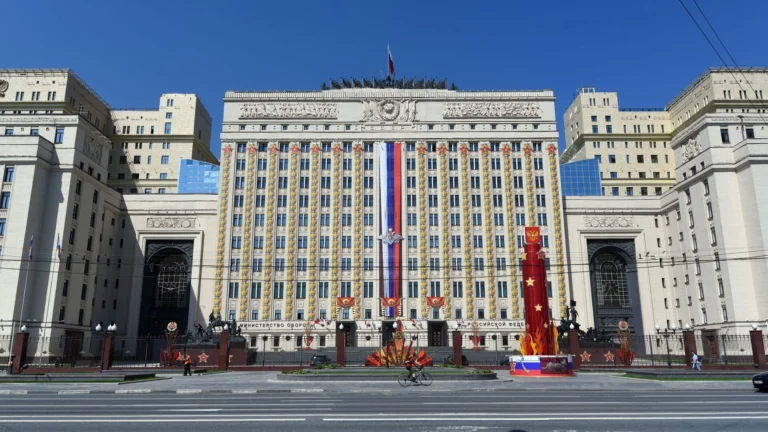
Moscow, Russia – The Russian Ministry of Defense announced on Sunday that its air defense systems intercepted and shot down 140 Ukrainian drones overnight. This occurred during a large-scale operation targeting several regions in the southwest of the country. The ministry stated that the neutralized drones were targeting strategic areas, including the regions of Belgorod, Bryansk, Voronezh, Kaluga, Kursk, Rostov, and Moscow. The Krasnodar region and the Crimean Peninsula were also targeted. Additionally, areas in the Sea of Azov and the Black Sea were targeted. These attacks come amidst the ongoing daily escalation by Kyiv forces using drones and missiles to target the Russian interior.
Targeting the “Wildburys” logistics center
In a related development, a long-range drone attack has had widespread repercussions after targeting distribution centers belonging to Wildberrys (the Russian equivalent of Amazon). The attack struck a center in Elektrostal, east of Moscow, and another in Kotovsk, southeast of the capital. The Elektrostal attack sent plumes of thick black smoke billowing across an area of approximately 2,000 square miles. As a result, satellite imagery shows that the sun was blocked out in nearby towns. Russian officials reported that the attack killed eight workers and injured 62 others.
Justifications for escalation and strategic objectives
For his part, Ukrainian President Volodymyr Zelensky justified the strikes by claiming that the company’s warehouses were used “to supply sanctioned components for the production of drones and navigation equipment.” He described the operations as a response to Russian attacks against Ukrainian civilian infrastructure.
In contrast, Russian President Vladimir Putin emphasized the need to expand the scope of the Russian military operation. He also stressed the importance of pushing Kyiv’s forces away from Russian territory—including newly captured territory—to a distance that would prevent them from using Western missiles and weapons against Russia.
These developments on the ground reflect the entry of the Russian-Ukrainian confrontation into a new phase of “war of attrition” targeting logistical facilities and the economic heartland. In this context, the two sides are exchanging attacks on vital infrastructure, further complicating the military and political landscape along the border.