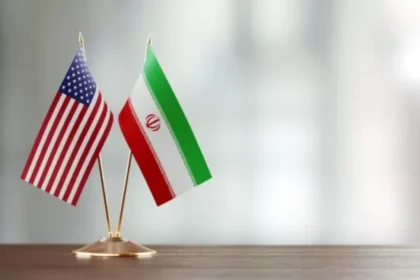
Voice of the Emirates – In an exclusive statement to Voice of Emirates, researcher and political analyst specializing in Gulf and Arab affairs, Tariq Abu Zeinab, affirmed that the region is experiencing a highly complex regional moment. The confrontation between the international axis and Iran has transcended the concept of traditional conflict. This confrontation has also transformed into a dangerous turning point that threatens the very structure of the international order.
Violating laws and targeting civilian infrastructure
Abu Zainab explained to “Sawt Al Emarat” that the recent Iranian escalation no longer adheres to the rules of engagement. Rather, it has shifted to a systematic pattern directly targeting civilian infrastructure and vital facilities in the Gulf states and Jordan through ballistic missiles and drones.
He pointed out that targeting airports and desalination plants, culminating in the unprecedented attack on the UAE consulate in Erbil, reflects a policy based on exporting crises. He further explained that this constitutes managing chaos in flagrant violation of the UN Charter.
The UAE: Resilience on the ground and a sovereign vision
Regarding the targeting of the UAE, Abu Zainab said, “The UAE has emerged as one of the countries most frequently targeted by attempts at political and security blackmail. However, Abu Dhabi did not merely react; it countered the threat with advanced air defense systems and precise security measures that have proven effective in containing the attacks.”
He added that the real danger lies in the Iranian message, which attempts to transform Gulf security into a tool for international pressure by targeting civilians, in addition to redrawing the rules of engagement.
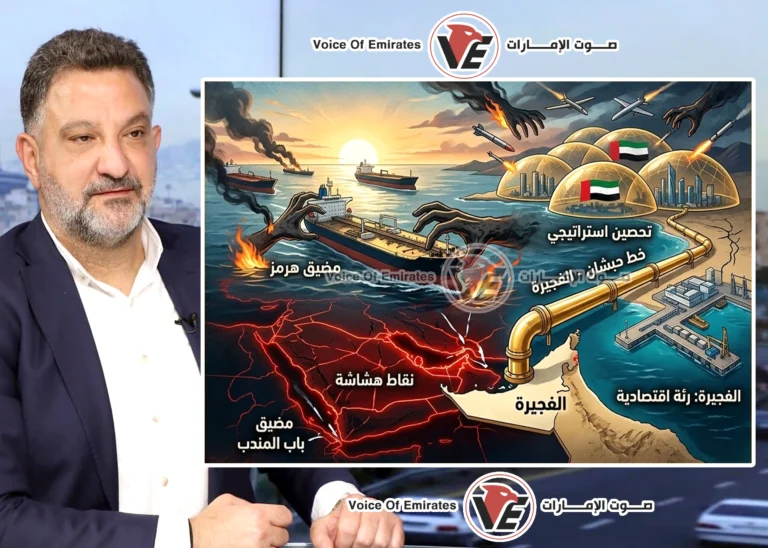
The weapon of geography: Hormuz and Bab el-Mandeb
In his analysis of the waterways, Abu Zainab stated that the Strait of Hormuz has been transformed by Tehran from an economic artery into a “geopolitical pressure tool.” He also emphasized that the threat to disrupt navigation through it constitutes “economic terrorism” that impacts global food and energy security.
He further pointed to the Bab el-Mandeb Strait, where Iran utilizes its militia proxies, specifically the Houthis. These proxies are working to disrupt supply chains between Asia and Europe.
Fujairah… the “lung” that thwarted the strangulation plans
In an interview with “Sawt Al Emarat,” researcher Tariq Abu Zeinab highlighted the brilliance of the UAE’s strategy in confronting these threats. He praised the construction of the Habshan-Fujairah pipeline.
He stated, “This project is not merely an economic step, but a sovereign vision that has redistributed geopolitical risks. Fujairah has become an economic lifeline, granting the UAE significant resilience and allowing it to export oil away from the volatile points of conflict in the Strait of Hormuz, thus reducing the ability of any party to resort to direct strangulation.”
Call for international action under Chapter VII
Abu Zainab concluded his statement to “Voice of the Emirates” by emphasizing that international condemnations are no longer sufficient. He also called on the Security Council to take concrete action under Chapter VII to impose binding measures that guarantee freedom of navigation and prevent the blackmailing of the global economy.
He concluded by saying, “The battle today is a battle for control of the lifelines, and while some exploit geography for blackmail, the UAE has proven its ability to reshape it to protect its sovereignty and global stability.”