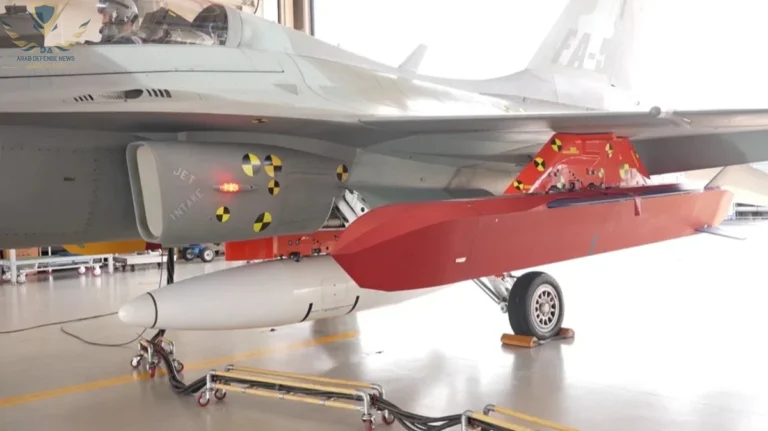
Seoul, South Korea – In a significant step to bolster its independent defense capabilities, South Korea announced the successful completion of the first technical flight test of its domestically produced long-range air-to-surface missile, the Cheonryong, nicknamed the “Sky Dragon.” This success follows two previous failed tests in January and March of this year. The achievement represents a major technological leap for South Korean engineers, who have finally overcome the challenges of engine operation and flight control.
A crucial test that strengthens deterrence independence
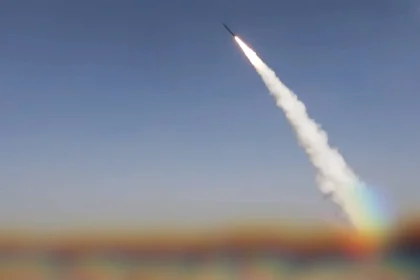
The test was conducted at the South Korean Air Force’s 3rd Training and Combat Wing, where the missile demonstrated its ability to smoothly separate from the FA-50 light attack aircraft. It then ignited its jet engine in flight and maintained a stable, self-powered flight path. This achievement puts the program on track for completion by 2028, with mass production slated to begin in 2029, paving the way for its entry into active service on the advanced KF-21 Boramae fighter jet in the early 2020s.
Why “Chunryong”? The Underground Fortress Hunter
The development of the “Sky Dragon” missile is a strategic response to North Korea’s extensive construction of fortified command and control facilities deep within granite mountain ranges. These facilities are designed to withstand conventional attacks.
The missile is specifically designed to be a “fortification killer.” Therefore, it possesses reinforced concrete penetration capabilities that rival, and even surpass, those of the German Taurus KEPD 350 missile currently in service with Seoul.
According to defense reports, the new missile boasts superior technical specifications:
Range: More than 600 kilometers, 20% more than its German counterpart.
Accuracy: A circular error margin of no more than two meters, thanks to a multi-modal guidance system (terrain matching, image processing, and inertial navigation), which makes it immune to jamming.
Stealth: Flying at low altitudes with a ghostly structure and radar-absorbing coatings, minimizing the likelihood of detection.
Readiness: The ability to keep fuel inside the missile for up to 10 years without deterioration, which means immediate readiness for urgent strikes without the need for lengthy preparations.
Strengthening the “Three-Axis System”
The Cheonryong is a cornerstone of South Korea’s deterrence strategy, known as the “Tripartite System,” specifically within the concept of “Comprehensive Punishment and Deterrence” (KMPR), which aims to target the adversary’s top leadership. Its design, with dimensions and weight that allow it to be compatible with F-50, KF-16, and F-15K fleets, ensures the South Korean Air Force can disperse its offensive capabilities across a wide range. This avoids reliance on limited platforms or imported capabilities that may be subject to political or technical constraints.
The success of this test is not merely an engineering triumph. It is also a strategic deterrent message: South Korea is moving toward possessing an air force capable of penetrating even the most sophisticated defenses. Furthermore, it demonstrates its reliance on indigenous technology, granting it complete sovereignty in its defense decisions without total dependence on allied strategic assets.