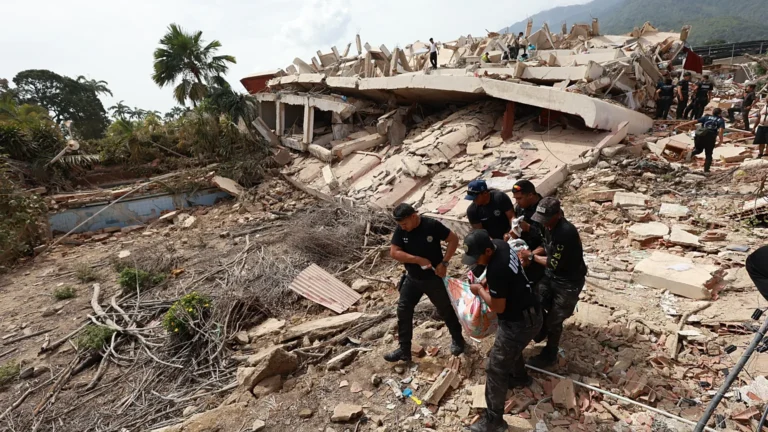
CARACAS, Venezuela – Intense international efforts continued Tuesday in Venezuela in a last-ditch attempt to pull survivors from the rubble of thousands of buildings destroyed by the twin earthquakes that recently struck the country. More than 72 hours after the disaster, hopes of finding anyone alive were fading. The country has been left with a scene of grief and devastation unseen for more than a century.
disastrous outcome
Official reports indicate that the two earthquakes, measuring 7.2 and 7.5 on the Richter scale, killed at least 1,700 people and injured 5,000 others. NASA satellite data suggests that approximately 58,870 buildings were damaged or destroyed. The United Nations estimates that some 50,000 people are missing in the disaster, which generated more than 1.2 million tons of debris, particularly in the devastated state of La Guaira. In Caracas, crematoriums are operating at full capacity as the number of victims recovered increases daily.
International response and field challenges
Twenty-seven countries are participating in the search and rescue operations, with some 40 teams comprising more than 2,000 personnel and supported by 160 sniffer dogs. The US military played a pivotal role in repairing the port of La Guaira and also contributed to reopening Simón Bolívar Airport to facilitate the arrival of international aid. Despite the grim atmosphere, Monday brought a glimmer of hope. Rescuers managed to pull a 21-year-old man from the rubble in the town of Tanaguarina, a rare moment amidst the devastation.
Public anger and political crises
Amid this tragedy, citizens are openly expressing their anger at the slow government response and limited aid in a country already grappling with economic crises and widespread emigration. This disaster adds further strain to the already struggling economy. The losses are estimated at $6.7 billion, equivalent to 6% of the GDP.
On the political front, the controversy intensified when opposition leader María Corina Machado accused the government of preventing her return to the country to participate in relief efforts by closing the airspace. The government has remained officially silent on these accusations.
As survivors stand in long lines outside the temporary morgue in La Guaira to identify the remains of their loved ones, the fate of some 7 million people in Venezuela hangs in the balance, dependent on the speed with which international aid arrives. Furthermore, it hinges on overcoming the logistical challenges that are hindering relief operations in a country facing one of its worst natural disasters in modern history.