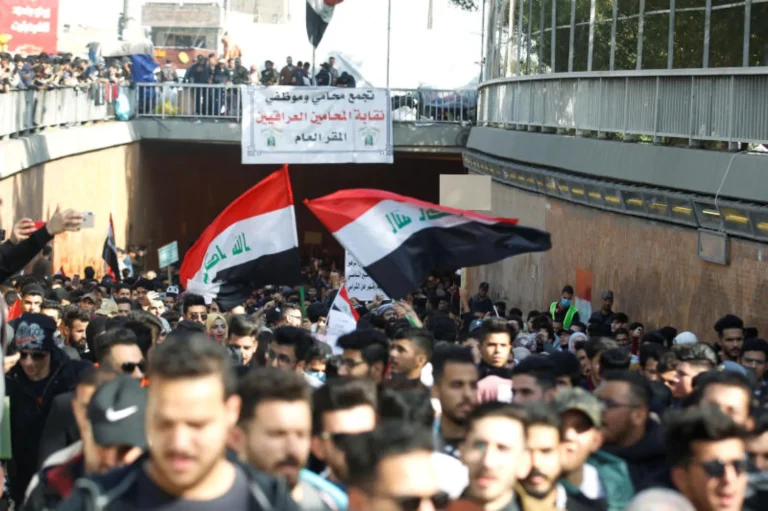
Basra, Iraq – Basra, the oil capital of Iraq, witnessed a new escalation of tensions on Tuesday, as more than 600 employees of the Basra Oil Company, working at the export terminals, demonstrated in front of the gate of the Zubair oil field.
The protest led to the closure of the vital gate for several hours. As a result, it partially disrupted traffic entering and exiting the field. This field is one of the country’s most important economic pillars, with a production exceeding 300,000 barrels per day.
Legitimate demands and outstanding entitlements
The protesters, who included employees, engineers, and graduates working on oil field projects, focused their demands on the release of their overdue salaries for 2023, 2024, and 2025. These salaries remain outstanding despite their continued work under extremely harsh environmental and professional conditions. The demonstrators emphasized that they work tirelessly to ensure the flow of this vital artery of the Iraqi economy. Meanwhile, their financial rights remain hostage to “administrative procrastination.”
The protesters also expressed their strong rejection of administrative marginalization policies, pointing to the unfair distribution of land plots allocated to employees. Privileges go to managers, while the rank and file suffer exclusion.
The employees raised a very serious humanitarian issue concerning the contraction of serious illnesses among workers due to the nature of their work in the fields. In light of this, they pointed to the complete absence of healthcare or necessary care provided by the company.
Employment and funding crisis
In addition to financial demands, participants in the sit-in criticized the shift in funding from a “self-financing” system to a “centralized” one. They argued that this measure negatively impacted the continuation of local projects and job opportunities.
The graduates, particularly those with engineering and scientific degrees, also demanded a resolution to the issue of permanent appointments or the regularization of their contracts. Furthermore, they warned against the continued practice of quotas and unfair appointments, which they believe are fueling resentment among Basra’s youth.
Threat of an open-ended sit-in
Hours after the closure, company management intervened, promising to consider the demands, which led to the temporary reopening of the gate. However, the protesters remained largely unconvinced, emphasizing that their demonstration was peaceful and legal, but carried a strong message.
In this context, employee representatives called on the Prime Minister to intervene directly to compel the relevant authorities to release the outstanding payments immediately. They also demanded a transparent investigation into the reasons for this chronic delay. In a statement, the employees affirmed: “We continue to protect Iraq’s wealth, but our silence regarding our rights has its limits. If our demands are not met within one week, we will organize an open-ended sit-in at all oil field gates, and we will not be satisfied with merely closing them for a few hours.”
These developments present a renewed challenge to the authorities in Baghdad and Basra. This comes amidst recurring protests in the Rumaila, Burjesia, and Majnoon oil fields. As a result, the widening gap between the immense wealth generated and the living and professional realities of workers in this sector is becoming increasingly apparent.