Washington, United States – In a scene that reopens the files of controversy over the reality of Asian football, the Asian teams bid farewell to the 2026 FIFA World Cup competitions almost collectively. This left the continent in a state of “football mourning.”
With Japan’s recent exit at the hands of Brazil, only Australia remained in the tournament. It represents the Asian Confederation geographically and administratively, but it does not belong to the continent.
Shocking figures and a history of failure
Despite Asia fielding its largest-ever delegation in the World Cup (nine teams), the results were unprecedentedly disappointing. This participation marked the continent’s smallest representation in the knockout stages since the tournament’s expansion.
The statistics from the World Cup were harsh; the seven eliminated Asian teams conceded a combined 52 goals and scored only 14. They managed just one victory in 21 matches, a performance described by observers as a “major setback.”
Mirage of hope and promises
The tournament began with a glimmer of hope following positive results in the first round, but those hopes quickly faded as the major teams regained their footing. The continent discovered that the technical gaps remained vast.
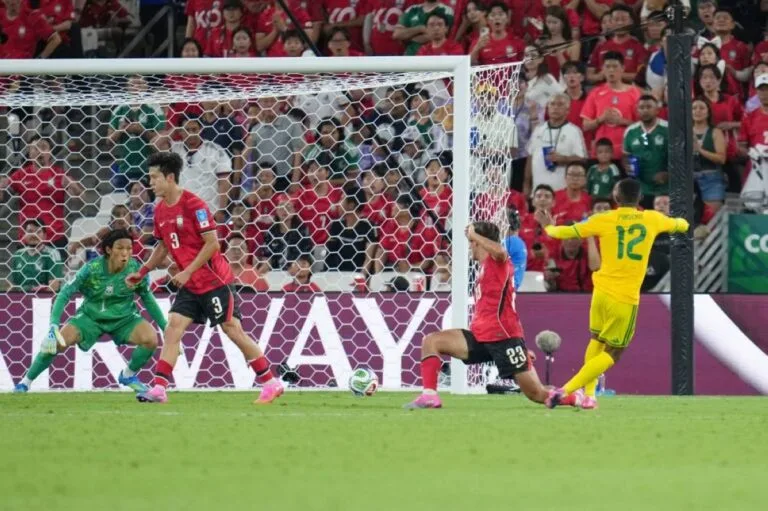
South Korea, considered a favorite to qualify, exited the tournament with a painful loss to South Africa, prompting their coach, Hong Myung-bo, to resign immediately and apologize to the fans. Meanwhile, Saudi Arabia failed to repeat their 2022 success, managing only two points after late tactical changes.
Iran’s drama and Japan’s recurring pain
Iran experienced the cruelty of sporting adversity, exiting the tournament on goal difference after a dramatic final group stage match. The team departed with dignity, leaving behind a poignant message in the locker room that reflected pride in their identity.
Meanwhile, the tragedy continued for Japan, the true Asian powerhouse, who suffered another defeat, this time against Brazil with a goal in stoppage time. This repeated the painful exits they endured in 2018 and 2022.
Contrast with Africa: A lesson in professionalism
In contrast, African teams provided a powerful lesson, with 90% of their squads successfully reaching the knockout stages.
Experts believe the secret lies in the professionalism of African players in major European leagues, while Asian stars remain confined to their domestic leagues. Jordan’s coach, Jamal Sellami, summarized the problem by saying, “We need players who compete in stronger leagues.”
Account and the future
The “cleansing and accountability” process began immediately, with the resignation of the Saudi Arabian Football Federation president, calls for a comprehensive review in South Korea, and official investigations in Iraq. In light of these findings, the Asian Football Confederation president, Sheikh Salman bin Ibrahim, acknowledged the extent of the failure, emphasizing the need for serious efforts to address the shortcomings.
The bitter truth, expressed by a South Korean fan at Incheon Airport, is that “South Korean football is dead.” This statement encapsulates the anger of an entire continent awaiting a footballing miracle to rescue it from its current predicament, before these World Cup appearances become nothing more than additional statistics in the annals of global failure.