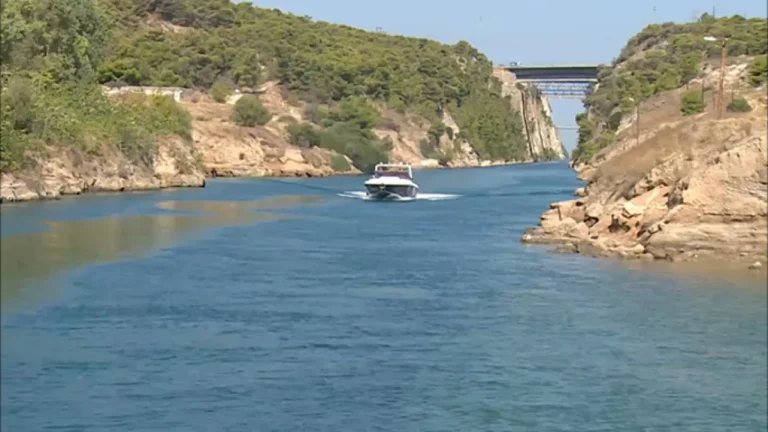
Athens, Greece – For the thousands of travelers who cross the isthmus each year, the Corinth Canal remains a breathtaking geological and engineering marvel. But for the global shipping industry, it is much more than just a visual landmark. It has been a strategic artery connecting the Aegean and Ionian Seas for 132 years, shortening journeys by thousands of miles and saving time, fuel, and operating costs.
After much anticipation, the Corinth Aqueduct was fully reopened on June 17th, following the completion of major restoration and stabilization work on its rocky slopes. This marked the return to full operation of one of Greece’s most iconic infrastructure projects. The event ushered in a new era, combining the preservation of historical heritage with the transition to the digital age.
Strategic and global origin
The Corinth Canal is a unique case in Greek infrastructure; it is a waterway, a tourist attraction, a piece of history, and an international engineering project. It is operated by the Corinth Canal Company (AEDIK), wholly owned by the Greek Growth Fund. Despite the radical changes in maritime transport since its opening in 1893, the canal continues to play a pivotal role, with over 11,000 commercial and private vessels using it annually. The Corinth Canal remains the preferred choice for merchant ships, luxury yachts, and the rapidly growing number of leisure cruise boats in the Mediterranean. This cements its position as the shortest sea route connecting the heart of Greece to the Ionian Sea.
Digital transformation: A new operational philosophy
In keeping with the times, the company’s management is currently adopting a digital transformation strategy. Data indicates that 78% of recreational boat trips are now booked and paid for electronically. Simultaneously, the development of customized digital services for corporate and individual clients continues, reflecting an operational philosophy focused on speed, flexibility, and enhancing the customer experience.
Furthermore, the AEDIK management body has expanded its responsibilities to include port facilities at the entrances to the Corinth Canal, the submerged bridges of Posidonia and Isthmia, and surrounding vital areas. This is done with the aim of promoting the isthmus as a comprehensive global tourist destination combining tourism, culture, and trade.
Vision for the next decade: The canal as a development hub
Nassos Bekkas, CEO of AEDIK, explains that the canal is a project with a strong present and a promising future. He also points out that the strategic plan for the next decade is based on three dimensions: “the strategic importance of navigation, international recognition of its history, and the potential for regional development.”
Picas added: “Our first objective is to ensure that the canal remains a safe and reliable passage, employing modern technologies. Our ultimate goal is to make it an engine for regional development in Corinth, by attracting investments and creating new economic activities that will make the canal a benchmark center for tourism and cultural experiences.”
A Journey Through History: From Diolcus to Nero
The story of the canal is a journey of human struggle. In the 7th century BC, Periander, ruler of Corinth, conceived the idea of digging a canal, but lacking the necessary technology, he resorted to building the Diolcus, a paved road used by ships to travel overland. Historical attempts followed, from Julius Caesar to Caligula, and even Nero, who personally led the symbolic first strike to begin work in 67 AD, before the project was aborted by his death. With the rise of the modern Greek state, and inspired by the success of the Suez Canal, the idea was revived in 1882, and the canal finally saw the light of day in 1893. Today, approaching its 133rd year, it continues to serve its fundamental purpose: bringing seas and peoples closer together.
Geological challenges and safety
The years of operation were not easy, as the challenging geological conditions presented frequent landslides. Recent restoration work has reinforced the safety of the steep slopes, which reach up to 80 meters.
The company has also implemented modern environmental practices, in line with International Maritime Organization (IMO) standards, to ensure the responsible management of ship waste. This underscores that safety and the environment are fundamental pillars of the New Suez Canal era.
Promising economic prospects
For the Growth Fund, the canal is a “strategic asset” in its portfolio. The reopening, coinciding with the peak tourist season, will also boost economic returns, not only from navigation fees but also from logistics and tourism related to the surrounding area.
The Corinth Canal, with its majestic scenery and ships navigating between the rocky cliffs, is more than just a waterway; it is a symbol of humanity’s ability to tame geography. With its inauguration today, Greece is not only regaining a shipping lane but also strengthening its international gateway to development. These achievements confirm that this historic project will forever remain a vital link connecting the seas and markets at the heart of the world.