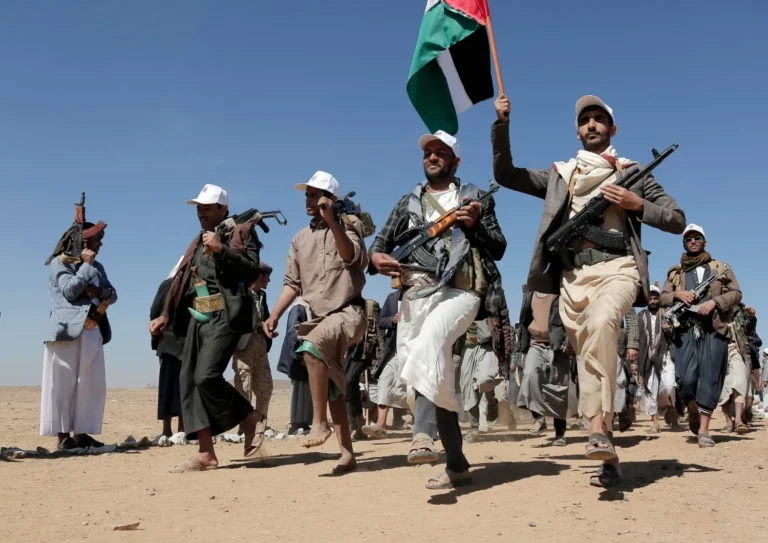
Aden, Yemen – The Houthi group has escalated its military operations against Southern Forces and Joint Forces positions in the governorates of Al-Dhale’ and Shabwa. This coincides with the deployment of massive reinforcements of personnel and equipment to the front lines separating Al-Dhale’ and Ibb governorates. This is a clear indication of the group’s attempt to impose new realities on the ground in vital and relatively stable fronts.
Al-Dhale’ Front: Fiercest attack in months
Al-Dhali’ is the most active and volatile front, witnessing almost daily clashes in the Bab Ghalq, Al-Fakher, Hajar, and Battar sectors.
In a significant development on the ground, the Houthis launched a large-scale attack at dawn on Wednesday. This attack was described as the most intense in months. It targeted positions held by Southern Forces and government troops on the Bab Ghalq front in the Qa’tabah district, north of the province.
The Houthi strategy on this front relies on simultaneous ground attacks supported by heavy artillery and mortar fire, as well as the use of drones. However, the Southern and Joint Forces have successfully repelled most of these attacks, as was the case in the battles of May and April 2016, despite the Southern Forces suffering casualties.
Tensions in Shabwa: Drones and ground infiltration
In Shabwa Governorate, the operations take on a different character; the attacks are less intense compared to those in Al-Dhale’a. However, they are concentrated in strategic border areas such as Bayhan (Wadi Khar), Harib, and the desert regions.
The Shabwa Defense Forces face continuous drone attacks and ground infiltration attempts. The most recent of these occurred in June 2026, when the forces repelled similar attacks. These attacks resulted in casualties among the soldiers.
Strategic context and political dimensions
These moves come within a broader context of historical fault lines between the Houthis and the Southern Forces. Tensions have increased significantly since the events of 2015 in the south, and the accompanying shifts in the balance of power and internal conflicts.
Observers believe that, through this ongoing escalation, the Houthis are seeking to exhaust the southern forces and force them to engage in defensive fronts. They also take advantage of the instability in the region.
As the southern forces continue to thwart the attacks and the attackers suffer heavy human and material losses, these fronts remain a “powder keg” capable of exploding. This remains pending any political developments that may change the course of the ongoing confrontations along the dividing border.