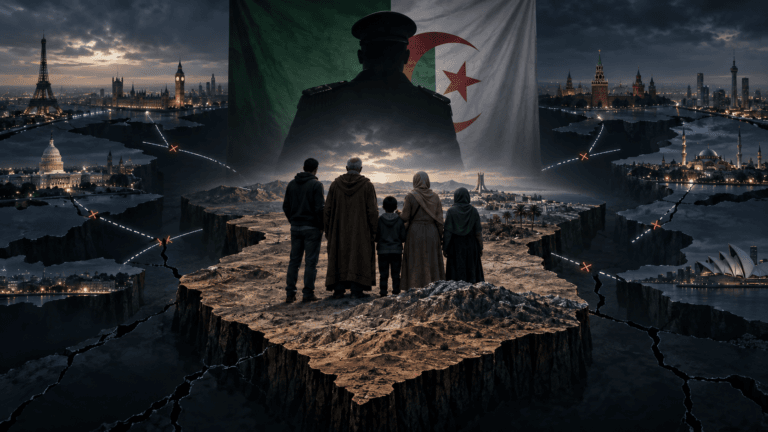
Dubai, United Arab Emirates – Algeria’s ruling military establishment has pushed the country into a new phase of international isolation. This comes after the Algerian government announced on Thursday that it was severing diplomatic relations with the United Arab Emirates. The decision adds another crisis to those created by the authorities across Algeria’s Arab, regional and international relationships. Meanwhile, the Algerian people remain the ones most exposed to the consequences.
Algeria’s Ministry of Foreign Affairs said diplomatic relations were being severed after what it described as the “exhaustion of all available avenues to preserve bilateral relations”. The ministry accused the UAE of engaging in “provocative or hostile actions”. However, its statement did not clearly identify those actions. It also did not present detailed evidence to justify resorting to the highest level of diplomatic escalation.
The ministry also summoned the UAE ambassador to Algeria and formally informed him of the decision. He was given 48 hours to comply with it, according to the Algerian Press Service.
A political decision with a diplomatic facade
Although the decision was formally issued by the government and the Ministry of Foreign Affairs, it cannot be separated from the nature of Algeria’s political system. In this system, the military establishment represents the real centre of power in political, security and foreign-policy decisions. President Abdelmadjid Tebboune and his government operate within the boundaries established by the military leadership.
Severing relations with the UAE, therefore, does not appear to be an isolated diplomatic decision. Instead, it is an extension of an approach that manages disagreements through escalation and rupture instead of dialogue. It avoids the preservation of communication channels. This is the case even with countries connected to Algeria through Arab relations. It is also the case with countries with shared economic and investment interests.
Tensions had escalated over recent months through repeated Algerian statements directed against the UAE. In February, the Algerian authorities began terminating an air services agreement signed by the UAE and Algeria in 2013. This paved the way for the transition from political and media escalation to a formal diplomatic rupture.
Expanding disputes and diminishing interests
The decision comes as Algerian diplomacy faces mounting challenges. These result from a series of disputes with countries of significant political and economic influence.
Relations with Morocco have been severed since 2021. Moreover, relations with France entered one of their most serious crises since Algeria gained independence. Relations with Spain also endured years of tension before the beginning of a cautious process to restore them.
The disputes extended into the Sahel, where a serious confrontation developed with Mali. This prompted expressions of solidarity from Niger and Burkina Faso. Algeria was subsequently forced to seek the restoration of its regional relationships and recover some of its declining influence.
At the same time, more Western and African countries have backed Morocco’s autonomy initiative for Western Sahara. This has weakened a position to which Algeria has devoted a significant part of its foreign policy. Algeria has also devoted financial and military resources to this position.
Instead of reviewing the policies that contributed to this decline, the military establishment has chosen to open a new diplomatic confrontation with the UAE. This extends Algeria’s disputes into the Arab and Gulf region.
The people bear the cost
The consequences of severing diplomatic relations are not limited to official statements or the closure of embassies. They also affect citizens, businesses, investments, travel and economic cooperation.
Emirati companies and investors have a presence in several Algerian sectors, including port management, industry and services. The absence of diplomatic relations increases uncertainty surrounding these interests. Furthermore, it weakens Algeria’s appeal to foreign investors seeking stability and predictability in international relations.
This comes at a time when the Algerian economy needs to diversify its sources of income, attract investment and create employment opportunities. Instead, it is losing partners because of political decisions in which the public has no say. The public must bear the consequences of these decisions.
The UAE, which has built an extensive network of economic and diplomatic partnerships around the world, will not see its regional standing or international interests determined by its relationship with Algeria. By contrast, Algeria stands to lose more after adding an influential Arab country to the list of states with which its authorities have created disputes in recent years.
What have Algerians gained?
The decision raises a question that extends beyond the present crisis: What have Algerians gained from a recurring policy of hostility towards countries with significant political and economic influence?
The dispute with Morocco has not created jobs for Algerians. Escalation with France has not improved their living conditions. The crisis with Spain has not strengthened their economy, while tensions with Sahel countries have not enhanced Algeria’s regional standing.
Today, severing relations with the UAE offers no clear benefit to the Algerian public. Instead, it threatens to close another avenue for cooperation, investment and engagement with the wider world.
National sovereignty does not mean multiplying disputes or turning every disagreement into a diplomatic rupture. Also, it does not mean measuring a country’s strength by the number of ambassadors summoned and channels of dialogue closed. Rather, a country’s strength is demonstrated by its ability to protect the interests of its people and manage disagreements. It must do so without sacrificing its international standing or the future of its citizens.
Exporting domestic crises
The manner in which the decision was announced, along with the accusatory language used without the presentation of specific evidence, reflects the military establishment’s continuing use of foreign disputes. This serves to divert attention from Algerians’ political, economic and social concerns.
Creating a new foreign adversary allows the authorities to present themselves once again as defenders of national sovereignty. Meanwhile, citizens remain preoccupied with rising living costs, unemployment, and limited economic opportunities. They also face the difficulty of moving towards an economy less dependent on oil and gas revenues.
Manufacturing adversaries, however, does not address unemployment, attract investment, improve purchasing power or strengthen Algeria’s international position. Instead, it pushes the country another step towards isolation. It also transforms its foreign relations into a succession of open-ended crises. In seeking to spite others, Algeria’s military establishment is ultimately inflicting the greatest damage on its own country and people. The public is left to pay for decisions that expand Algeria’s foreign disputes. The resulting isolation is presented as a defence of national sovereignty.