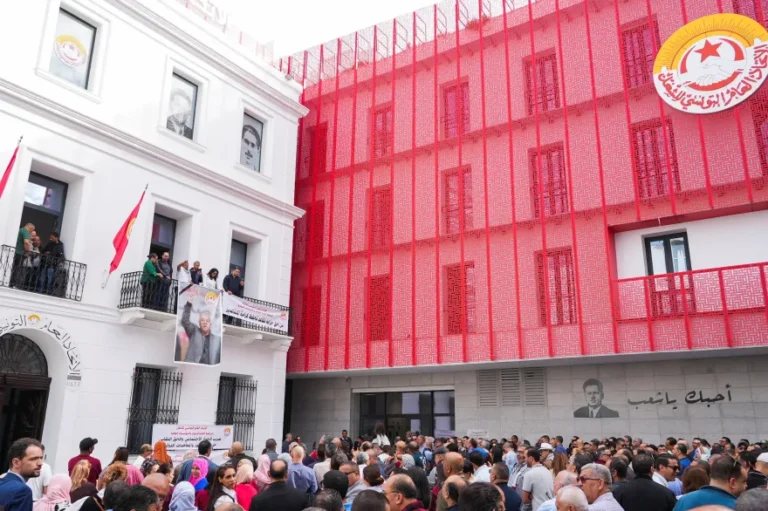
Tunis – The Tunisian General Labour Union (UGTT) has warned of worsening economic and social crises, authorizing its leadership to implement a campaign of action that includes a general strike. This move is to be carried out in consultation with the coordination committee and civil society forces in defense of economic and social rights, public and individual freedoms, and the interests of the Tunisian people. In this context, the National Administrative Commission of the UGTT held a meeting on September 9, 2026, at the union’s headquarters at Place Mohamed Ali, presided over by Secretary-General Brother Slaheddine Salmi. After reviewing the general situation in the country—and the state of affairs regarding the economy, society, and politics—the Commission expressed deep concern over the escalating crisis gripping Tunisia. This crisis stems from choices and policies that have proven incapable of addressing accumulated crises; indeed, these policies have served only to deepen the problems and exacerbate their impact on workers, the working classes, and marginalized regions.
The Labor Union also saluted workers’ struggles—foremost among them those in the mining, banking, transport, fuel transport, environmental, and education sectors (including secondary and primary education and the common civil service corps)—as well as private-sector workers in Sfax and Ben Arous and all peaceful social movements demanding legitimate rights. It declared its principled support for the protests of the unemployed, including degree holders and others, and rejected any attempts to criminalize social protest or to address legitimate demands through security-based measures. Furthermore, it commended the exceptional efforts made by the personnel of the electricity, gas, and water utilities to ensure the continued supply of electricity and water to the Tunisian people.
The Union expressed its deep solidarity with the people of Ben Guerdane and the families of the victims of the irregular migration tragedy, extending its sincere condolences and sympathy to the families who lost their children. It called for the formulation of a genuine national policy for development, employment, and youth protection—one that breaks with a reality driving Tunisia’s youth to risk their lives in search of a future they could not find in their homeland. The organization notes the continued erosion of purchasing power, rising prices, and the decline of public services, as well as the worsening conditions in the health, education, and transport sectors.
Rejecting apologetic rhetoric and holding the authority responsible for the failure.
The Labor Union rejected justificatory rhetoric and all attempts to evade responsibility or shift the burden of the crisis onto others after five years of one-man rule. State governance is not achieved through the leveling of accusations or unilateral decisions; rather, it requires accepting responsibility and listening to the people and their active forces. The Union also held the authorities fully accountable for the failure to manage public affairs, for the policy of unilateral decision-making, and for the absence of any form of dialogue with social, civil, and political forces. Furthermore, it held the authorities responsible for their inability to offer genuine solutions to the economic and social crises that have weighed heavily on Tunisians, eroded their purchasing power, and expanded the scope of poverty, unemployment, precariousness, and marginalization.
Defending trade union rights and judicial independence
The statement strongly condemned the undermining of trade union activity and the targeting of trade unionists—both men and women—due to their activism and defense of the workers they represent. It demanded the release of imprisoned unionists, the dropping of all legal proceedings against them, and the reinstatement of those who had been dismissed. It further affirmed that the Tunisian General Labour Union (UGTT) would remain an independent national social force, championing workers’ interests, trade union rights, and democracy, while rejecting all forms of subjugation, tutelage, and exclusion.
The statement also emphasized the importance of upholding judicial independence, guaranteeing the conditions for a fair trial, and respecting the rights of litigants. It affirmed the right of associations, organizations, political parties, and national forces to carry out their roles within the framework of the law, recognizing civil and political society as essential partners in building Tunisia. Furthermore, it expressed support for journalists and the freedom of the press and reiterated the call for the release of all individuals imprisoned for their opinions or peaceful activities. It also condemned the harsh conditions endured by prisoners and rejected the use of the judiciary to settle political and civil disputes.
A rescue roadmap and upcoming escalatory steps
The Union called for the formulation of an urgent national plan for economic and social recovery, grounded in protecting purchasing power; combating monopolies, speculation, and corruption; supporting public institutions and enterprises; and rescuing vital sectors. It also demanded that employment and regional development be accorded the priority they deserve, that the subsidy system and public services be safeguarded, and that the rights of Tunisians to healthcare, education, transportation, water, electricity, and a decent standard of living be guaranteed.
The Union reaffirmed its commitment to implementing the general strike decision ratified at the 26th Ordinary Congress and welcomed the establishment of a coordination framework with civil society forces. It also authorized the National Executive Bureau to devise a plan of escalating action—culminating in the general strike—in consultation with national forces, ensuring that Tunisia remains a free voice championing truth and just causes, foremost among them the Palestinian cause.