- Why does Pakistan deny considering a military response?
- Mecca Agreement Faces the Test
- Iran and the Houthis: Does Tehran Hold the Key to Escalation?
- The Red Sea Shifts the Calculus
- Saudi Arabia Faces a Different Front
- Pakistan does not want a war with Iran.
- Three paths lie ahead for the Mecca Agreement.
- The next battle may be over influence.
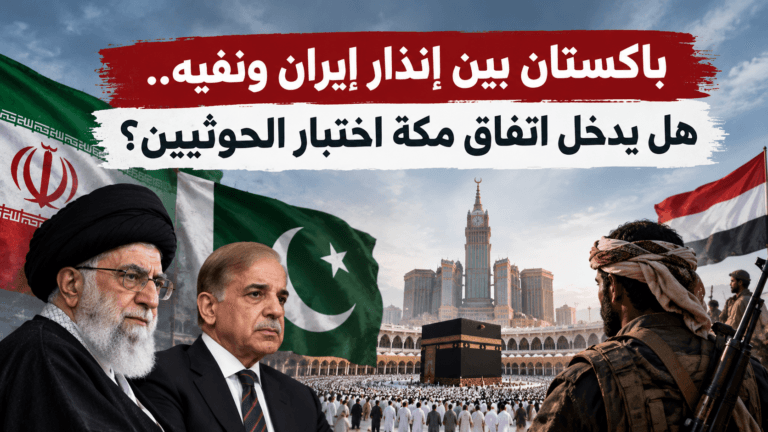
Abu Dhabi, UAE – Amid reports that Pakistan has warned Iran over Houthi attacks on Saudi Arabia—and Islamabad’s denial that any military response is currently under discussion—the defense agreement linking Saudi Arabia, Pakistan, and Turkey faces an early test. The Red Sea front is evolving into a new theater of the conflict involving Iran; Houthi attacks on Saudi Arabia are no longer merely a front tied to the war in Yemen. As strikes against Saudi cities and energy facilities escalate, the crisis is testing the limits of Pakistan’s role in the region, particularly following the signing of the joint defense agreement with Saudi Arabia and Turkey.
In the latest official statement, Pakistan’s Foreign Ministry said that Islamabad is not currently discussing any military response under the Makkah Agreement. However, it affirmed that Pakistan would take action “when the time comes.” This follows a Reuters report stating that Pakistan had warned Iran against the escalation of attacks by its Houthi allies on Saudi Arabia.
Why does Pakistan deny considering a military response?
Pakistan’s denial does not mean that Houthi attacks have been dropped from Islamabad’s security calculations. Pakistan has affirmed its condemnation of the attacks on Saudi Arabia while simultaneously attempting to maintain its role as a mediator between Iran and the United States. This equation reveals a delicate policy: a security commitment to Saudi Arabia coupled with an avoidance of direct confrontation with Iran. Consequently, it appears that Islamabad intends to keep the Mecca Agreement a tool for deterrence rather than rapidly transforming it into a mechanism for war.
Mecca Agreement Faces the Test
The joint defense agreement between Saudi Arabia, Pakistan, and Turkey stipulates that an armed attack on any of the three nations is considered an attack on all of them. As Houthi attacks reach Saudi cities and vital facilities, the question of the threshold at which such escalation constitutes a threat warranting the agreement’s activation becomes increasingly significant. However, current statements from Pakistan indicate that Islamabad does not believe that moment has yet arrived. This places the agreement before a test that is political in nature before it is a military one.
Iran and the Houthis: Does Tehran Hold the Key to Escalation?
Demands for Iran to rein in the Houthis presuppose that Tehran exercises full control over the Yemeni group’s decisions; however, the relationship between the two parties is far more complex. While Iran provides the Houthis with significant military and technical support, the group maintains its own agenda—linked to the war in Yemen—and its own regional calculations. Consequently, Tehran’s ability to influence the group does not necessarily equate to direct control over every specific attack; thus, the message directed at Iran shifts from a simple demand to halt attacks into a genuine test of the extent of its influence over the Houthis.
The Red Sea Shifts the Calculus
The Houthi escalation threatens not only Saudi Arabia but also places pressure on one of the world’s most vital maritime corridors. The surge in Houthi attacks has coincided with broader regional instability, including tensions surrounding the Strait of Hormuz. This situation raises the risk of the crisis evolving from a regional conflict into one that disrupts the global flow of energy and trade. International reports have warned that simultaneous disruptions at the Bab al-Mandab Strait and the Strait of Hormuz could compound pressures on oil and shipping markets. The strategic importance of Bab al-Mandab has been further underscored by recent developments along Yemen’s western coast; the Associated Press reported that Houthi forces entered the strategic city of Mocha—a move that could bring them closer to Red Sea shipping lanes, should their control on the ground be confirmed.
Saudi Arabia Faces a Different Front
Riyadh faces a new security equation: missile and drone attacks from the south, pressure on energy facilities, and threats to Red Sea navigation. Reuters notes that recent Houthi attacks represent one of the most dangerous escalations against Saudi Arabia since the 2022 truce. These concerns have quickly impacted oil markets, with Brent crude approaching the $100-per-barrel mark. Consequently, any expansion of attacks on Saudi energy facilities would be more than just a military development; it could become a source of direct pressure on the global economy.
Pakistan does not want a war with Iran.
Islamabad recognizes that direct military involvement in Yemen entails significant strategic costs. Pakistan shares borders and security ties with Iran while simultaneously maintaining growing defense relationships with Saudi Arabia and Turkey. Furthermore, Islamabad seeks to preserve a diplomatic role regarding the Iran-US crisis; thus, entering into a direct confrontation with an Iranian-backed group could undermine the space for mediation it aims to maintain. Consequently, Pakistan’s stance can be understood as a policy of calculated deterrence: affirming its commitment to Saudi Arabia while keeping the decision on military intervention on hold.
Three paths lie ahead for the Mecca Agreement.
The first track involves containing the escalation through diplomatic channels, with Pakistan maintaining political pressure on Iran without resorting to military confrontation. The second track entails the continuation of indirect messaging between Islamabad and Tehran while leveraging the Mecca Agreement as a deterrent to prevent the expansion of Houthi attacks. The third track would be triggered if the attacks evolved into a sustained campaign against Saudi energy facilities or cities; at that point, pressure on Pakistan and Turkey would likely intensify regarding the implementation of the joint defense agreement.
The next battle may be over influence.
The issue is no longer merely whether or not Pakistan warned Iran; the more critical question is whether Tehran can prevent the Houthis from turning Saudi Arabia and the Red Sea into an open battlefront, or if its influence over the group has limits. If diplomatic pressure succeeds in containing the attacks, the Mecca Agreement could remain a deterrent without requiring military action. However, should the escalation continue and the targeting of Saudi Arabia expand, the agreement would face its first real test of its ability to transform a political alliance into a security umbrella.
While Islamabad denies that a military response is currently under consideration, its statement that Pakistan “will act when the time is right” leaves the door open for a different course of action should the nature of the attacks change. Herein lies the significance of the crisis: the Houthis are testing not only Saudi defenses but also the limits of Iranian influence, the resilience of the Makkah Agreement, and Pakistan’s ability to remain a mediator without becoming a party to the war.