- 440.9 kilograms… the number that changed the game
- Where did the uranium disappear to?
- When “missing information” becomes a weapon
- The rocket… the second link in the equation
- The war created a new problem
- From “nuclear threshold” to “nuclear ambiguity”
- Israel faces the dilemma of a “moving target”
- Washington faces an even bigger dilemma
- The most dangerous scenario is not the bomb.
- “Deterrence through doubt”: The new weapon
- What should be monitored now?
- The Iranian story is no longer just a race between enrichment and the bomb.
Abu Dhabi, UAE – The most critical questions surrounding Iran’s nuclear program are no longer simply whether Tehran possesses a nuclear bomb or how long it would take to build one. The most pressing question now is different: What happens when the world loses the ability to ascertain the whereabouts and fate of Iranian nuclear materials? After months of war and strikes on Iranian nuclear facilities, the International Atomic Energy Agency (IAEA) faces an unprecedented problem: the inability to maintain “continuity of knowledge” regarding key components of Iran’s nuclear program, including its stockpiles of highly enriched uranium. This is where the game changes.
Iran doesn’t necessarily need to declare that it possesses nuclear weapons to force its adversaries to reconsider their calculations. It’s enough that the question of where the nuclear materials are, whether they’ve been moved, and whether there are undiscovered facilities remains unanswered. This is an equation that can be described as “deterrence through ambiguity”; not in the sense that Iran actually possesses nuclear weapons—there is no reliable public evidence to prove this—but rather that the very uncertainty itself can become a strategic asset.
440.9 kilograms… the number that changed the game
According to the most recent data that the International Atomic Energy Agency (IAEA) was able to verify, Iran possessed approximately 440.9 kilograms of uranium enriched to 60% before the latest military escalation. The significance of this figure lies in the fact that 60% enrichment puts the material much closer, technically speaking, to the level of enrichment required for a nuclear weapon, although possessing this quantity does not necessarily mean having a ready-made nuclear bomb. This distinction is crucial.
There is a complete chain of events between possessing enriched uranium and possessing a usable nuclear warhead: fissile material → enrichment to weapons-grade level → designing a nuclear device → manufacturing and testing components → miniaturizing the device → integrating it with a delivery system. Therefore, converting the figure of 440.9 kilograms into a specific number of ready-made bombs would be a misleading conclusion. But the figure remains significant for another reason: the world is no longer able to verify the fate of the entire stockpile.
Where did the uranium disappear to?
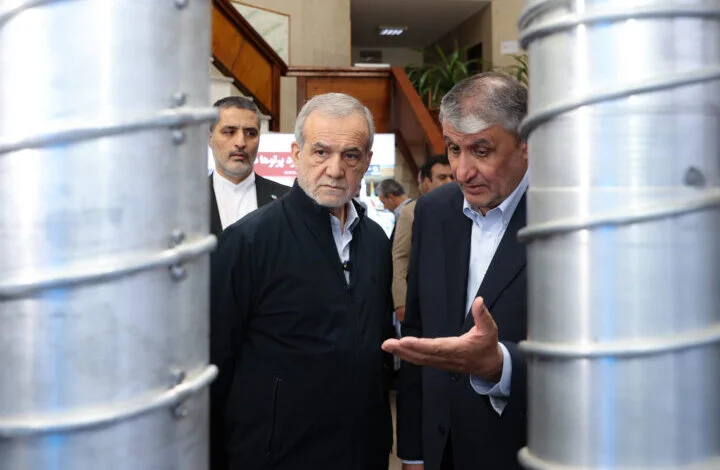
This is the crux of the matter that could reshape the crisis. The IAEA had identified a tunnel complex in Isfahan as a key nuclear storage site, and reports indicated that a significant portion of Iran’s highly enriched uranium stockpile was located in the Isfahan area prior to the strikes. Satellite imagery analysis also suggested that Iran may have transferred substantial quantities of its highly enriched uranium stockpile to the tunnel complex before the attacks. Some research estimates have even suggested that significantly larger quantities may have been moved to Isfahan, but these estimates do not constitute on-site proof. The problem is that the IAEA no longer has the ability to conduct regular, direct verification of all relevant sites and facilities.
In June, the agency reported that Iran had not provided the agency with crucial information regarding the fate of its stockpiles of low- and high-enriched uranium, including uranium enriched to 60%. This marked the most serious shift in the story: the problem was no longer just the size of the stockpile, but the break in the chain of knowledge that would allow it to be tracked.
When “missing information” becomes a weapon
In controlled nuclear programs, the importance of inspectors extends far beyond simply discovering a new facility. Their constant presence allows for the construction of a timeline: Where was the material? How much was it? When was it moved? Where did it go? Was it used? Was it diverted? Did it remain in the location declared by the state?
When this chain is broken, it does not automatically mean that a state has developed a weapon. But it does mean that the international community loses the ability to confidently rule out certain scenarios. This is the essence of the current Iranian threat. The IAEA has stated that there are outstanding safeguards issues related to undeclared nuclear materials and activities at Iranian sites, while the military conflict has made it even more difficult to regain a complete picture of the program.
The rocket… the second link in the equation
Iran already possesses a substantial ballistic missile arsenal, so discussions about a “nuclear missile” should not begin with the missile itself. The missile is merely the delivery vehicle. The real nuclear question begins with: Does Iran possess a nuclear warhead? To date, there is no credible public evidence that Iran has integrated a nuclear warhead with a ballistic missile. In fact, US assessments reported by Reuters in May indicated that if Iran’s leadership were to make the political decision to pursue a nuclear weapon, it might need approximately a year to build one. This point precludes jumping to the conclusion that any Iranian missile launch necessarily implies a nuclear test.
The war created a new problem
Ironically, the strikes targeting Iran’s nuclear infrastructure could backfire if they push Tehran to view acquiring a nuclear weapon as a matter of survival. In March, Reuters reported, citing sources, that hardliners within Iran were beginning to call for a reassessment of nuclear policy, even though, according to those sources, Tehran had not yet decided to change its doctrine or officially pursue a nuclear bomb. Conversely, Iranian Foreign Minister Abbas Araqchi stated in March that his country’s position against developing nuclear weapons would not fundamentally change. These contradictions reveal the core of the crisis: the declared political stance is one thing, the accumulated technical capabilities are another, and the ultimate military decision is yet another.
From “nuclear threshold” to “nuclear ambiguity”
For years, Iran was described as a country with advanced nuclear capabilities, though it never officially declared possessing nuclear weapons. But the war added a new element: ambiguity surrounding the location of the materials. Three levels of complexity can be envisioned here:
Level 1: A declared nuclear program that is subject to oversight.
Level Two: Advanced nuclear capabilities with the potential to approach weapon production.
Level Three: A program whose international monitoring capacity is declining, while its nuclear and missile capabilities remain intact.
The third level is the most worrying, because it creates ample room for estimations, doubts, and miscalculations.
Israel faces the dilemma of a “moving target”
If the nuclear facility is known, it can be targeted. But what if the nuclear material itself has been moved? Here, bombing becomes much more complicated. Strikes might destroy an enrichment facility or centrifuges, but they cannot necessarily destroy nuclear material that has been moved to another location. This explains why the success of any military campaign against a nuclear program cannot be measured solely by the number of buildings destroyed. The real question is: Has the knowledge, capability, and material been destroyed together? If the answer is no, the program can be delayed but not eliminated.
Washington faces an even bigger dilemma
For the United States, the problem isn’t simply preventing Iran from acquiring a nuclear weapon. The problem is determining whether that prevention has actually been achieved. And if Washington loses the ability to obtain a complete picture from within the facilities, the options become more difficult: Does it wait for inspections to resume? Does it rely on intelligence and satellite imagery? Does it target additional sites based on uncertain assessments? Or does it accept a gray area where it can’t be proven that Iran has built a weapon, but it also can’t be ruled out that it has begun the process?
The most dangerous scenario is not the bomb.
The greatest paradox in the Iranian file is that the most dangerous scenario might not be the detonation of a nuclear bomb. The most dangerous scenario is: military strikes → transfer of nuclear materials → loss of oversight → internal Iranian hardening of positions → withdrawal from some oversight commitments → rebuilding nuclear capabilities at more secret sites → transformation of the program from a “latent capability” to a “deterrent capability.” In this case, the bomb would not be the beginning of the crisis. The bomb would be the result of a process that began with the loss of the ability to know where the program is located.
“Deterrence through doubt”: The new weapon
If Iran reaches a point where it can maintain genuine ambiguity about the fate of its nuclear materials and capabilities, it could gain some deterrent benefits without declaring possession of a bomb. Israel cannot definitively say that Iran possesses a weapon, and the United States cannot definitively say that it does not. This situation forces both sides to consider the worst-case scenario. In the world of nuclear deterrence, suspicion is not equivalent to a weapon. However, it can influence state decisions almost as much as a weapon itself. Herein lies the paradox: Iran may not need to prove it possesses a bomb to compel its adversaries to act on the assumption that it does.
What should be monitored now?
There are a number of indicators that could move the issue from the stage of “nuclear ambiguity” to a more dangerous stage:
- Centrifuges have been restarted at undisclosed locations.
- The emergence of underground facilities related to enrichment or storage.
- Moving uranium stockpiles away from known locations.
- Long-standing refusal to allow the return of IAEA inspectors.
- The emergence of intelligence information about activities related to the design of a nuclear warhead.
- Simultaneous activity at nuclear facilities and ballistic missile units.
- Iranian announcement of a change in nuclear doctrine.
- Formal withdrawal from the Treaty on the Non-Proliferation of Nuclear Weapons.
The appearance of one of these indicators does not mean that Iran has made a bomb, but the convergence of several indicators at the same time will radically change the risk assessment.
The Iranian story is no longer just a race between enrichment and the bomb.
It is now a race between knowledge and secrecy. The less inspectors can pinpoint the location of nuclear materials, and the more fortified and secretive the sites become, the greater the uncertainty within which intelligence agencies and decision-makers operate. This is the danger that doesn’t appear on radar screens. At this stage, Iran doesn’t need to launch a nuclear missile to change the rules of the game. It is enough that the question, “Where is the uranium?” remains unanswered. And then, the missing information itself becomes a source of power.