- Three partners.. and three different forms of power
- The pact’s first test.. and the military power came from Pakistan
- Pakistani researcher: The pact is asymmetric
- And Turkey.. what does it want from a smaller military power?
- The “Golden Vault”
- American analyst: Pakistan cannot replace the US security guarantor
- The UAE and Qatar.. protection from a stronger power without an equivalent obligation
- Why does Riyadh need equality in the wording?
- A Gulf agreement has said the same thing for a quarter of a century
- When money becomes indirect military power
Dubai, United Arab Emirates – On paper, the mutual defense equation linking Saudi Arabia, Turkey and Pakistan appears simple and balanced: an armed attack on one of the three countries is treated as an attack on them all. But moving from the wording of the agreement to the actual balance of power raises a more sensitive question: can Saudi Arabia genuinely defend nuclear-armed Pakistan or NATO member Turkey in the same way those two countries could defend the Kingdom?
The Mecca agreement signed on August 7, 2026, came less than a year after Saudi Arabia and Pakistan signed their “Strategic Mutual Defense Agreement,” which explicitly stated that any aggression against either country would be considered aggression against both. The trilateral agreement extended the same principle to Turkey.
Yet similarity in political commitments does not mean similarity in what the three countries can actually deliver when war begins.
Three partners.. and three different forms of power
Pakistan enters the equation as a nuclear power with a vast military establishment and decades of experience, while Turkey brings one of NATO’s largest armed forces, a growing defense industry and an established capacity to operate beyond its borders. Saudi Arabia, despite its substantial military spending and sophisticated arsenal, brings some of its strongest strategic assets from outside the battlefield: its economy, energy resources, investment capacity, contracts and defense procurement.
Analysts who spoke to “Voice of Emirates” said it would be misleading to view the agreement as a military alliance among three states with equal capabilities, because each partner offers something fundamentally different to the others. They said Saudi Arabia’s central strength in this equation lies in its ability to transform its financial and economic weight into a network of strategic interests tied to the Kingdom’s security.
According to those analysts, Riyadh does not need to convince Islamabad that it can defend Pakistan as effectively as Pakistan can deploy forces to defend the Kingdom. Nor does it need to persuade Ankara that the Saudi military represents a decisive addition to the security of a country already protected by NATO’s Article 5.
What Saudi Arabia needs is something different: to make its own security part of the strategic and economic interests of states that possess military capabilities the Kingdom needs.
The pact’s first test.. and the military power came from Pakistan
Events have already provided an indication of where the immediate need lies in the Saudi-Pakistani relationship.
Following Iranian attacks on Saudi Arabia in March 2026, Saudi Defense Minister Prince Khalid bin Salman discussed the attacks with Pakistan’s army chief, Asim Munir, within the framework of the mutual defense agreement. Weeks later, the Saudi Ministry of Defense announced the arrival of a Pakistani military force at King Abdulaziz Air Base, including fighter jets and support aircraft from the Pakistan Air Force, as part of the agreement.
It was the first publicly announced military implementation of the pact, and the force moved from Pakistan to Saudi Arabia.
That does not mean the Kingdom is incapable of providing military assistance to Pakistan. But it does reveal, in practical terms, which side required reinforcement from the other during the agreement’s first test.
Pakistani researcher: The pact is asymmetric
Haleema Sadia, a Pakistani researcher specializing in defense and strategic studies, argues that the Riyadh-Islamabad agreement is inherently asymmetric.
In an analysis published by the “Asia-Pacific Leadership Network”, she pointed to Pakistan’s financial dependence on Saudi Arabia while also questioning whether Riyadh would intervene militarily in a meaningful way if Pakistan faced a major escalation with India, arguing that this contradiction exposes the flexible and unequal nature of the arrangement.
Sadia argues that the agreement gives Saudi Arabia greater reassurance, while Pakistan gains political and economic advantages at a time of economic vulnerability. She also concludes that political commitments written into agreements do not necessarily translate into military deployments during crises.
That brings the question of “mutual defense” into sharper focus.
If Pakistan were to face an existential war, it would hardly be waiting for Saudi Arabia to become the military force that saves a nuclear-armed state confronting a major adversary. Saudi Arabia can, however, offer Islamabad something of a different strategic value: investment, financing, energy, contracts and economic and political support.
And Turkey.. what does it want from a smaller military power?
The Turkish case makes the imbalance even clearer.
Turkey is not joining the Mecca agreement because it needs an army to defend its territory. It is a NATO member with a large military force and an advanced defense-industrial base.
Rich Outzen, a senior fellow in the Turkey program at the “Atlantic Council”, has viewed the agreement through a broader lens than direct military defense, noting that Saudi participation adds significant economic resources to the arrangement, while Turkey’s defense industry stands to benefit from broader commercial opportunities. Defense partnerships, in turn, reinforce networks of trade, energy and business.
In other words, what Turkey seeks from Saudi Arabia is not necessarily a Saudi soldier to defend Ankara.
For Turkey, Saudi Arabia is a major market for defense industries, a source of investment, capital and energy, and an influential economic and political partner in the Gulf and the wider Arab world.
The “Golden Vault”
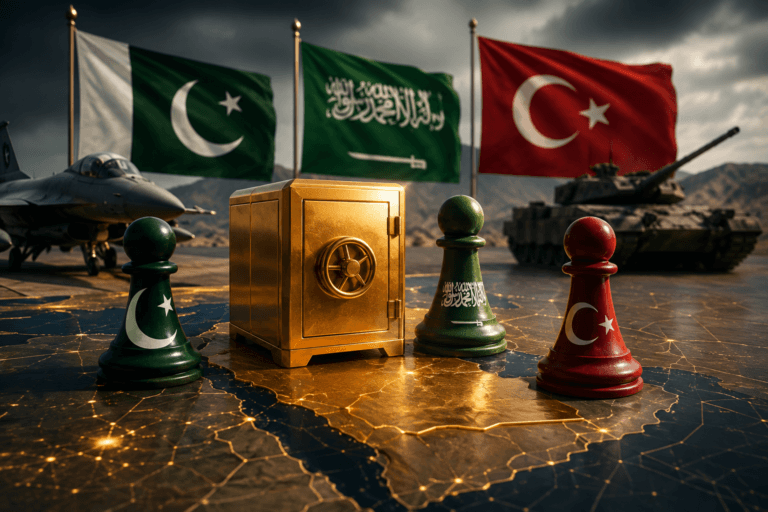
This is where the picture emerges that analysts who spoke to “Voice of Emirates” described as closer to a relationship between a “golden vault” and a military shield.
There is no public document stating that Saudi Arabia paid for protection, and the relationship among the three countries cannot simply be reduced to a “money for soldiers” formula.
But the distribution of power is difficult to ignore.
Pakistan brings military strength and nuclear deterrence.
Turkey brings a large army, defense industries and operational experience.
Saudi Arabia brings one of the region’s largest economies, capital, investments, energy, arms contracts and a market capable of creating long-term economic interests for both partners.
According to analysts who spoke to “Voice of Emirates”, the importance of Saudi money in this equation does not lie in directly purchasing protection. Its value lies in making the Kingdom’s stability and security part of a broader network of Turkish and Pakistani interests.
Under that interpretation, the Saudi vault itself becomes an instrument of deterrence.
American analyst: Pakistan cannot replace the US security guarantor
Even the Pakistani shield has limits.
Gregory Gause, a professor of international affairs and a specialist in Gulf politics, argues that the Riyadh-Islamabad agreement also carried a Saudi message to the United States that the Kingdom could seek alternative security providers.
But he has described part of that message as political maneuvering, arguing that Pakistani support cannot replace US weaponry, security cooperation or the American military presence in the region. He has also questioned whether Pakistan would risk using its nuclear weapons to defend Saudi Arabia, noting that Pakistan’s nuclear deterrent is fundamentally designed around India.
That suggests Saudi Arabia is not building a complete alternative security umbrella. It is assembling several layers of protection and deterrence.
The UAE and Qatar.. protection from a stronger power without an equivalent obligation
A comparison with other Gulf states highlights the distinctiveness of the Saudi approach.
The UAE has an exceptionally strong defense agreement with France. France commits to participating in the defense of the UAE’s security, sovereignty, territorial integrity and independence, and to deploying agreed capabilities to deter any state threatening it. But the published text does not reverse the equation by stating that an attack on France automatically constitutes an attack on the UAE.
France is the military power providing the security guarantee to the UAE.
Qatar, meanwhile, received an explicit US security guarantee in September 2025, when Washington declared that any armed attack on Qatari territory, sovereignty or critical infrastructure would be regarded as a threat to US peace and security, with a commitment to take measures that could include military action if necessary. The decision does not contain a reciprocal commitment requiring Qatar to regard an attack on the United States as an attack on Doha.
In both cases, the relationship is clear: a major military power provides a security umbrella to a Gulf state.
Saudi Arabia chose different language.
It did not simply seek an agreement saying that Turkey and Pakistan would defend it. The formula places Riyadh on formally equal footing with both partners and says Saudi Arabia will defend them as well.
Why does Riyadh need equality in the wording?
Observers see one explanation for this formulation in Saudi Arabia’s political image and regional standing.
The Kingdom seeks to present itself as a power that builds and leads alliances rather than a state searching for a protector. The phrase “mutual defense” therefore gives Riyadh the status of a partner that also provides guarantees to others.
But political image and actual military capability are two different things.
When war becomes real, each country’s contribution will not be measured by the sentence written into the agreement, but by what it can actually send to the battlefield.
It is difficult to imagine Saudi military power becoming the final line of defense for nuclear-armed Pakistan or NATO-protected Turkey. It is far easier to imagine the reverse scenario if the Kingdom requires additional troops, aircraft, air defenses or military expertise.
A Gulf agreement has said the same thing for a quarter of a century
The greater paradox is that Saudi Arabia already had a collective defense clause long before Turkey and Pakistan entered the picture.
Under the Gulf Cooperation Council’s Joint Defense Agreement, the security of the GCC states is considered indivisible, and an attack on one member is regarded as an attack on all members, a principle the Council reaffirmed officially in 2026.
Practical experience, however, has exposed a gap between declaring the principle and automatically entering a collective war when a member state comes under attack.
After the Israeli attack on Qatar in September 2025, the GCC Joint Defense Council declared that the attack on Qatar constituted an attack on all Gulf states. Yet the publicly announced measures centered on greater intelligence sharing, integrating the regional air picture, accelerating ballistic missile early-warning capabilities, updating defense plans and conducting joint exercises.
That episode alone helps explain part of Saudi Arabia’s search for additional layers of deterrence.
Riyadh does not need another document telling it that an attack on the Kingdom is an attack on its allies. It has had such language within the GCC framework for years.
What it needs is force behind the words: states with both the interest and the capability to act when war breaks out.
When money becomes indirect military power
According to analysts and observers, this is where Saudi Arabia’s core value in the new alliance lies.
States do not always need to contribute the same thing for a relationship to be mutually beneficial.
Turkey and Pakistan possess military capabilities Saudi Arabia needs.
Saudi Arabia possesses financial and economic capabilities both countries need.
From this perspective, “mutual defense” appears less like an exchange of identical military power and more like a political framework for exchanging different forms of power.
Alison Minor, director of the Middle East Integration Initiative at the “Atlantic Council”, argues that Riyadh is using a growing network of partnerships to reduce its dependence on any single partner or bloc. At the same time, she cautions against overstating what Turkey and Pakistan would necessarily provide, arguing that military support from both would remain highly dependent on the context and that Saudi Arabia’s previous defense arrangements have not, in practice, produced a response comparable to NATO’s Article 5.
That may be the most realistic way to understand the agreement.
Saudi Arabia can buy aircraft, missiles and air-defense systems.
But buying weapons does not instantly buy decades of military experience, a nuclear-armed military establishment or manpower ready for deployment.
Riyadh may therefore have found the faster route: tying the owners of those capabilities to a web of economic, political and security interests that makes Saudi stability part of their own interests.
In this equation, the “golden vault” is hardly a marginal player.
It is the strategic price that makes the alliance possible.
Turkey and Pakistan place greater military weight on the table.
Saudi Arabia provides what can bind that weight to its security: money, investment, energy, contracts, markets and economic influence.
The real test of the agreement will come outside the signing halls: When “an attack on one is an attack on all,” will all three countries pay the same price.. or will Saudi Arabia pay with its money while the others pay with their military power?