- Two Defense Umbrellas, One Principle
- Article 8.. Where Is the Red Line?
- If Saudi Arabia Is Attacked.. Who Responds?
- When Could a Real Conflict Emerge?
- Saudi Arabia and Pakistan.. The Foundation of the New Alliance
- Ankara Reaffirmed Its NATO Commitment Just One Month Earlier
- The Real Test Awaits the First Crisis
Dubai, United Arab Emirates – The “Makkah Mutual Defense Agreement” has placed Türkiye in a new security equation, making Ankara, a member of the North Atlantic Treaty Organization “NATO”, part of a second collective defense framework alongside Saudi Arabia and Pakistan, based on the principle that an armed attack against any one of the three countries will be considered an attack against them all.
Saudi Arabia, Türkiye and Pakistan signed the agreement in Makkah on Friday, August 7, 2026, in the presence of Saudi Crown Prince Mohammed bin Salman, Turkish President Recep Tayyip Erdoğan and Pakistani Prime Minister Shehbaz Sharif, in a move aimed at strengthening defense cooperation and collective deterrence among the three regional powers.
Türkiye’s participation gives the agreement significance beyond its immediate regional scope. For the first time, the emerging defense framework directly includes a NATO member, raising questions about the limits of Ankara’s obligations if Saudi Arabia or Pakistan faces a military crisis that triggers the agreement while the Atlantic alliance takes a different position.
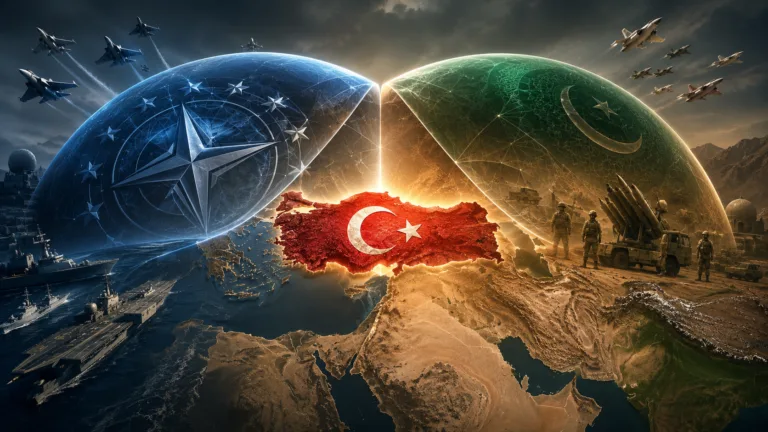
Two Defense Umbrellas, One Principle
The core wording of the “Makkah Agreement” resembles the principle underpinning Article 5 of the Washington Treaty. The trilateral agreement regards an attack on one of its members as an attack on all three, while NATO’s collective defense system similarly considers an armed attack against one Ally an attack against them all.
The similarity in principle, however, does not mean that the obligations are identical.
Article 5 allows each NATO member to take “such action as it deems necessary” to assist an Ally that has been attacked, including the use of armed force. This gives individual member states considerable discretion over the nature of their response.
The full implementation mechanisms of the new trilateral agreement, including precisely what form of military assistance would be required when it is activated, have not yet been publicly detailed.
Article 8.. Where Is the Red Line?
The most important provision for understanding how Türkiye’s new agreement relates to its NATO membership is Article 8 of the Washington Treaty.
The article requires every NATO member not to enter into any international engagement that conflicts with the provisions of the Treaty. Türkiye can therefore conclude defense agreements and security partnerships outside NATO, provided that its new commitments remain compatible with the obligations arising from its membership in the Alliance.
From this perspective, the publicly announced principles of the “Makkah Agreement” do not in themselves create an automatic legal conflict with Türkiye’s NATO membership.
The issue becomes considerably more complicated when an actual attack occurs and Ankara is required to translate its commitments toward Saudi Arabia or Pakistan into military action that intersects with the policies or interests of NATO members.
If Saudi Arabia Is Attacked.. Who Responds?
The geographical scope of the NATO Treaty reveals an important distinction between the two defense frameworks.
Article 6 defines the areas to which Article 5 applies and expressly includes Turkish territory, alongside specified territories, forces, vessels and aircraft within the European, Mediterranean and North Atlantic regions.
Saudi Arabia and Pakistan, however, fall outside NATO’s collective defense umbrella.
An attack on Saudi Arabia or Pakistan could therefore activate Türkiye’s obligations under the “Makkah Agreement”, while the same attack would not automatically create a collective defense obligation for the other NATO members.
Any Turkish response in such a scenario would arise from Ankara’s obligations under the trilateral agreement rather than from a NATO military decision. This places Türkiye in a security position different from that of most NATO members: Ankara receives collective defense guarantees for its own territory while simultaneously extending an independent defense commitment to Saudi Arabia and Pakistan under another agreement.
When Could a Real Conflict Emerge?
A serious dilemma could emerge if Saudi Arabia or Pakistan enters a military confrontation, determines that the conditions for activating the “Makkah Agreement” have been met, and calls on Türkiye to fulfill its collective defense commitment while NATO members take a different view of the conflict.
The situation would become even more sensitive if the confrontation involved a NATO member, a country closely aligned with an Alliance member, or a conflict in which Turkish military action directly affected broader NATO security interests.
Another form of friction could emerge within Türkiye’s own military planning. Fulfilling the trilateral agreement could require Ankara to allocate combat aircraft, troops, ammunition, air-defense systems or intelligence capabilities at the same time those assets are needed for NATO missions or defense plans.
The issue would then move beyond legal interpretation and become a practical question of how Türkiye prioritizes and distributes its military capabilities between two collective defense commitments.
Saudi Arabia and Pakistan.. The Foundation of the New Alliance
The “Makkah Agreement” builds on a defense structure that had already begun taking shape between Riyadh and Islamabad before Ankara joined.
On September 17, 2025, Saudi Arabia and Pakistan signed a “Strategic Mutual Defense Agreement” aimed at strengthening defense cooperation and joint deterrence. The agreement established that aggression against either country would be considered aggression against both.
The partnership subsequently moved beyond political declarations and into military implementation, with Saudi authorities announcing in April 2026 the arrival of a Pakistani military contingent, including fighter jets and support aircraft, at King Abdulaziz Air Base as part of the defense cooperation between the two countries.
Türkiye’s entry adds a significantly different dimension to this structure, bringing into the arrangement a country with one of NATO’s largest militaries, a rapidly expanding defense industry, substantial operational experience and deeply institutionalized military ties with Western states.
Ankara Reaffirmed Its NATO Commitment Just One Month Earlier
The timing of the agreement is particularly significant because Türkiye hosted a NATO summit in Ankara only a month before signing the new pact.
In the Ankara Summit Declaration issued in July 2026, NATO leaders reaffirmed their commitment to collective defense under Article 5 and reiterated the principle that an attack against one Ally is considered an attack against all.
The close timing between the NATO summit and the signing of the “Makkah Agreement” points to a Turkish strategy of expanding its network of security partnerships while maintaining its position within the Atlantic defense architecture.
The Real Test Awaits the First Crisis
The “Makkah Agreement” gives Türkiye greater room to operate across the Middle East and South Asia and places a NATO military power inside a regional defense arrangement alongside Saudi Arabia and Pakistan.
Under the commitments publicly disclosed so far, the two defense umbrellas can coexist, while Article 8 of the Washington Treaty provides a clear legal boundary against any Turkish international obligation that would conflict with its NATO commitments.
The real test, however, will come with the first crisis that requires the new agreement to be activated. If Saudi Arabia or Pakistan is attacked and calls on Türkiye to fulfill its collective defense pledge while NATO’s strategic calculations point in a different direction, Ankara will face the question left open by the Makkah agreement: How will Türkiye balance two collective defense umbrellas when their obligations converge in the same war?