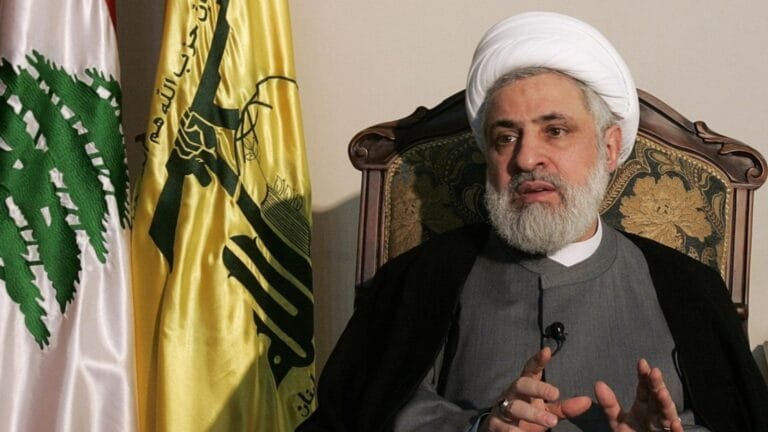
Beirut, Lebanon – Hezbollah Secretary-General Naim Qassem launched a scathing attack on the framework agreement signed by Beirut and Tel Aviv under US auspices, describing it as “entirely in Israel’s favor” and containing constitutional and legal violations that render it invalid. In a televised address broadcast Wednesday, Qassem asserted that the agreement represents “a sell-out of Lebanon,” as its text lacks any explicit commitment to an Israeli withdrawal and instead employs terms like “redeployment,” which he argued effectively enshrines Israeli control over parts of Lebanese territory.
Invitation to indirect negotiations
Qassem addressed Lebanese President Joseph Aoun, proposing “indirect negotiations” as the sole path to a solution, emphasizing that “the priority is restoring sovereignty and expelling the occupation,” and affirming that the party would not accept external dictates. Qassem stressed that the only acceptable national equation is “a complete Israeli withdrawal in exchange for the deployment of the Lebanese army south of the Litani River.” He also criticized the American role, demanding an end to “American tutelage,” which he accused Washington of using to exhaust Lebanon and serve Israeli interests. Qassem affirmed that the steadfastness of the resistance and Iranian support remain the fundamental pillars that imposed the ceasefire.
Casualty figures and developments in the diplomatic process
These statements come amid continued tensions on the ground, with the Lebanese Ministry of Health announcing that the death toll from the Israeli aggression since March 2, 2026, has risen to 4,321 martyrs and 12,203 wounded. Despite the signing of the “framework agreement” on June 26, Israeli forces remain deployed more than 10 kilometers inside Lebanese territory.
For his part, Israeli Foreign Minister Gideon Sa’ar announced last Tuesday that a new round of talks would be held in Rome next week. While Lebanese officials view this path as a step toward restoring state sovereignty, Hezbollah maintains its rejection of the agreement, considering the linking of the Israeli withdrawal to the disarmament of the resistance a “crossing of red lines.” This internal division over the nature and viability of the agreement presents Lebanon with a complex political challenge, given the continued occupation of large border areas and the ambiguity surrounding the timeline for a complete withdrawal, thus exacerbating the uncertainty about the future of stability in southern Lebanon.