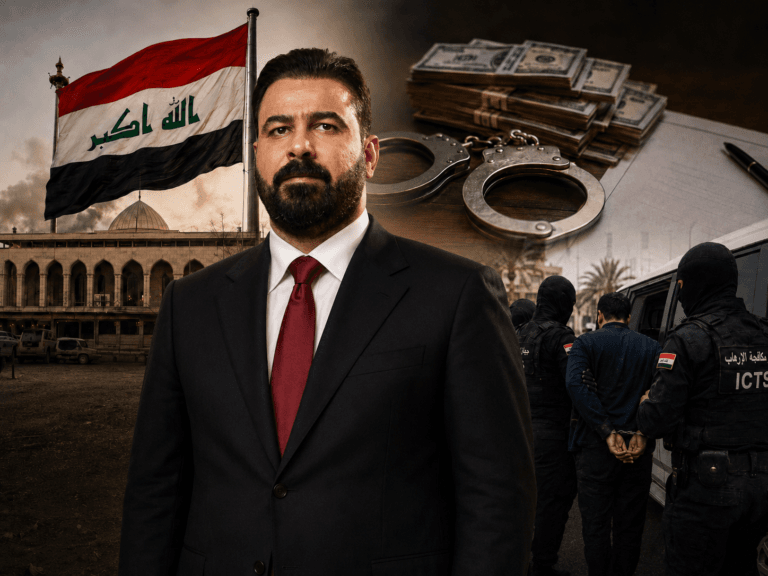
Damascus, Syria – Iraq’s new government has launched the country’s most sweeping anti-corruption campaign in more than two decades, arresting dozens of senior politicians, lawmakers and government officials in an unprecedented operation that comes as Baghdad grapples with a sharp decline in oil revenues, renewed U.S. financial oversight and mounting pressure to curb the influence of Iran-backed armed groups.
The campaign, led directly by Prime Minister Ali Al-Zaidi, represents the boldest attempt by any Iraqi administration since the fall of Saddam Hussein’s regime to dismantle what officials describe as deeply rooted corruption networks that have flourished inside state institutions since 2003.
The campaign comes against the backdrop of a complex political and security landscape that took shape in Iraq after 2003, when the changes that followed the U.S. invasion redrew the balance of power inside the state and opened the door to growing regional influence, particularly from Iran, through political forces and armed factions that became influential players in Iraq’s political scene.
Observers say this political and security legacy continues to affect the ability of successive Iraqi governments to impose state authority, combat corruption networks and regulate the relationship between official institutions and armed factions, as Baghdad seeks to balance pressure from Washington and Tehran.
Senior Iraqi officials say the arrests are only the beginning of a nationwide operation expected to expand across multiple ministries and provinces, with investigators pursuing current and former ministers, deputy ministers, members of parliament and senior civil servants.
The crackdown coincides with Washington’s decision to resume U.S. dollar shipments to Iraq after suspending them for several months, while the country’s finances come under growing strain from sharply reduced oil exports and widening budget deficits..
Claims of More Than $2 Trillion Lost Since 2003
Investigators estimate that corruption has cost Iraq more than $2 trillion since the 2003.
Ongoing interrogations continue to expose additional suspects, many of whom allegedly attempted to flee Iraq or sought refuge in the Kurdistan Region. Authorities say the Kurdistan Regional Government has already transferred eight wanted individuals to federal investigators.
Officials said the investigations include illicit enrichment, unexplained accumulation of wealth and money laundering, reflecting what prosecutors describe as sophisticated financial networks operating inside state institutions.
Extraordinary Wealth
Investigators say they have uncovered enormous personal fortunes among senior officials.
Some officials owned more than 50 residential and commercial properties, registered under their own names or those of relatives. The wife of one suspect allegedly purchased a property valued at $5 million.
Authorities have already arrested more than 28 officials connected to Basra’s Electricity Directorate, with similar operations expected in Nasiriyah, Amarah and other governorates.
Public Trials
Officials say corruption trials will be conducted publicly, with court proceedings expected to be broadcast to Iraqi citizens. Convicted defendants will not be eligible for release.
Dawn Assault
The latest phase of the campaign unfolded before dawn, when Iraq’s elite Counter-Terrorism Service carried out coordinated raids across Baghdad.
Security and judicial officials said special forces entered homes belonging to senior politicians and government officials, including residences inside Baghdad’s heavily fortified Green Zone.
Government officials confirmed that 47 suspects—among them members of parliament and senior government officials—were arrested during one phase of the operation.
The campaign, code-named Operation Dawn Assault, followed judicial warrants issued during a months-long corruption investigation.
Officials said many of the arrests were triggered by testimony from Adnan Al-Jumaili, Iraq’s Deputy Oil Minister for Refining Affairs, whose confessions allegedly implicated a wide network of political figures and senior bureaucrats.
Government officials insist the operation is unrelated to Prime Minister Al-Zaidi’s upcoming visit to Washington.
Prime Minister Stakes His Authority
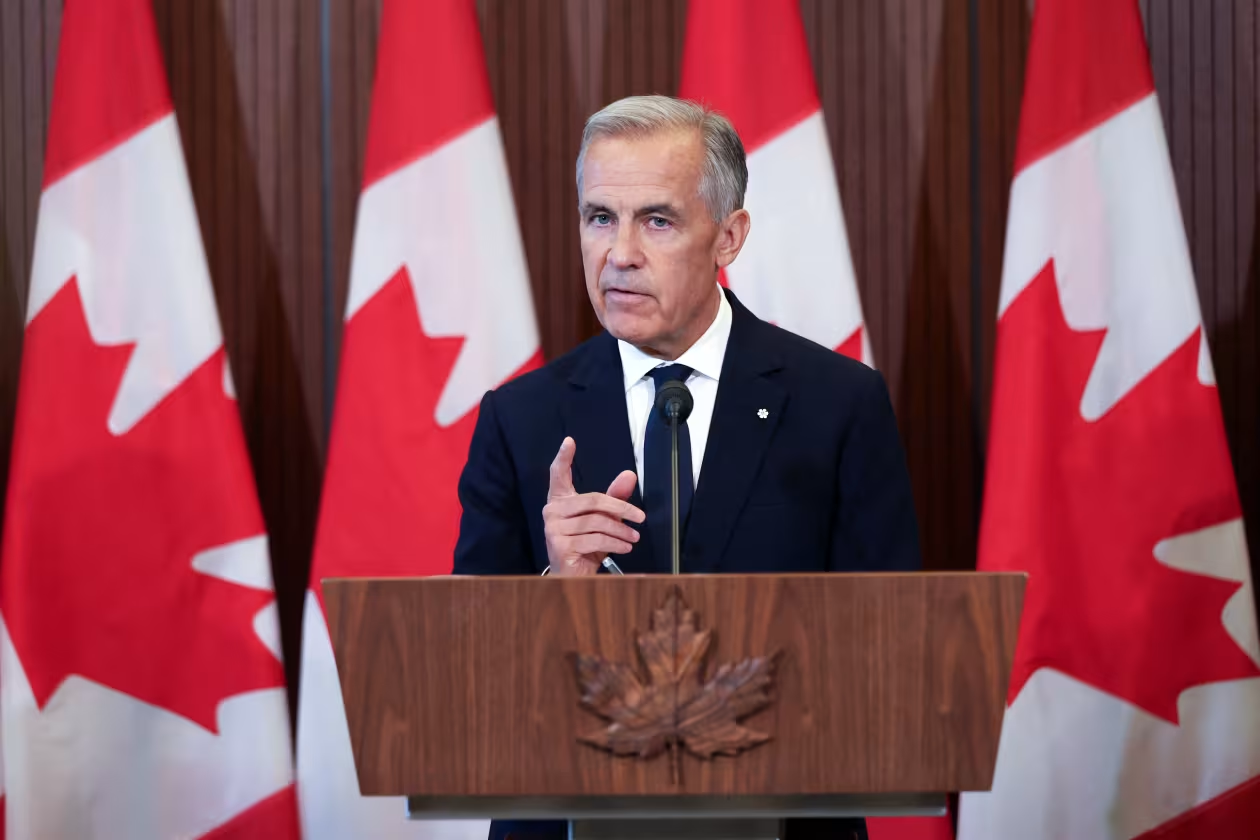
Since taking office earlier this year, Al-Zaidi has made anti-corruption reforms the defining priority of his administration.
The campaign has received rare public support from influential Shiite cleric Muqtada Al-Sadr, who described the arrests as a “heroic” effort capable of restoring public confidence in government.
Sadr urged Friday sermons across Iraq to focus on corruption, declaring that Islam prohibits both corruption and injustice.
Millions in Cash, Gold and Property Seized
Security officials say raids have produced one of the largest asset seizures in recent Iraqi history.
Authorities reportedly confiscated approximately $11 million in cash, nearly 98 billion Iraqi dinars (around $63 million), approximately 1.5 kilograms of gold, around 40 properties in Baghdad, Salahuddin and Erbil, and large quantities of weapons and ammunition.
Investigations remain ongoing, with officials expecting additional arrests.
Washington Restores Dollar Shipments
Senior Iraqi officials confirmed that the United States has resumed air shipments of U.S. dollars after suspending them earlier this year.
The suspension began in April under President Donald Trump’s administration, when Washington temporarily blocked Iraq’s access to portions of its oil revenues held at the Federal Reserve Bank of New York.
Washington’s actions reflected growing concern over Iranian influence inside Iraq, particularly allegations that U.S. currency was reaching sanctioned entities, criminal organizations and Iran-backed armed factions.
Iran-Backed Armed Groups
Al-Zaidi ordered that every armed faction operating inside Iraq be placed under direct state authority.
Several of Iraq’s most powerful Iran-aligned militias, including Kataib Hezbollah, have rejected the government’s efforts.
The group has claimed responsibility for attacks targeting U.S. personnel in Iraq and has also acknowledged involvement in several high-profile kidnappings, including that of an American journalist in Baghdad earlier this year.
Oil Revenue Crisis
Iraq faces one of its sharpest declines in oil export revenues in recent years as a result of the Trump-Netanyahu war on Iran beginning in February.
According to the Ministry of Oil, January exports totaled 107.6 million barrels, but by April exports were just 4.6 million barrels.
Oil revenues fell from $6.8 billion in February to $1.9 billion in March and $1.1 billion in April, despite benchmark prices climbing to approximately $110 per barrel.
A Defining Test
For Prime Minister Ali Al-Zaidi, the campaign represents more than a law enforcement operation.
It is an early test of whether Iraq’s new leadership can confront entrenched patronage networks, stabilize an increasingly fragile economy and balance competing pressures from Washington and Tehran—all while convincing Iraqis that accountability can finally reach the highest levels of power.
Journalist Steven Sahiounie Interviewed Dr. Mahmoud Al-Hashemi, the Director of the Union Center for Strategic Studies, of Iraq.
1. Steven Sahiounie (SS): The Iraqi government has launched a major anti-corruption campaign and has arrested dozens of members of parliament and government officials. In your opinion, is the government genuinely serious about this campaign, or is it merely a regional political purge, as some have suggested?
Dr. Mahmoud Al-Hashemi (MAH): The current Iraqi government was not the direct outcome of the parliamentary elections held at the end of 2025. U.S. intervention reached unprecedented levels during the government formation process, unlike anything witnessed in previous electoral cycles.
The elections resulted in the resistance-aligned factions winning 108 parliamentary seats, a result that reportedly caused considerable concern among U.S. officials. Consequently, Mark Savaya, described as the U.S. President’s representative in Iraq, stated that the key positions in Iraq’s new government—including the offices of the President, the Prime Minister, the Speaker of Parliament, and sovereign ministries such as Interior, Defense, and Oil—should be determined by the United States.
The United States also used its leverage through the U.S. Federal Reserve, where Iraq deposits revenues from its oil exports under U.S. financial protection.
President Donald Trump subsequently published several statements opposing the nomination of the candidate agreed upon by the largest parliamentary bloc, the Coordination Framework. Instead, according to this perspective, Washington backed the appointment of Ali Al-Zaidi, the owner of Al-Janoub Bank, a figure considered to be outside Iraq’s traditional political and security establishments, as Prime Minister. Trump himself claimed that he was responsible for Al-Zaidi’s appointment.
There is no doubt that Iraq suffers from widespread administrative and financial corruption. This corruption has contributed significantly to the country’s economic deterioration and negatively affected the lives of its citizens, while the ruling political class bears responsibility for much of this corruption.
However, an important question remains: can someone who came to power under substantial U.S. pressure, lacks extensive political experience, and is still relatively young successfully undertake such a difficult mission?
2. SS: The U.S. government has welcomed the anti-corruption measures implemented by Prime Minister Ali Al-Zaidi’s administration, particularly since many of those arrested reportedly appear on U.S. sanctions lists. In your opinion, does the United States have a role in everything that is happening in Iraq today?
MAH: Does the United States genuinely seek to eliminate corruption in Iraq when, according to this viewpoint, it laid the foundations for that corruption following the 2003 invasion by dissolving the Iraqi Army and police forces and allowing state institutions to be looted?
From this perspective, the government’s current measures are intended to eliminate the influence of Iraq’s existing political class by placing virtually all established political figures under suspicion of corruption.
As a result, a new political elite would emerge under American sponsorship, implementing a number of U.S. strategic objectives, including:
1. Expanding the role of the military, since the Prime Minister lacks a strong political base.
2. Transforming Iraq’s economy from a centrally planned system to a market economy.
3. Integrating Iraq into the United States’ regional security, political, and economic framework.
4. Distancing Iraq from Iran, Russia, and China.
5. Encouraging greater participation by American companies in Iraq’s economy.
6. Disarming the resistance factions, dissolving the Popular Mobilization Forces (PMF), and integrating them into Iraq’s official security institutions in order to eliminate their independent identity and symbolism.
The question therefore becomes: to what extent can the new Prime Minister succeed, both in combating corruption and corrupt officials and in achieving these broader strategic objectives?
In our view, this will be an extremely difficult task.
Iraq’s established political leaders possess extensive experience, significant financial resources, loyal supporters, and influential media platforms. They are therefore expected to resist this project vigorously.
3. SS: There is growing discussion that the regional confrontation between Tehran and Washington could drag the Middle East into a civil war, particularly in Iraq and Lebanon, by fueling Sunni-Shiite conflict—a scenario that some claim Israel seeks to encourage. In your opinion, how credible are these claims, and do you believe that Washington and Tel Aviv will succeed in drawing the region into such a conflict?
MAH: According to this perspective, Iran will confront this project through various means in order to prevent the United States from consolidating its influence along Iran’s borders. Tehran is believed to retain numerous political and strategic tools despite the recent conflict, which may have temporarily diverted its attention from Iraqi affairs.
This view further argues that Iran has emerged victorious from the recent war and now considers the removal of American military presence and U.S. regional dominance to be among its highest strategic priorities.
Iran also continues to enjoy substantial support inside Iraq.
According to this analysis, the planned funeral procession for the late Ayatollah Ali Khamenei, which is expected to take place in the holy Iraqi cities of Najaf and Karbala on the eighth of this month, will serve as a demonstration of Iran’s enduring influence and deep-rooted presence within Iraq.
Journalist Steven Sahiounie interviewed Reema Naissah, Syrian journalist, News Anchor and with vast experience on Iraq to get another opinion on what is happening in Iraq
1. SS: Some voices support the Iraqi government’s anti-corruption campaign, while others question its credibility and accuse Baghdad of implementing an American agenda. In your view, which narrative is closer to the truth, and what does the Iraqi public think?
Reema Naissah (RN): The anti-corruption campaigns launched in Iraq—particularly since 2003—have often targeted political rivals rather than corruption itself. Successive governments have announced similar campaigns, but in most cases they have served as tools for political score-settling or public relations rather than representing a genuine effort to combat corruption.
The current government of Al-Zaidi may prove to be an exception, not because of domestic or regional circumstances, but due to an exceptional international environment that has created a different set of realities. For this reason, it is too early to conclude which narrative is correct. Only time will reveal the government’s true intentions. If the current administration is genuinely committed to fighting corruption, it should begin at the top of the political hierarchy by holding senior officials accountable before targeting lower-ranking public employees.
As for the skepticism among ordinary Iraqis, it is entirely understandable. Public trust in both the government and the political class has collapsed as a result of past experiences and the enormous sums of public money that have been looted since 2003. Ultimately, only time will determine whether Al-Zaidi’s government is sincere in its efforts to eradicate corruption.
2. SS:Since the first day of the U.S. war against Iran, the Iraqi government has tried to distance itself from the conflict. But is Baghdad truly capable of remaining neutral, especially given that Iraq has become an arena for regional and international rivalries?
RN: Baghdad’s attempts to distance itself from the conflict remain cautious and, in my view, do not amount to a serious policy of neutrality. Armed factions in Iraq have effectively become a state within a state, and their close ties to Iran make genuine neutrality extremely difficult to achieve. These groups have carried out attacks against Gulf countries, yet the Iraqi government has been unable to restrain them.
The greatest challenge facing Al-Zaidi’s government is not corruption but bringing all weapons under the exclusive control of the state. Will these armed factions surrender their weapons? Will they comply with American pressure? These are difficult but essential questions. Establishing the state’s monopoly over arms is the first step toward restoring state authority and, ultimately, tackling corruption as well. Given Iraq’s geopolitical—and to some extent religious—position, it cannot remain isolated from the regional conflict. Baghdad will continue trying to strike a balance and avoid taking sides, but this objective will remain difficult to achieve as long as armed factions aligned with the ideology of Wilayat al-Faqih (“Guardianship of the Islamic Jurist”) continue to play a significant role in Iraq’s political and security landscape.