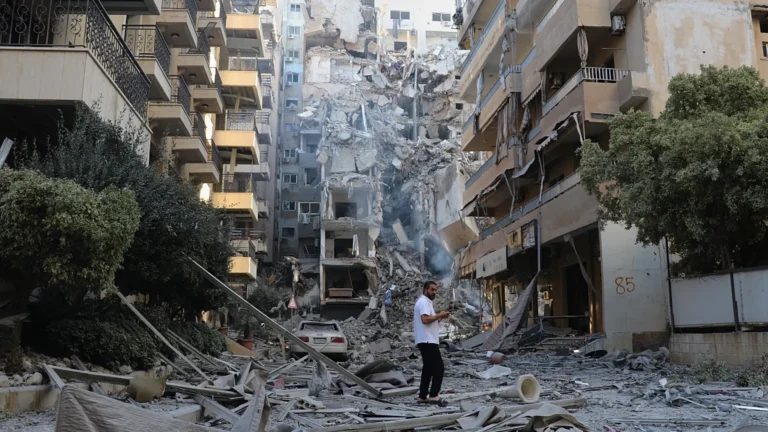
Beirut, Lebanon – Lebanon’s National News Agency reported on Tuesday that eight people were killed in a series of separate Israeli airstrikes targeting several areas in southern Lebanon. This deadly escalation on the ground came despite US President Donald Trump’s announcement of a “ceasefire understanding” between Israel and the Lebanese group Hezbollah.
Details of airstrikes and casualties in the south
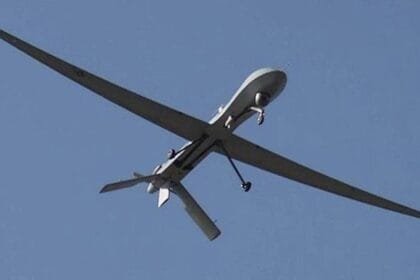
The official news agency reported that an attack by an enemy drone on the Nabatieh-Khardali road killed a dentist and his two sons as they were returning from Sidon. It also reported that Israeli warplanes carried out a heavy airstrike on the Lebanese Civil Defense center located on the Masil road in the town of Kfarsir. This resulted in the complete destruction of the center, which had been evacuated of personnel and equipment several days prior.
In a related development, the agency confirmed that two Syrian nationals were killed in a drone strike that directly targeted them inside a plant nursery where they worked in the town of Jebchit. Drones also targeted a motorcycle on Martyr Sabra Street in the Toul area, as well as a car in the Dhi’at al-Arab neighborhood of Ansar. These attacks resulted in the deaths of two more people. Field reports indicated that a drone targeted a car in the morning at the Harouf-Toul roundabout, missing the initial strike. However, it pursued the car with two subsequent strikes to the Qalaa intersection, ultimately hitting it with precision and killing the driver.
Trump announces “ceasefire agreement”
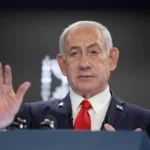
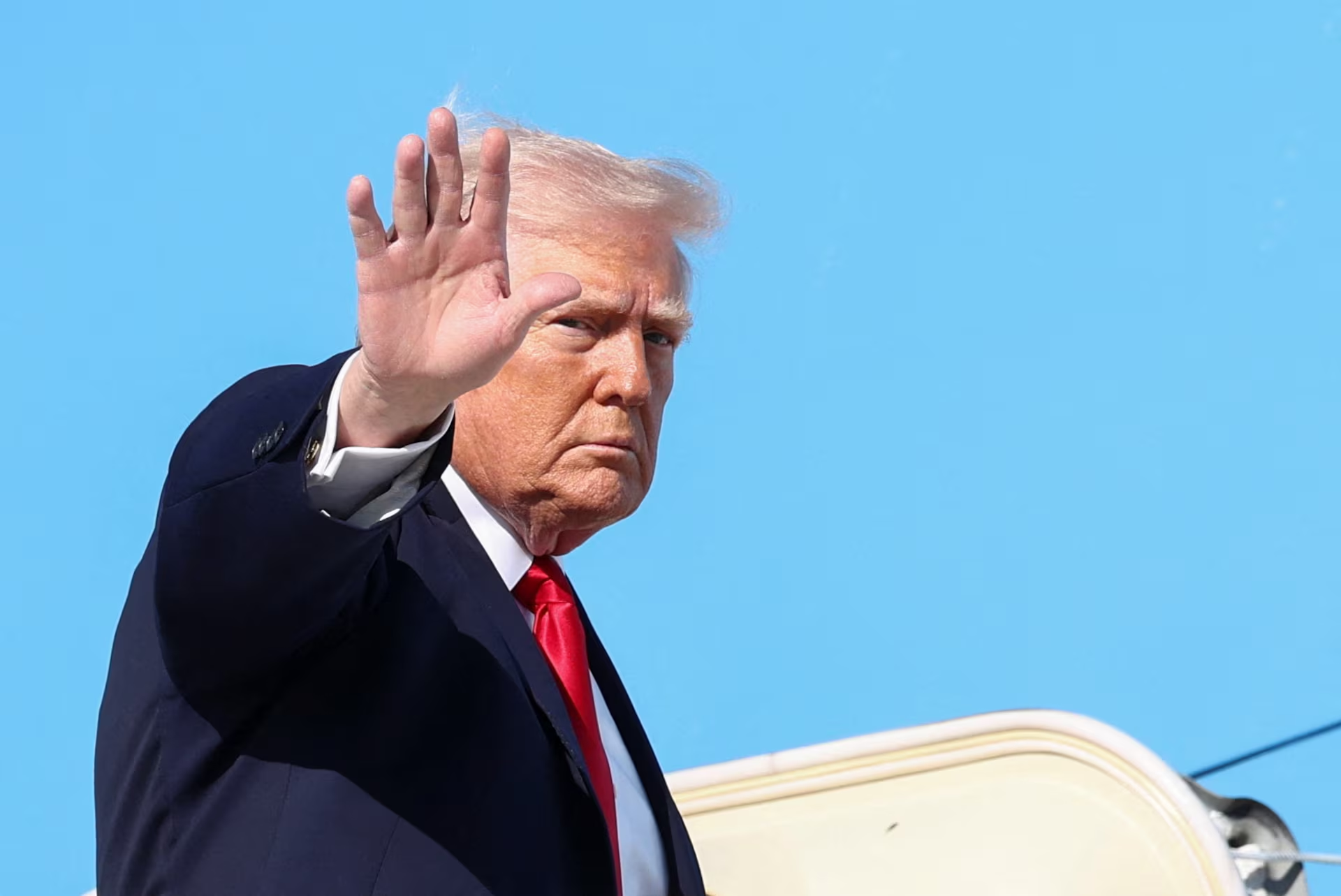
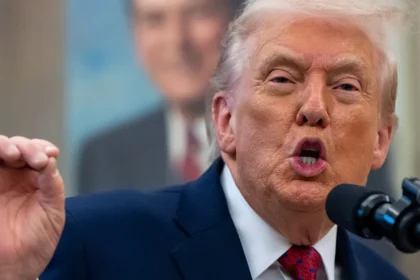
These rapid developments on the ground come just hours after US President Donald Trump’s remarks on Monday evening. Trump announced that he had a “very productive call” with Israeli Prime Minister Benjamin Netanyahu. Trump also asserted that “there will be no troops going to Beirut,” and that any troops that were en route there “have already been turned back.”
Trump added that he had also had, through high-level representatives, “very good contact” with Hezbollah. He indicated that they had agreed to a ceasefire. He explained via his “TRUTH SOCIAL” platform that the current understanding stipulates that “Israel will not attack them, and they will not attack Israel.”
Hezbollah’s position and diplomatic moves
Prior to these statements, informed sources reported that official Lebanese diplomatic channels had notified the United States of Hezbollah’s acceptance of the American ceasefire proposal. The party expressed its full readiness to refrain from targeting Israel, provided that Israel made a similar commitment not to target Beirut’s southern suburbs.
Sources considered this step positive and a foundation upon which to build in order to de-escalate military tensions and prevent a slide into a wider, more comprehensive confrontation in the region. The sources indicated that these developments reflect the importance of continued diplomatic coordination and present a genuine opportunity to strengthen lasting de-escalation.
This call between Trump and Netanyahu came in the wake of serious Israeli threats to target Beirut’s southern suburbs, while Iran vowed to strike northern Israel if the suburbs were bombed. Meanwhile, the Tasnim News Agency reported that Tehran had suspended its exchange of messages with Washington through intermediaries, coinciding with the escalation of intense Israeli attacks on Lebanese territory.
Emergency meeting of the UN Security Council amid widespread condemnation
Internationally, an emergency meeting of the UN Security Council, convened at the request of France, saw near-unanimous agreement, with the exception of the United States, calling on Israel to immediately withdraw its forces from southern Lebanon. The Council also demanded that Israel refrain from launching further escalatory attacks.
This meeting took place amidst a massive exodus of tens of thousands of Lebanese residents who fled their homes toward overcrowded shelters. Widespread panic gripped the Lebanese public following Israeli threats of an imminent and violent attack on Beirut’s southern suburbs. During the session, permanent members of the Security Council, including France, Britain, Russia, and China, strongly criticized Israel, while Washington, in its statement, focused on holding Iran and Hezbollah directly responsible for the current escalation.