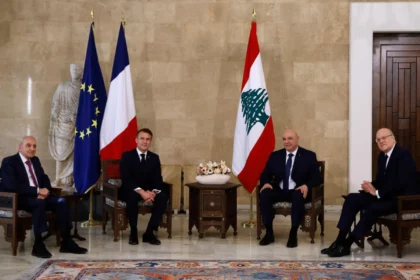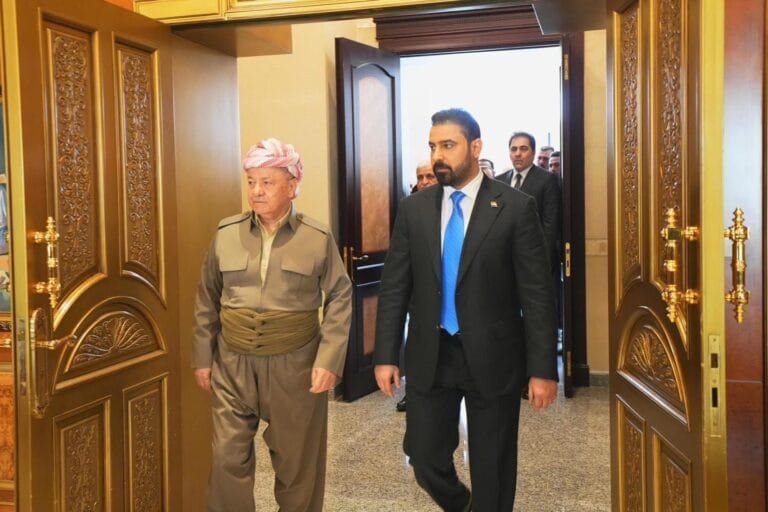
Erbil, Iraq – The Iraqi capital, Erbil, witnessed intense political activity on Saturday aimed at breaking the deadlock in the formation of the federal government. Kurdish leader and head of the Kurdistan Democratic Party, Masoud Barzani, held an important meeting with Prime Minister-designate Ali Faleh al-Zaidi and his accompanying delegation of leaders from the Coordination Framework.
A statement issued by the media office of the prime minister-designate indicated that the meeting, held at Barzani’s residence in Salahaddin resort, focused on reviewing the overall political and security situation in the country. The meeting also addressed ways to advance the national dialogue process.
During the discussions, both sides emphasized the necessity of moving forward with the formation of a new federal government, one characterized by strength and the ability to confront current challenges. They also stressed the importance of overcoming the accumulated crises that have burdened the state and its citizens.
The statement indicated that the meeting emphasized the importance of unifying visions and positions among the active political forces. It also stressed the need to work according to a comprehensive national vision that contributes to strengthening security and driving economic development, thereby fulfilling the aspirations of all segments of the Iraqi people. For his part, President Barzani affirmed the importance of genuine partnership and national consensus as fundamental pillars for the sustainability of any future government project.
Al-Zidi’s visit to Erbil comes at a sensitive time, as the prime minister-designate seeks the support of Kurdish forces for his government program and the distribution of ministerial portfolios in a way that ensures a political balance and prevents the government from stalling in parliament. Following his visit to Erbil, al-Zidi is expected to travel to Sulaimaniyah. There, he will meet with the leader of the Patriotic Union of Kurdistan, Bafel Talabani, to discuss the same outstanding issues and ensure comprehensive representation for the Kurdistan Region in the anticipated cabinet.
Observers are placing great hopes on this shuttle diplomacy tour of the region. They believe that an agreement between Baghdad and Erbil is the cornerstone of any future political stability. This is especially true given the regional tensions and economic pressures, which necessitate a fully empowered government capable of making crucial decisions.