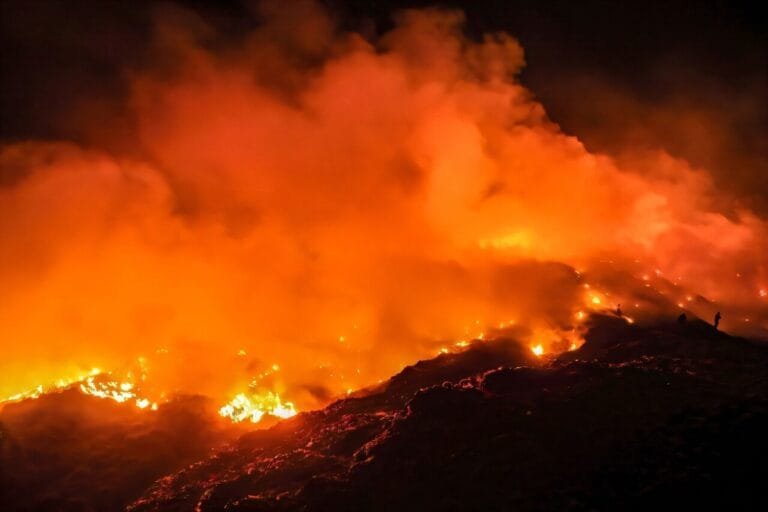
Jakarta, Indonesia — Wildfires across Indonesia destroyed approximately 235,000 acres in July alone, fueled by intensifying El Niño climate conditions that have brought severe drought. Consequently, fire risks have surged, rapidly expanding the total burned land area across the archipelago. Furthermore, officials warn that the crisis could reach its peak throughout August and September.
Doubling Burned Area and Escalating Damage
Indonesian Forestry Minister Raja Juli Antoni stated that the land area destroyed in July nearly doubled the aggregate damages recorded over the preceding six months. Additionally, official ministry data reveals that total burned area rose from 107,000 hectares (~265,000 acres) between January and June to roughly 202,000 hectares (~499,000 acres) by the end of July.
This drastic increase underscores how prolonged dry spells are accelerating flame dispersion. Consequently, emergency response teams are ramping up containment efforts to protect communities and ecologically sensitive zones.
Comparative Severity and El Niño Projections
Antoni noted that El Niño’s intensity by mid-August surpassed levels observed during the catastrophic 2015 fire season, although total affected land remains below 2015’s 600,000 hectares (~1.4 million acres). Additionally, current destruction has already exceeded total damages recorded in both 2019 and 2023.
Meanwhile, Indonesia’s Meteorology, Climatology, and Geophysical Agency projects El Niño conditions to persist through early 2027, posing sustained logistical challenges for disaster management authorities.
Finally, Indonesian authorities are scrambling to implement mitigation measures ahead of expected peak fire conditions in late August and September. Ultimately, the effectiveness of regional containment strategies will be critical in curbing haze, protecting biodiversity, and safeguarding public health.