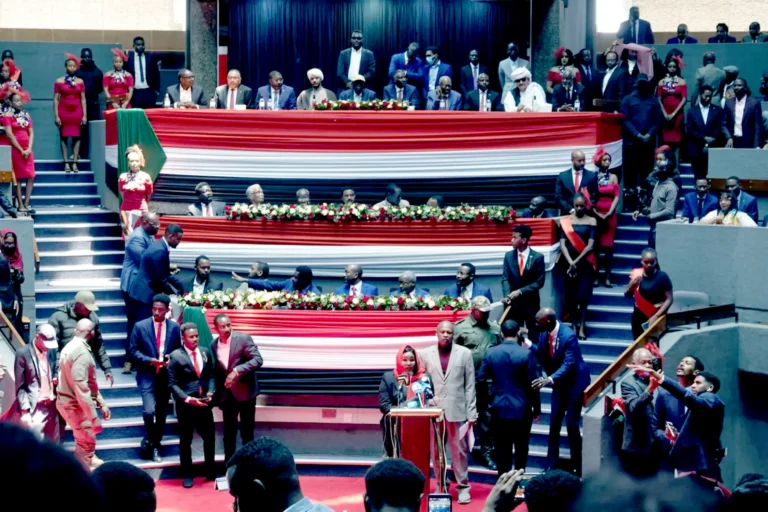
Nairobi, Kenya – Sudanese political and civil forces, in their final statement issued after their meeting in the Kenyan capital, Nairobi, affirmed that the political process required to end the crisis in Sudan cannot be limited to a settlement between the conflicting parties.
Rather, it must be a comprehensive and profound process that addresses the root causes of the protracted Sudanese crisis.
comprehensive political path
The statement emphasized that any future solution must be based on
a comprehensive political vision that rebuilds the Sudanese state on new foundations.
It must also address the structural causes that led to the current conflict.
The participants clarified that the desired political process should transcend the logic of power-sharing or partial agreements.
Furthermore, it should aim to build a comprehensive national framework that achieves lasting stability and puts an end to recurring cycles of violence.
The statement noted that previous partial solutions have failed to achieve sustainable peace.
Therefore, a more comprehensive approach is needed, one that addresses issues of governance, transitional justice, and institution-building.
Rebuilding and a call to end the war
The Sudanese forces affirmed that rebuilding the state is a fundamental priority in any future settlement.
They also stressed the necessity of involving all civilian stakeholders in shaping the country’s future,
thereby strengthening national legitimacy and restoring confidence in the political process.
The statement called for international and regional support for an independent Sudanese
political process leading to an end to the war and the achievement of stability.
It also highlighted the importance of addressing the conflict’s impact on civilians and infrastructure.
The statement concluded by emphasizing that ending the war in Sudan requires genuine political will that transcends narrow calculations.
Furthermore, it must lay the foundation for a lasting peace based on justice, equality, and the rule of law.