Paris, France – In 843 AD, Europe witnessed a historical event that would change the map of the continent for centuries.
This occurred after the descendants of Emperor Charlemagne signed the Treaty of Verdun,
which ended a struggle over the succession to the Frankish Empire.
The treaty also led to the division of the empire into three main parts.
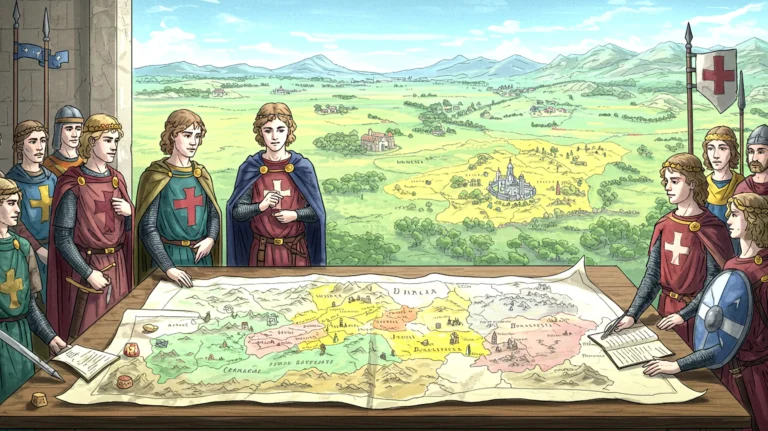
The division of Louis the Pious’s empire
treaty came after the death of Louis the Pious, Charlemagne’s son,
and the escalation of the conflict between his sons over control of the empire,
which included large areas of Western and Central Europe.
Under the agreement, Charles the Bald obtained the western part,
which was later linked to the development of the French Kingdom.
While Louis the German took over the eastern part. This part became one of the historical foundations
for the formation of Germany. As for the central part,
it went to Lothair I and extended from the North Sea to areas in Italy.
The Treaty of Verdun represented a significant turning point
Although the Treaty of Verdun did not directly create modern France and Germany,
it marked a significant turning point in European history.
The division of the Carolingian Empire contributed to the emergence of political entities
that gradually evolved into independent states and kingdoms.
Historians consider the treaty one of the most important milestones in shaping
the political landscape of Western Europe.
It ended the unity of the empire built by Charlemagne and paved the way
for new conflicts and alliances that would last for centuries.