
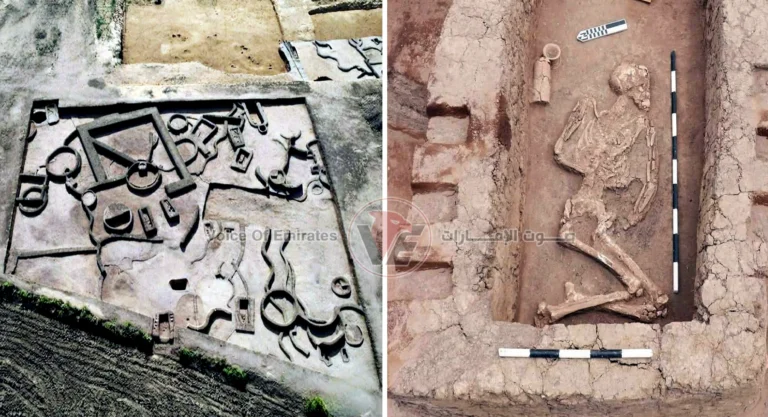
Cairo, Egypt – Archaeological excavations in the Kom El-Khulgan area of Daqahliya Governorate have revealed new details about the lives of communities that settled in the Nile Delta thousands of years ago. This discovery follows the unearthing of 110 tombs belonging to three distinct cultural periods.
The Ministry of Tourism and Antiquities explained that the discovered tombs date back to the Lower Egyptian culture known as Buto I and II, and the Naqada III culture. Some tombs also date to the Second Intermediate Period, also known as the Hyksos period, reflecting the continuous human settlement in the region throughout successive historical periods.
Discovery of 110 tombs
The discoveries included 68 tombs dating back to Lower Egypt, and five tombs from the Naqada III period. In addition, there were 37 tombs from the Second Intermediate Period.
The tombs revealed clear differences in burial practices and funerary customs between the various periods. Burials of individuals in different positions were found, along with burials of children and infants inside pottery vessels.
The discoveries also included pottery, stone tools, palettes, and grinding implements. Jewelry, amulets, and scarabs were also found, artifacts that help researchers understand aspects of daily life and the beliefs of the region’s inhabitants.
The importance of Kom Al-Khalij excavations
The discoveries were not limited to tombs. Excavations also uncovered kilns, hearths, and the remains of mud-brick building foundations. This indicates the presence of settled residential and industrial activities at the site.
The excavation results underscore the importance of Kom el-Khulgan in studying the evolution of human settlement in the Nile Delta. The findings reveal that the area was home to organized communities thousands of years ago. These communities underwent gradual transformations in lifestyles, burial practices, and tool use.
Archaeological missions continue their work in the area to uncover further secrets that can contribute to reconstructing the daily lives of the Delta’s inhabitants. This work also helps in understanding the stages of development of Egyptian society, leading up to the rise of the ancient Egyptian state and subsequent periods.