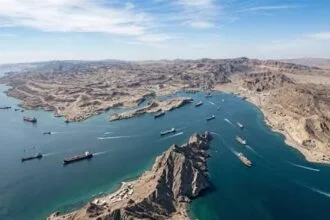

Tehran, Iran – In striking remarks reflecting the extent of the pressure on Iran’s economy due to the current crisis, Majid Reza Hariri, head of the Iran-China Chamber of Commerce, stressed the need for immediate action to end the US naval blockade imposed on Iran’s southern ports. He explained that “the consequences of the blockade far outweigh those of a direct war.”
A naval blockade is more dangerous than war.
In a detailed interview with the local news website Khabar Online, Hariri stated, “Whether through negotiation, supplication, threats, or even war, this naval blockade imposed on our coasts must end.” He also emphasized that Iran did not suffer from such severe economic crises and shortages during the “Forty Days’ War.” However, it did during the naval blockade.
The head of the joint chamber warned against adopting misguided policies in managing the crisis. He explained, “The worst thing that could happen today is believing that the naval blockade can be circumvented and attempting to govern the country despite its continuation. We have already made this mistake with sanctions. Instead of seeking to lift them or finding a genuine mechanism to neutralize them, we resorted to methods of circumvention and evasion. The inevitable result was a weak economy and a fragile economy, and rampant corruption.”
Astronomical figures and exorbitant logistical costs
In refuting claims of significant economic losses resulting from abandoning sea routes and relying on land alternatives, Hariri presented a detailed numerical comparison of commercial shipping costs. He also highlighted the enormous differences between sea and land transport. Hariri explained that a single container arriving in Iran from China via ships and seaports costs only about $3,000 to transport. Moreover, he pointed out that when sea routes are disrupted and traders resort to importing the same container by land, the transport cost rises to an average of $12,000 per container.
Annual losses exceed the bill for medicines and basic goods
The head of the Iran-China Chamber of Commerce presented detailed calculations of the expected losses in the medium term. He also stated that Iran’s imports through its southern ports amount to approximately two million containers annually. He further explained the scale of the economic disaster: “If this blockade continues, each container will impose additional trade burdens and costs on the Iranian economy amounting to $9,000. In reality, this will cost us approximately $18 billion annually in additional transportation costs alone.”
Hariri concluded by emphasizing the enormity of this figure, saying, “To truly grasp the magnitude of this sum, it suffices to know that the Iranian economy’s total annual need for importing essential goods and vital medicines is essentially less than $15 billion.” This means that the continued sanctions are consuming sums exceeding the country’s entire food and medicine security budget.