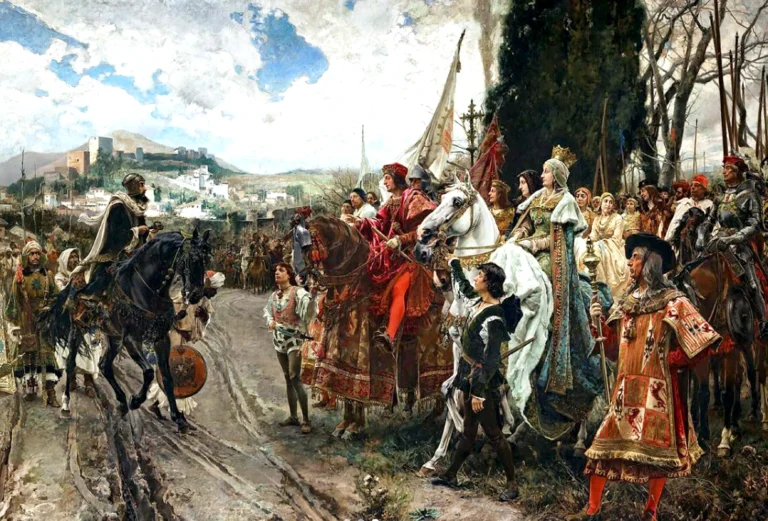
Granada, Spain – Abu Abdullah Muhammad XII, historically known as Abu Abdullah al-Saghir (the Younger), remains one of the most controversial figures in Islamic history.
His name is associated with the fall of the Kingdom of Granada in 1492, the last Muslim stronghold in al-Andalus.
This marked the end of an era that had lasted for nearly eight centuries.
Abu Abdullah al-Saghir assumed power in Granada during a period of political turmoil
and internal conflict. At that time, the Christian kingdoms,
under King Ferdinand II and Queen Isabella I, were uniting to complete the Reconquista of the Iberian Peninsula.
The deposed sultan left Granada
The division within the ruling family and the power struggle weakened the kingdom.
In response, Spanish forces laid a long siege to Granada.
This ended with the signing of the Treaty of Surrender, under which Abu Abdullah surrendered the keys to the city on January 2, 1492.
This surrender was in exchange for promises to protect the Muslim population
and their rights—promises that proved short-lived.
Historical sources recount that the deposed sultan left Granada for the Alpujarras region,
where he paused at a high point overlooking the city and cast a final farewell glance.
Tears welled in his eyes, a scene associated with the famous account attributed to his mother,
Aisha al-Hurra. She is said to have addressed him with her famous words:
“Weep like a woman for a kingdom lost, which you could not defend like a man,”
although some historians question the veracity of this account.
Abu Abdullah the Younger, the last ruler of Andalusia
After leaving Andalusia, Abu Abdullah al-Saghir moved to Morocco, where he spent his final years away from power.
Accounts differ regarding the location of his death, but most sources indicate
that he died in Fez in the early 16th century.
Abu Abdullah al-Saghir remains in historical memory as the last ruler of Andalusia.
The fall of Granada represents one of the most significant events
in the history of Europe and the Islamic world, due to the political,
religious, and cultural transformations that ensued, ultimately ending
the Muslim presence in the Iberian Peninsula.