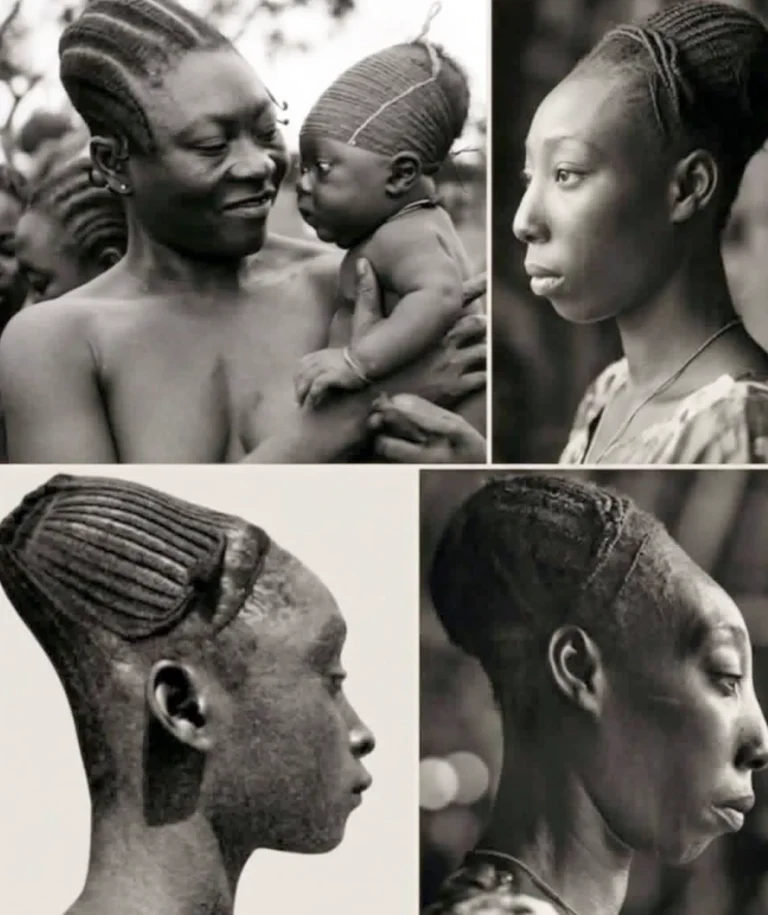
Kinshasa, Democratic Republic of Congo – The Mangbetu tribe is one of Africa’s most intriguing, due to its unique historical tradition of elongating the skulls of its children.
This practice has given them a distinctive appearance and led many anthropological studies to refer to them as “the long-headed ones.”
The tribe has historically lived in areas stretching from northeastern Democratic Republic of Congo to parts of Central Africa,
and their presence has also been linked to neighboring regions.
For centuries, the tribe has adhered to cultural and aesthetic beliefs
that elongated heads symbolize prestige and social status.
Some members also believe this shape embodies perfection
and beauty and brings the wearer closer to spiritual forces.
As a result, this custom holds a special place within the community.
The secret behind the skull’s distinctive cylindrical shape
The process of head elongation began a few days after the child’s birth, when the skull was tightly wrapped in pieces of cloth.
Later, straps or supports made of leather or wood were used to gradually guide the skull’s growth backward.
This process took advantage of the flexibility of the child’s skull bones in their early years.
It continued for several months until the skull acquired its distinctive cylindrical shape.
Initially, this custom was limited to the children of ruling families and social elites,
serving as a symbol of power and distinction.
However, over time, it spread among broader segments of the tribe,
becoming part of their cultural identity.
Some researchers have linked this phenomenon to some ancient Egyptian drawings and statues
that show figures such as Akhenaten, Nefertiti, and Tutankhamun with heads that appear relatively elongated.
However, most archaeologists confirm that there is no conclusive historical
or scientific evidence proving the transfer of this custom from the ancient Egyptians to the Mangbetu tribe.
Also, the features of Egyptian statues may reflect an artistic style rather than an accurate description of the shape of the skull.
harmful and inhumane practice
With the dawn of the 20th century, this practice gradually declined, particularly during the Belgian colonial period in the Congo,
when authorities deemed it harmful and inhumane. Restrictions were imposed, leading to its gradual disappearance by the 1950s.
Despite the decline of the skull elongation custom, the Mangbetu people still preserve a significant part of their cultural heritage,
especially through traditional hairstyles, arts, music, and handicrafts, which have become their distinctive identity.
Anthropologists are keen to study the tribe’s history as a model for understanding the cultural diversity
and social customs that have characterized African societies throughout history.