
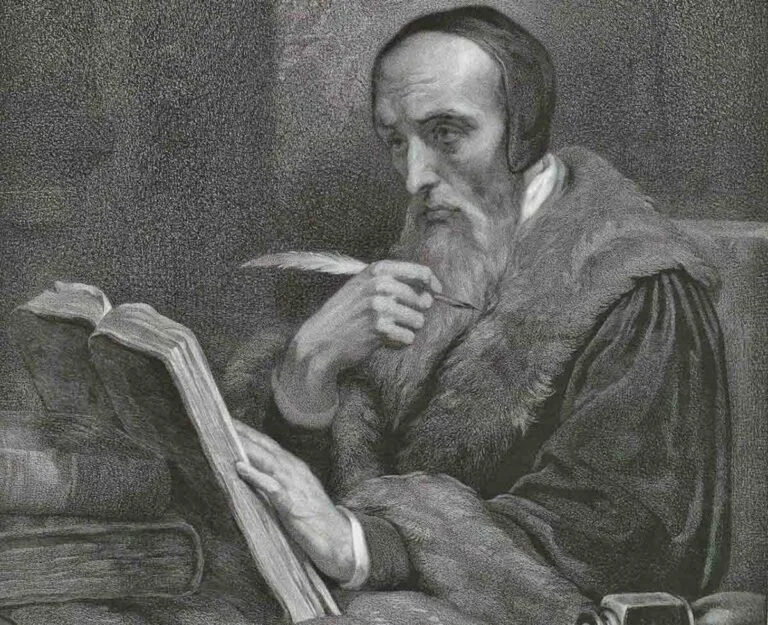
Geneva – Switzerland – John Calvin stands as one of the most prominent religious and intellectual figures in European history. He played a central role in establishing the foundations of the Protestant Reformation during the sixteenth century, eventually becoming the namesake of a denomination that spread across vast regions of the globe. While his followers view him as a religious reformer who brought about a profound transformation in Christian thought, others regard him as a controversial figure due to his rigid opinions and the manner in which he governed the city of Geneva.
Origins and Intellectual Path
John Calvin was born in 1509 in the French city of Noyon. He studied law and the humanities before turning his attention to theology, heavily influenced by the reform movement led by Martin Luther. He quickly became one of the foremost theorists of the Protestant Reformation after publishing his famous work, “Institutes of the Christian Religion,” which is considered one of the most significant theological texts in Christian history.
Reformation in Geneva
In 1536, Calvin moved to the Swiss city of Geneva, where he worked to reorganize religious and social life according to his reformist vision. He imposed a strict system aimed at cementing moral discipline and adherence to religious teachings. Thanks to this system, the city was transformed into a primary hub for Protestant thought, attracting students and clergy from across Europe, which allowed Calvin’s influence to extend far beyond the city’s borders.
The Doctrine of Predestination
Calvin became famous for his doctrine of “predestination” or “the elect,” which is based on the belief that God has pre-determined the fate of humanity regarding salvation or damnation. This idea, in particular, sparked widespread theological debates and remains a subject of controversy to this day within Christian and philosophical circles. Some see it as a vision that enhances individual responsibility, while others criticize the harshness of its perception of human destiny.
Confrontation and Historical Controversy
Calvin’s name became linked to the case of the Spanish philosopher and physician Michael Servetus, who was executed in Geneva in 1553 on charges of heresy. This incident became a source of intense criticism directed at Calvin by his contemporaries and later historians, as critics argue it reflects his intolerance toward those who disagreed with his ideas. Conversely, his supporters emphasize that judicial rulings in that era were issued according to prevailing laws and that the decision was not an individual one, placing the case within its complex historical context.
Legacy and Global Impact
John Calvin’s influence transcended the borders of Europe. Reformist churches based on his teachings spread to numerous countries, including Switzerland, France, the Netherlands, and Scotland, later extending to the United States, Canada, and parts of Africa and Asia. Calvinism became one of the most prominent currents within Protestant Christianity. Historians note that Calvin’s ideas were not limited to the religious sphere; they extended into the fields of education, administration, and labor, contributing to the formation of concepts regarding discipline and individual responsibility. More than four centuries after his death in 1564, John Calvin remains a central figure whose legacy blends praise for his role as a pioneer of reform with criticism of his rigid positions, keeping his name present in historical and theological discussions to this day.