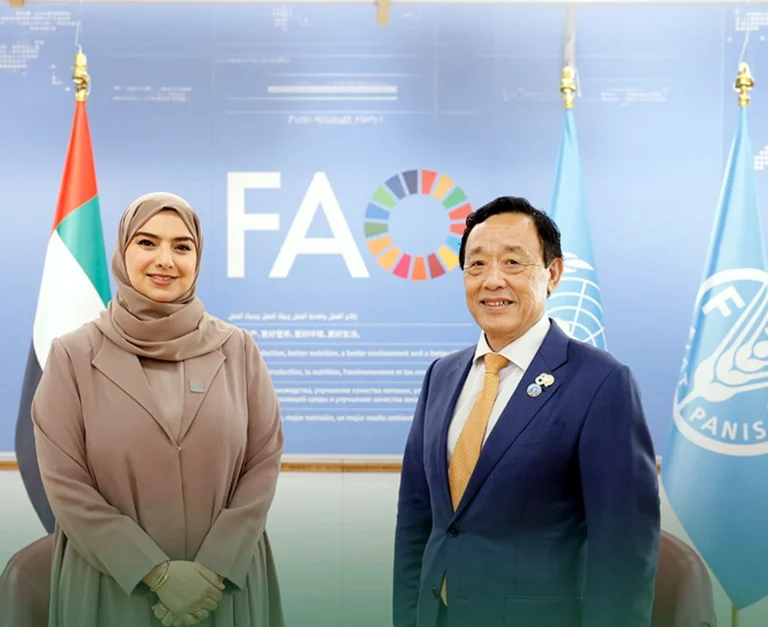
Rome, Italy – The United Arab Emirates affirmed that food security is a pillar of sovereignty and an integral part of its comprehensive national security system.
It also stressed the need to protect maritime routes and global supply chains from geopolitical shocks.
This came during the UAE’s presidency of the 38th session of the Food and Agriculture Organization of
the United Nations (FAO) Regional Conference for the Near East and North Africa in Rome.
Her Excellency Dr. Amna bint Abdullah Al Dahak, Minister of Climate Change and Environment,
explained that the UAE’s presidency of this session aims to lead a genuine transformation in food systems.
Furthermore, it aims to transform the challenges of water scarcity into opportunities for innovation.
She noted that this is based on the outcomes of the historic COP28 Declaration on Sustainable Agriculture.
Navigation disruption and its impact on fertilizers
The conference discussed recent FAO assessments of the repercussions of regional conflicts.
Participants warned that any disruption to strategic waterways would
directly lead to increased agricultural production costs and grain shortages,
particularly the Strait of Hormuz, through which approximately 30% of global fertilizer trade passes.
His Excellency Mohammed Saeed Al Nuaimi, Undersecretary of the Ministry of Climate Change and Environment,
affirmed that the proactive vision of the wise leadership has granted the UAE
a high degree of flexibility in ensuring the flow of goods and the stability of local markets.
He explained that this flexibility has been achieved despite recent pressures on waterways.
He also called for the activation of early warning systems to monitor fluctuations in global food and energy markets.
Climate finance and equity for rural communities
Her Excellency Minister Al Dahak highlighted the “unfair climate” faced by rural families and women,
who bear a disproportionate share of income losses from environmental shocks compared to wealthier groups.
She also called for a reformulation of international financing mechanisms to ensure fairness and inclusivity.
The UAE delegation showcased the country’s investment efforts through the Abu Dhabi Fund
for Development in dam construction and land reclamation projects regionally.
Additionally, they presented the Emirates Development Bank’s AED 100 million portfolio dedicated to supporting agricultural technology.
The delegation members emphasized that every dollar withheld from supporting food
security today will cost the world many times more in the future.
Youth empowerment and the digital transformation roadmap
The conference concluded with the adoption of a comprehensive roadmap under the UAE presidency.
This roadmap aims to harmonize regional policies and secure trade and logistics corridors.
Laila Ahmed Al Dhaheri, an agricultural development researcher at the Ministry, emphasized the pivotal role of youth in leading change.
She noted that young people are driving change by localizing climate-smart agricultural technologies
and stressed the need to transform them from beneficiaries into partners in decision-making.
Furthermore, the ministerial declaration acknowledged the importance of accelerating
the adoption of circular innovations and digital agriculture to address climate challenges.
This will ensure the development of resilient food systems capable of withstanding geopolitical shifts
and safeguarding the future of generations to come.