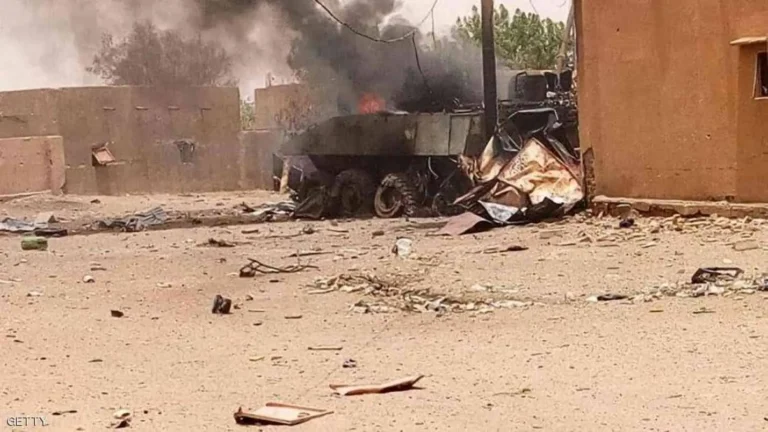
Bamako, Mali – On Saturday morning, Mali was rocked by a wave of violent and coordinated attacks targeting strategic sites and military barracks. This sparked panic and confusion in the capital, Bamako, and other cities.
In an urgent official statement, the Malian army announced that “unidentified armed terrorist groups” had carried out attacks targeting specific military installations in the heart of the capital. The statement also confirmed that military units were “currently working to eliminate the attackers” and secure the targeted sites.
Clashes in Bamako and Modibo Keita Airport
Eyewitnesses and Associated Press journalists in Bamako reported hearing heavy gunfire from heavy weapons and automatic rifles. The shooting appeared to be concentrated around Modibo Keita International Airport, about 15 kilometers from the city center. Military helicopters were seen conducting intensive patrols over the nearby suburbs, attempting to secure the area around the airport and prevent further infiltration of armed elements into vital installations.
Coordinated attacks and the fall of neighborhoods in Kidal
The attacks were not limited to the capital; residents in various Malian cities reported hearing simultaneous explosions and gunfire. This suggests a large-scale, coordinated military operation.
In a significant development, a former mayor of Kidal (in the northeast of the country) stated that armed men had entered the city and seized control of some residential areas. This led to fierce clashes and exchanges of fire with army forces stationed there.
Context of security disturbances
These dangerous developments come at a time when Mali is grappling with a complex security situation. The country is beset by insurgencies led by fighters affiliated with al-Qaeda and the Islamic State (ISIS), as well as an ongoing separatist rebellion in the north.
This coordinated attack, which targeted the heavily fortified capital and northern cities simultaneously, poses a significant security challenge to the ruling military junta. It also raises questions about the ability of armed groups to penetrate the country’s strategic depth despite extensive security measures and regional military cooperation.