Abu Dhabi, UAE – A team of scientists from the Mubadala Center for Climate and Environment Research in the Arabian Gulf “ACCESS” at New York University Abu Dhabi completed a research study on coral reefs on the coast of the UAE, with the aim of measuring their ability to adapt to rising temperatures.
This is in cooperation with the Environment Agency – Abu Dhabi, the Fujairah Environment Agency, and the Environment and Nature Reserves Authority in Sharjah.
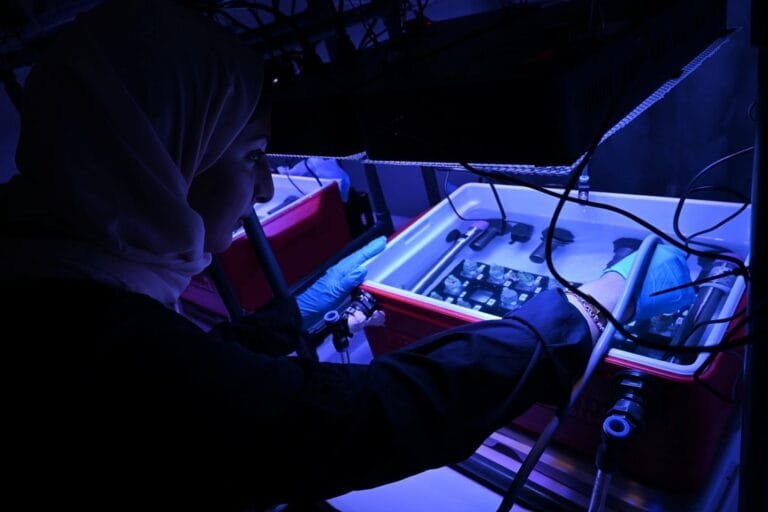
Using an advanced tool known as the Automated Coral Reef Bleaching Stress System – ACCES, the researchers conducted hundreds of field tests on coral reefs.
These tests, which take only 18 hours, reveal the heat tolerance of each coral group by gradually raising the water temperature and then measuring its physiological performance.
This work supports ambitious national goals to preserve the marine environment.
Including the Environment Agency-Abu Dhabi’s goal of replanting four million coral reef units by 2030.
By selecting and cultivating the most tolerant coral reefs, a country can enhance the chances of its coral reefs withstanding marine heat waves in the long term, a phenomenon that is increasingly occurring.
She explained that through systematic surveys and heat stress assessments, coral reef colonies in Abu Dhabi waters were identified, which showed remarkable thermal capacity and resistance to bleaching phenomena.
These results became the scientific basis for the Authority’s coral reef rehabilitation programme.
This ensures that cultivation and reproduction efforts are focused on the most resistant species.
Next steps include conducting genetic studies to determine the drivers of the difference in heat resistance between coral reefs.
With selective cultivation and coral reef nurseries planned for next year.
The automated coral bleaching stress system is expected to be a critical tool in testing coral reefs for endurance.
This is done before planting them to help rehabilitate local reefs.