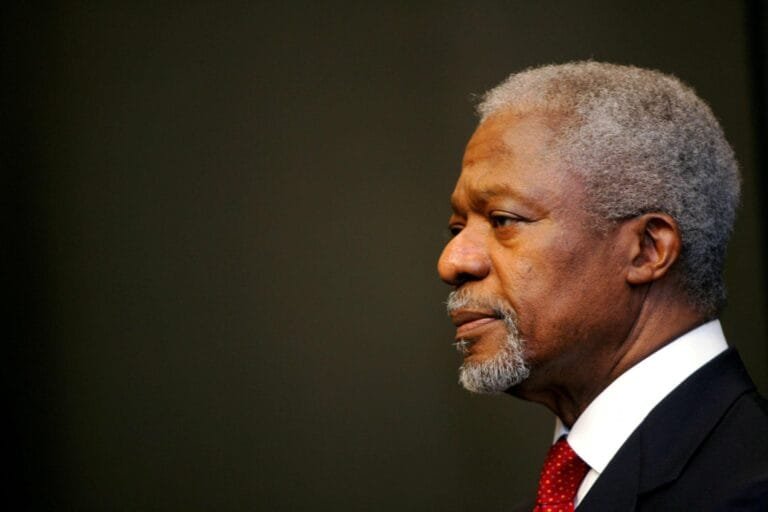
New York, USA – Today, Tuesday, August 18, marks the anniversary of the death of Ghanaian diplomat Kofi Annan, former Secretary-General of the United Nations, who passed away on this day in 2018 at the age of 80, after a long and distinguished career spanning decades in diplomacy and international affairs. Kofi Annan was born in Kumasi, Ghana, in 1938 and began his career within the United Nations system at a young age. He subsequently rose through the ranks, holding a number of international positions, eventually becoming one of the most prominent officials in the international organization.
Kofi Annan assumed the position of Secretary-General of the United Nations in 1997, becoming the first Secretary-General from sub-Saharan Africa. He served two consecutive terms until the end of 2006. During his tenure at the helm of the UN, Annan addressed numerous international crises and complex issues. He also focused on strengthening the organization’s role in peacekeeping, combating poverty and disease, and promoting human rights and sustainable development.
Kofi Annan, along with the United Nations, was awarded the Nobel Peace Prize in 2001 in recognition of his efforts to promote world peace and work towards the development of the international organization. His name thus became synonymous with a significant period in the history of multilateral diplomacy. After leaving his post as Secretary-General, Annan remained active in the international arena, participating in numerous mediation and conflict resolution initiatives. He also served as Chairman of the Kofi Annan Foundation, which continues its work in the areas of peace, security, development, and good governance.
In 2018, the United Nations announced the death of Kofi Annan in Bern, Switzerland, after a short illness. The international community mourned the loss of one of the most prominent diplomats who left an indelible mark on the history of the international organization. His passing was a great loss to the world of diplomacy. International leaders and officials praised his contributions to peace and human rights, affirming that his legacy would remain present in the efforts of the United Nations and the international community to resolve conflicts and strengthen cooperation between nations.