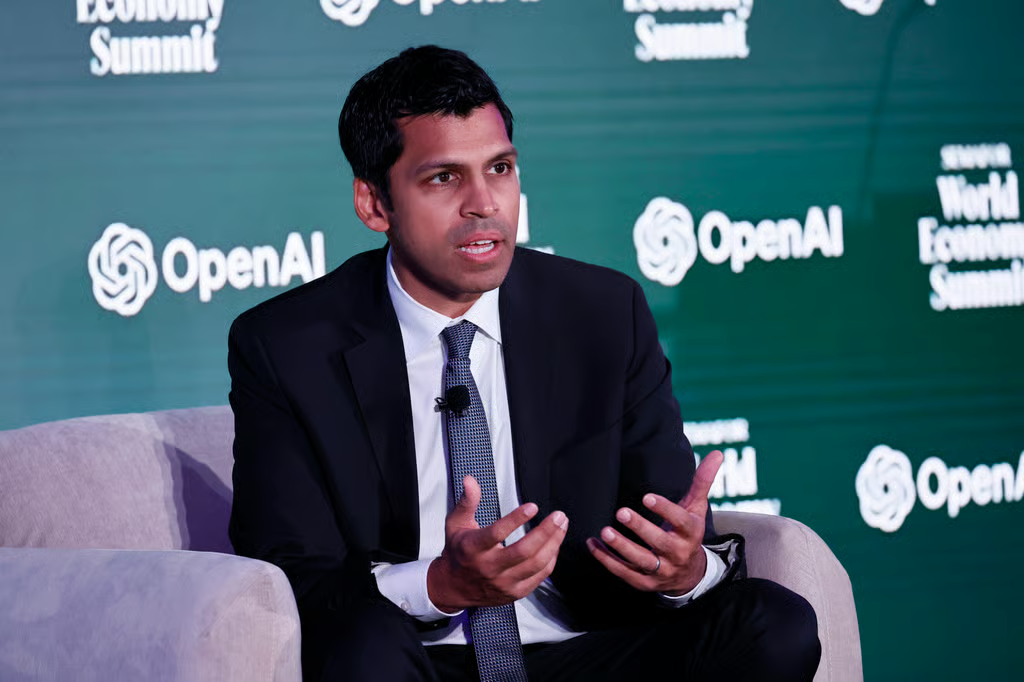
Amidst the growing global debate regarding the future of the job market in the era of the technological revolution, Rony Chatterjee, Chief Economist at OpenAI, offers a reassuring vision that counters pessimistic scenarios. He emphasizes that the rise of artificial intelligence does not necessarily mean the displacement of human labor. Instead, he views this technological shift as a continuation of historical patterns where tools evolve to enhance human capabilities.
History Repeats Itself: Lessons from the PC Era
During his participation in the European Central Bank’s annual workshop in Sintra, Portugal, Chatterjee presented a striking historical analogy, citing his father’s experience as an economist in the 1980s. When personal computers entered the workplace in 1985, fears similar to those we see today emerged. However, the introduction of the computer did not lead to the replacement of experts. Instead, it became an enabling tool that enhanced their analytical power and productivity.
Instead of relying on complex manual methods and punch cards for statistical analysis, economists were able to perform these tasks with superior speed and efficiency thanks to the PC. This historical example illustrates that new technological challenges often act as a tool to raise human efficiency rather than replace it, a principle that remains true in the current landscape of artificial intelligence.
The Gap Between Expectations and Field Reality
Chatterjee pointed to a fundamental truth concerning the software development sector, where actual data shows that gloomy predictions about job losses have not materialized to the extent many feared. Experience has demonstrated that just because a job is exposed to AI capabilities does not automatically mean the technology will replace the human. The economist urges a redefinition of the concept of a “job” and how professional tasks evolve over time, asserting that this deep understanding is the only way to move beyond the division between optimists and pessimists.
Financial Institutions: Careful Monitoring and Smooth Transition
This economic view aligns with the strategic direction of major international financial institutions, where the impact of AI has become a central file for central banks. Recent research findings from the European Central Bank indicate a lack of concrete evidence for mass layoffs due to technology thus far. Meanwhile, Christine Lagarde, President of the European Central Bank, emphasized the importance of adopting AI for its economic benefits and productivity gains, while simultaneously stressing the need for constant monitoring to ensure a safe and smooth transition in the job market, protecting labor while successfully adapting to technological changes.