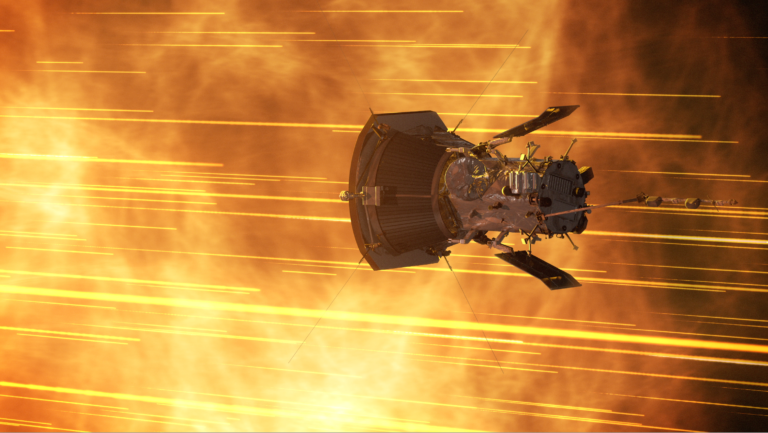
Washington, USA – The Parker Solar Probe, operated by NASA, continues to advance in one of the boldest space exploration missions in history. Consequently, the probe is gradually approaching the Sun’s outer layers to collect precise data on the solar atmosphere and solar wind behavior. Moreover, the Parker Solar Probe has successfully reached record distances from the Sun. No previous spacecraft has ever attained these distances. As a result, it continues to fly within the harsh thermal and radiation environment, utilizing advanced engineering to protect its instruments. Thus, humanity seeks to decode the nearest star from an unprecedented proximity.
Scientific Objectives and Deeper Understanding of Solar Phenomena
The Parker Solar Probe project aims to understand complex phenomena, such as how the solar corona reaches temperatures far exceeding the Sun’s surface. Accordingly, scientists are studying the mechanisms forming solar winds, which directly impact Earth’s magnetic field. In addition, understanding these winds is vital for protecting communication systems and satellites from solar storms. Conversely, the probe relies on a thermal shield made of advanced materials. These materials are capable of withstanding temperatures exceeding a million degrees Celsius. Consequently, this innovation remains the cornerstone allowing for the collection of scientific data from a previously unexplored region.
New Horizons in Solar Physics
Space scientists confirmed that every new approach by the Parker Solar Probe provides a unique opportunity to monitor plasma behavior and magnetic fields near their source. On the other hand, this observation contributes to improving the prediction of storms that might affect power grids and air navigation. Ultimately, the mission will continue to execute a series of close orbits over the coming years. Accordingly, this journey will redraw our comprehensive understanding of stars. It will open new horizons in solar physics and deep space exploration.