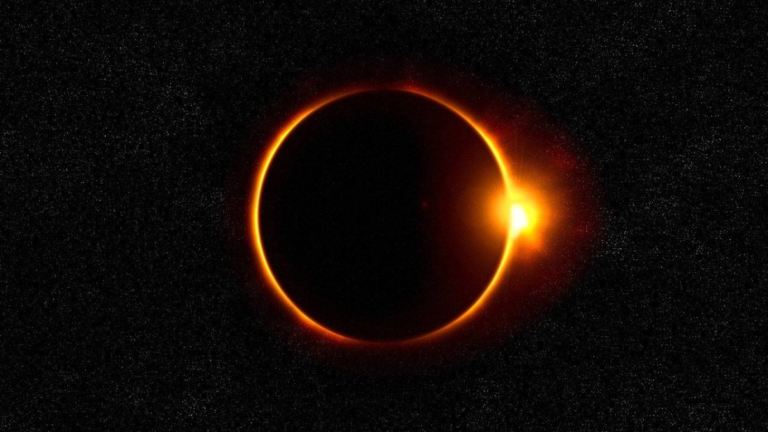
Cairo, Egypt – A solar eclipse has always been a “cosmic shock” that halted time for ancient civilizations. In bygone eras, the disappearance of the sun at midday was not merely an astronomical phenomenon. Instead, it was a “terrifying omen” carrying the anxieties of divine wrath. In ancient China, it was believed that a celestial dragon was devouring the sun. Meanwhile, in Babylon and Egypt, eclipses were read as political messages signaling the fall of thrones or the outbreak of conflict. These rituals and cries directed toward the sky were desperate attempts to restore order to a universe that seemed to be collapsing.
Science Flips the Table: The Eclipse as a “Physics Lab”
Furthermore, with the dawn of science, the eclipse transformed from a source of terror into a “window of knowledge.” Perhaps the most prominent milestone in this transformation was in 1919. That year, astronomers used a total solar eclipse to test Albert Einstein’s Theory of General Relativity. Photographs showing the bending of starlight around the sun during the eclipse proved that gravity is not just an attractive force. Rather, the phenomenon is a curvature in the fabric of spacetime itself. From this perspective, the eclipse was no longer a harbinger of a king’s fall. Instead, it was the proof that heralded the birth of “modern physics.”
What Do Eclipses Reveal to Scientists Today?
In the same context, this phenomenon remains an invaluable scientific tool today. The solar corona, which is invisible due to the sun’s blinding glare, becomes fully visible during a total eclipse. Consequently, scientists can study the corona’s temperatures and the movement of solar particles. They can also analyze the impact of solar winds on Earth’s atmosphere. The eclipse has become a “golden opportunity” for global observatories. As a result, it contributes to the understanding of the complex processes governing our nearest star. These processes, in turn, affect our communications and satellites.
From Myth to Knowledge: A Story of Human Awareness
Ultimately, the solar eclipse remains a striking example of the evolution of the human mind. The gap between ancient cries of fear and modern precision observation represents the journey of our understanding. While we are still mesmerized by the beauty of this phenomenon, we now realize it is merely a precise “celestial dance” of bodies. Amazingly, this dance can be calculated to the second. The eclipse hasn’t changed; we have. Instead of fearing the darkness it brings, we now search within it for the secrets of the universe. These secrets illuminate our minds.