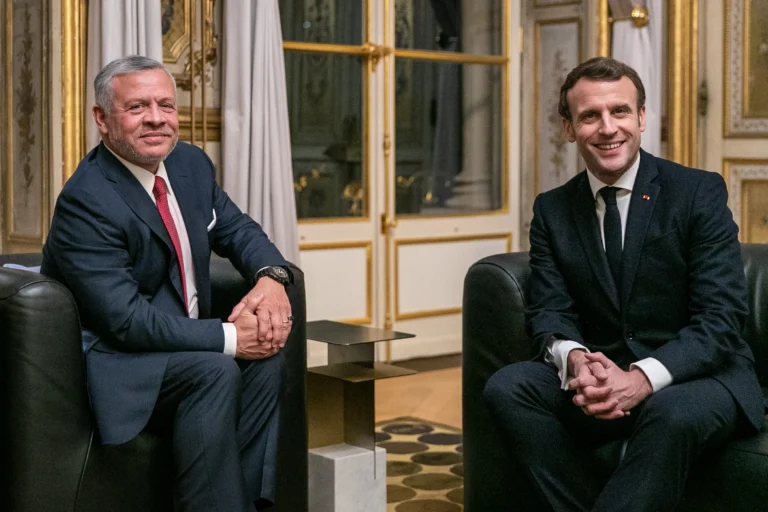
Amman, Jordan – In a high-level diplomatic move, King Abdullah II of Jordan, during his discussions with the French President, emphasized the pivotal role the international community must play in ending the state of tension between Tehran and Washington. The King warned that allowing tensions in the Gulf and surrounding regions to persist without a political solution threatens not only regional security but also poses global economic and security risks. From this perspective, both sides affirmed that “diplomacy is the only option” capable of defusing the crisis, calling for dialogue and the activation of indirect channels to prevent any slide toward a military confrontation with unforeseen consequences.
Jordanian-French Coordination: Searching for a “Stability Umbrella”
Furthermore, the Jordanian-French talks reflect close alignment in their views on Middle Eastern crises. The French President affirmed Paris’s full support for efforts aimed at de-escalation, noting that coordination with regional partners is the cornerstone of any comprehensive settlement. Moreover, Jordan, under the leadership of King Abdullah II, represents a rational voice in the region, continuing to press for radical solutions that ensure maritime security and regional stability, away from the brinkmanship policies adopted by some parties.
Warning Against “Escalation Scenarios”: Need for Political Solutions
In the same context, these moves come amidst growing international fears of a rapid deterioration of the situation. Observers believe that the joint emphasis from Amman and Paris on the importance of dialogue sends a strong message to the involved parties regarding the need for restraint. A military escalation—should it occur—would not be limited to the two nations involved but would extend to impact the security and stability of neighboring countries. Based on this, Jordan’s role stands out as a “strategic mediator” enjoying international trust, constantly seeking to bridge gaps and ensure that dialogue remains the dominant language in dealing with the Iranian file.
The Path Ahead: Will Diplomatic Efforts Succeed?
Ultimately, the bet remains on the ability of international and regional powers to translate this diplomatic momentum into tangible results. While tensions between Washington and Tehran persist, the greatest challenge is balancing the national interests of the conflicting parties with the necessity of preserving “regional peace.” The Jordanian-French stance today does not merely represent a “call for calm,” but a realistic roadmap affirming that stability is a shared interest and that the path of negotiation is the safest route for the future of the Middle East.