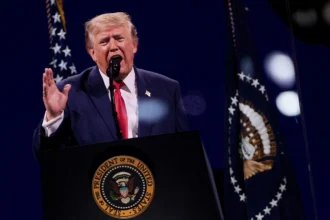
Washington, United States – In a significant development reflecting profound shifts in U.S. security strategy, CIA Deputy Director Michael Ellis announced that the agency is expanding its intelligence-gathering operations to directly target Chinese companies. Ellis made this announcement during a rare public appearance at a high-level security conference in Washington, D.C. He also explained that the nature of U.S. intelligence work has undergone a radical transformation since the Cold War era—when the Soviet Union was Washington’s primary adversary and intelligence target—as reported by *The New York Times*.
Chinese companies are legitimate targets for espionage.
The U.S. official explained that China represents a fundamentally different model from traditional adversaries, as it is simultaneously a comprehensive military and economic competitor. Ellis noted that strategic and vital information in advanced technology sectors—such as artificial intelligence, semiconductors, and biotechnology—is no longer confined to government institutions or military bases; instead, it is increasingly concentrated within the private sector. This new reality has led the Central Intelligence Agency (CIA) to regard Chinese companies as “legitimate targets for espionage operations,” particularly given the deep intertwinement and close relationship between the business community and the state in China. He further emphasized that innovative technical information is now stored in environments vastly different from those housing traditional political or military data.
A historical context of mutual accusations
It is worth noting that US-China relations have been marked by persistent tensions over the past decade regarding issues of technological espionage; the administration of former US President Barack Obama repeatedly accused Beijing of involvement in the theft of intellectual property from American companies. Although the two nations signed an agreement in 2015 pledging to refrain from engaging in cyber-espionage for economic purposes, Washington later accused Beijing of violating the terms of that accord. Commenting after the conference, Ellis summarized this shift by noting that while US intelligence has long gathered information through various means, the fundamental change today is that the battle is no longer limited to tracking military tanks, missiles, and submarines.
“Distillation” Technology and Cybersecurity Concerns
These firm statements from the CIA Deputy Director coincide with an unprecedented rise in U.S. security concerns regarding the ability of Chinese companies to keep pace with American technological advancements in artificial intelligence—despite the strict restrictions and regulations Washington has imposed to prevent Beijing from accessing cutting-edge technologies. Against this backdrop, the National Security Agency (NSA), the Federal Bureau of Investigation (FBI), and the Cybersecurity and Infrastructure Security Agency (CISA) issued a joint warning accusing Chinese AI companies of conducting large-scale operations to extract capabilities from advanced U.S. models using a technique known as “distillation.”
The three security agencies stated that Chinese companies have successfully extracted billions of digital tokens through millions of queries and interactions with leading models developed by major U.S. firms. This advanced technique enables Beijing to train its own models at lower costs and with record speed, thereby narrowing the technological gap with Washington. These activities are likely backed and sponsored by the Chinese government; they rely on using the outputs of advanced models to train smaller-scale systems, significantly reducing the need for Chinese companies to make massive investments in computing power, energy resources, and research and development.