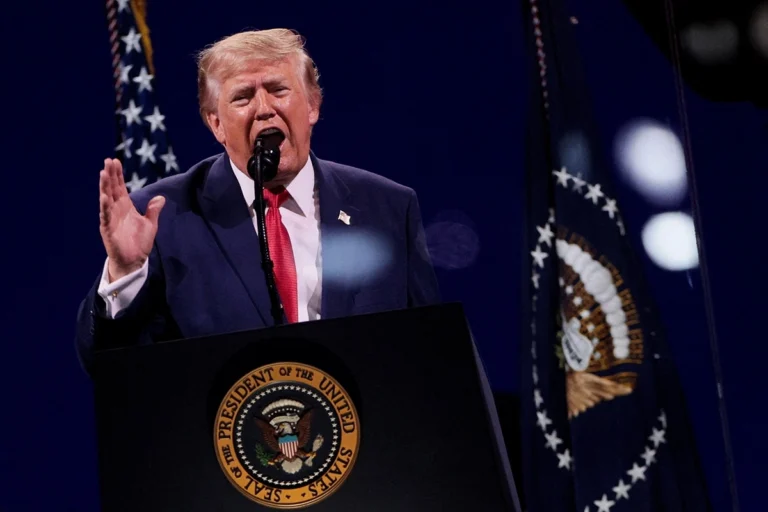
Washington, United States – On Wednesday, U.S. President Donald Trump accused the Iranian government of actively seeking to influence the outcome of the U.S. congressional midterm elections scheduled for this coming November. Trump made these remarks to reporters as he was leaving Washington for a party conference in Dallas. In this context, he explicitly acknowledged that he was not prepared to end the military conflict that has been ongoing for six months. He also indicated that he was not ready to lower high fuel prices prior to the elections.
In remarks made at Joint Base Andrews, Trump stated that the conflict would end immediately after the election, noting that Tehran “can no longer hold out and is desperate to influence the outcome.” He also asserted that oil prices would see a sharp, immediate drop once the election is decided. This comes as a recent wave of violence and reciprocal attacks has driven global oil prices to a record high, surpassing the $100-per-barrel mark. Meanwhile, Iranian leaders are facing mounting pressure due to the U.S. naval blockade and crippling economic sanctions.
Targeting of Jordan’s Al-Azraq Base and Firm Iranian Responses
On the ground, strategic experts told *The Washington Post* that Iran’s Islamic Revolutionary Guard Corps (IRGC) targeted the U.S. Al-Azraq Air Base overnight, marking a dangerous escalation in both military operations and political rhetoric. Meanwhile, the Jordanian military announced that its air defenses had intercepted 18 out of 20 missiles launched toward Jordanian territory; it further noted that two missiles landed in uninhabited areas, resulting in no casualties.
These volatile developments on the ground come just hours after U.S. forces struck five Iranian oil tankers on Tuesday. This action was a direct military response to repeated attempts by the Revolutionary Guard to launch ballistic missile attacks targeting U.S. warships in the region’s waters. Although U.S. vessels successfully evaded the attacks—sustaining no crew casualties—Admiral Brad Cooper, commander of U.S. Central Command, vowed a severe, deterrent response, stating: “Let the message to the Revolutionary Guard be clear: if you fire upon our ships, we will impose a far greater economic cost by destroying your fleet.” Meanwhile, Iranian state media quoted Parliament Speaker Mohammad Bagher Ghalibaf warning that Tehran would respond with greater force and asserting that “the era of proportionate responses is over,” while Deputy Speaker Ali Nikzad noted that the recent attacks represented only a fraction of Iran’s true military capabilities.
The Yemen front and the Bab al-Mandab Strait are increasing pressure on the global economy.
The arenas of confrontation were not limited to the Arabian Gulf; Iran-backed Houthi rebels launched a new wave of intense attacks inside Saudi territory. These strikes targeted vital energy facilities and military airbases. According to data released by the Saudi-led coalition in Yemen, the attacks resulted in injuries to at least 70 people. In response, the coalition carried out counter-airstrikes.
This ongoing escalation by the Houthis threatens to subject the global economy and international shipping to further profound disruptions by exerting constant pressure on the Bab al-Mandab Strait. This vital corridor serves as the alternative route upon which Saudi Arabia relies to circumvent potential disruptions in the Strait of Hormuz, as the Kingdom seeks to ensure the steady flow of its oil exports to global markets. Meanwhile, the US Navy is enforcing a tight blockade on Iranian ports, while Tehran maintains firm control over shipping and trade within the strategic Strait of Hormuz. Ultimately, the closure of the strait and control over its waters remain the primary obstacles to any international efforts to secure a permanent ceasefire and contain the volatile regional crisis.