- Dive-LD… A small vehicle with immense deep-sea capabilities.
- Why does the US Navy need an underwater “eye”?
- From the “Submarine” to a Network of Robots
- Hormuz: An Ideal Environment for Testing Subsurface Warfare
- The new war is being fought on the seabed.
- Why does a depth of 6,000 meters make a difference?
- “10 days” are sometimes more important than “6,000 meters.”
- The American Paradox: An Expendable Key System
- Can Iran obtain the “secrets”?
- From the sea to the “seabed”… Where is the war heading?
- Hormuz Reveals the “Invisible War”
Abu Dhabi, UAE – The significance of the US Dive-LD submersible—which Iran announced it had seized at the entrance to the Strait of Hormuz—lies not in its size or shape, but in the new trend in naval warfare it represents. This trend involves shifting an increasing share of reconnaissance, surveying, and mine-countermeasure missions to autonomous vehicles capable of operating underwater for extended periods without a human crew. The Dive-LD’s specifications reveal that the United States does not view unmanned underwater vehicles merely as auxiliary tools for submarines and surface ships; rather, it regards them as part of a broader architecture designed to generate continuous “awareness” of activity within the maritime domain and beneath the water’s surface.
Dive-LD… A small vehicle with immense deep-sea capabilities.
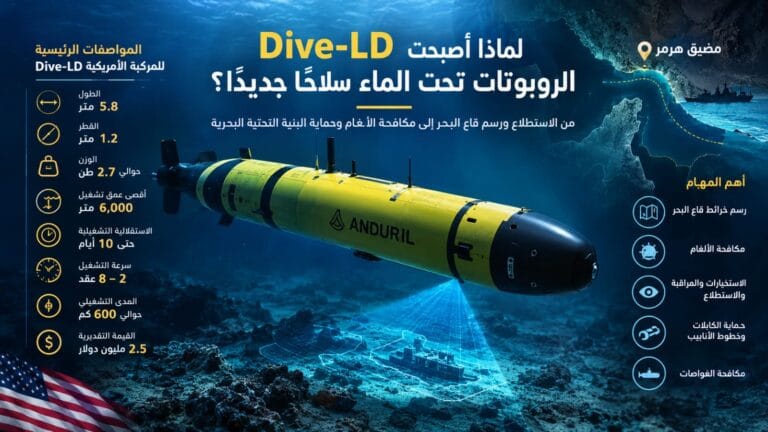
According to the manufacturer, Anduril, the Dive-LD measures approximately 5.8 meters in length and 1.2 meters in diameter. It is designed to operate autonomously for up to 10 days and reach depths of 6,000 meters. Its architecture allows for the installation of various payloads and sensors tailored to the specific mission. These specifications place the vehicle in a different category from traditional submarines, as it requires no onboard crew. It can be reconfigured for diverse missions—ranging from seafloor mapping and reconnaissance to mine countermeasures and anti-submarine warfare. Specialized data indicates that the vehicle can operate at speeds roughly between 2 and 8 knots and cover a distance of approximately 600 kilometers in a single mission, depending on operating conditions. Consequently, it is capable of covering vast areas without the constant presence of a manned surface vessel.
Why does the US Navy need an underwater “eye”?
The most significant aspect of the Dive-LD story is not merely its depth capability; rather, it lies in the data an autonomous vehicle can gather while operating in an environment that is difficult for humans to monitor. Anduril describes the platform as suitable for underwater intelligence, surveillance, and reconnaissance (ISR), as well as seafloor mapping, mine countermeasures, anti-submarine warfare, and survey and inspection operations. This implies that the vehicle’s military value may lie more in the data it collects than in its role as a direct combat platform. Knowledge of seafloor topography, potential mine locations, conditions surrounding maritime corridors, and underwater infrastructure can provide naval forces with a more precise picture of the environment in which their ships and submarines will operate.
From the “Submarine” to a Network of Robots
The Dive-LD story also reveals a broader shift in American military thinking. The vehicle was included among the systems selected in the second phase of the Replicator Initiative of the US Department of Defense. This is an initiative aimed at expanding the use of unmanned systems and producing them in relatively large numbers and more quickly than traditional weapons models. A US Congressional Research Service study indicates that the Replicator philosophy is based, among other goals, on distributing military capabilities over a greater number of unmanned systems rather than concentrating power on a limited number of high-cost platforms. This distribution makes them more difficult to target or disable. Here the importance of Dive-LD appears in a different way: the future is not necessarily one more advanced submarine. Rather, it is a larger number of independent platforms that act as an underwater sensor network.
Hormuz: An Ideal Environment for Testing Subsurface Warfare
The Strait of Hormuz lends added value to this technology due to the region’s sensitivity, the density of maritime traffic, and the waterway’s strategic importance. The United States had previously announced plans to deploy unmanned underwater vehicles as part of efforts to address the threat of mines in the Strait. This demonstrates that underwater systems have become an integral part of maritime operations in the area, rather than merely a technological project far removed from operational use. In such an environment, the ability to deploy an unmanned vehicle into a hazardous zone is far more critical than sending in divers or risking a manned vessel.
The new war is being fought on the seabed.
The importance of these systems extends beyond mines and submarines. The undersea domain contains vital infrastructure, including telecommunications and power cables, pipelines, and offshore installations. Organizations such as NATO treat the protection of this infrastructure as a security issue of growing importance. NATO’s Allied Command Transformation has noted that undersea infrastructure—including fiber-optic cables, pipelines, and seabed sensors—is vulnerable, with vast areas remaining difficult to monitor. In this context, the marine robot evolves from a mere “military vehicle” into a platform for monitoring an entire strategic environment.
Why does a depth of 6,000 meters make a difference?
Reaching a depth of 6,000 meters does not imply that every military mission will take place at that level; rather, it reveals the broad operational envelope for which the platform was designed. The company states that the Dive-LD is engineered to operate in both deep-water and coastal environments, with the capability to integrate various mission-specific payloads. This flexibility is crucial because the deep-sea environment differs radically from shallow coastal waters in terms of pressure, acoustics, temperature, seabed characteristics, and communication challenges. Consequently, possessing a platform capable of transitioning between deep-sea surveying, maritime reconnaissance, and mine countermeasures expands the operator’s options, thereby eliminating the need to develop a separate vehicle for each function.
“10 days” are sometimes more important than “6,000 meters.”
While the depth rating may appear to be the most striking figure, the ability to remain at sea for up to 10 days could prove more significant in certain operational scenarios. Extended endurance allows the vehicle to execute prolonged missions without the need for constant human intervention, enabling data collection over a longer period and the monitoring of a specific area, rather than simply performing a short operation and returning. The company emphasizes that the Dive-LD design also allows for mission duration to be extended through the addition of appropriate capabilities or modules. This aligns with the U.S. trend toward platforms that are upgradeable and reconfigurable, rather than being tied to a single, fixed mission.
The American Paradox: An Expendable Key System
This highlights one of the key implications of the Dive-LD story. The rationale behind unmanned systems is not merely to enhance their sophistication but to mitigate the costs associated with human risk. US sources have stated that the vehicle seized by Iran was an older model that had malfunctioned and carried no sensitive classified systems or data, while Anduril described the platform as designed for operation in hazardous environments. If this account is accurate, the loss of a single vehicle does not necessarily equate to the loss of the capability for which the platform was designed. This is precisely a core concept driving investment in scalable unmanned systems. However, this does not negate the potential intelligence value of any captured platform—particularly if an adversary manages to examine its components, analyze its engineering, or identify the types of payloads it can accommodate.
Can Iran obtain the “secrets”?
Seizing a physical platform does not automatically equate to possessing its technical secrets. The knowledge that can be extracted from an unmanned vehicle depends on its condition at the time of capture, whether it contains stored data, the nature of its software, the level of system protection, and whether the mission payload included sensitive equipment. This explains the divergent Iranian and U.S. assessments of the vehicle’s value: Tehran can frame it as an intelligence coup, while Washington can downplay its significance by highlighting the model’s age and the absence of sensitive systems. Publicly available information currently lacks sufficient evidence to conclusively determine the extent of the data Iran might have obtained from the vehicle itself.
From the sea to the “seabed”… Where is the war heading?
Modern military studies and programs indicate that the undersea domain is gradually evolving into an independent arena of competition. This shift encompasses not only traditional submarines but also autonomous vehicles, sensors, communication networks, and systems capable of mine detection, seabed monitoring, and the inspection of maritime infrastructure. Recent European studies on autonomous underwater systems highlight that development is not limited to increasing vehicle size; rather, it involves integrating autonomy and artificial intelligence to enable the execution of complex missions with minimal human intervention. Furthermore, NATO’s experience in monitoring maritime infrastructure illustrates a trend toward combining unmanned vehicles, sensors, and data to construct a more precise picture of the maritime domain.
Hormuz Reveals the “Invisible War”
The story of the Dive-LD reveals a less visible layer of the U.S.-Iran conflict. Naval warfare typically focuses on ships, aircraft, and missiles; however, an increasing share of the rivalry plays out far from the public eye—beneath the water’s surface. It is there that the seabed is mapped, mines are detected, and cables and installations are inspected. Unmanned vehicles operate in this realm, capable of remaining on mission for days at a time. Consequently, the most critical question following the Dive-LD incident is not merely how Iran seized the vehicle, but rather, what are major powers seeking to learn about the sea before a battle above it even begins? The answer may well be that naval dominance in the coming years will depend not only on possessing ships and submarines but also on the ability to see what is happening beneath them.