- Four maps… and one crisis
- Gaza: The map closest to Egyptian security
- Eastern Mediterranean: When energy becomes part of security
- The Red Sea… here the price of geography is revealed
- Hormuz… the distant strait that leads to Cairo
- Egypt is in the middle of a “strangulation chain”.
- From geography to influence
- Can Cairo become a point of equilibrium?
- Egypt’s real weapon… its location
- Cairo faces a new test
- The map that has not yet been drawn
Cairo, Egypt – Egypt is no longer on the sidelines of the Middle East crises; it now lies at the heart of four concentric circles whose borders, waterways, and interests intersect: Gaza, the Eastern Mediterranean, the Red Sea, and the Gulf and the Strait of Hormuz. From the Gaza war to the disruption of maritime and energy supplies, the repercussions of the conflict are spreading from one region to another, reaching the Suez Canal and impacting Egypt’s economy and national security. Therefore, can this highly sensitive position transform from a strategic burden into a source of influence, enabling Cairo to become a point of equilibrium in a reshaped Middle East?
Four maps… and one crisis
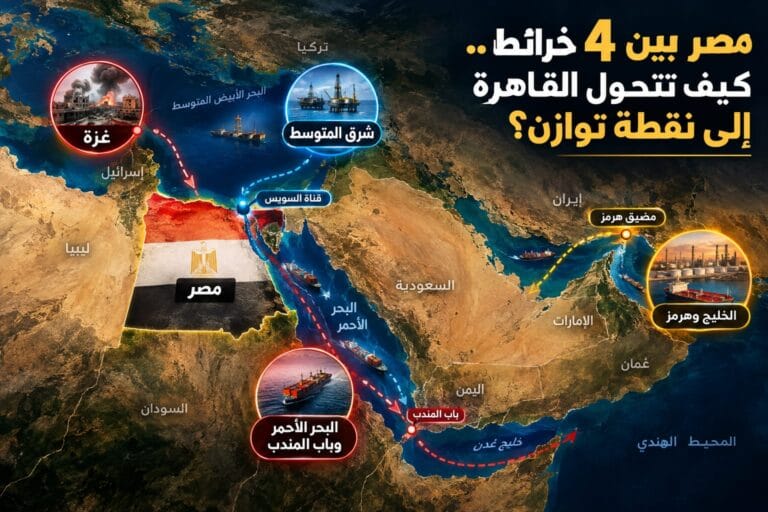
If maps of Gaza, the Eastern Mediterranean, the Red Sea, and the Gulf are superimposed, an undeniable truth emerges: Egypt lies at the heart of a geographical network where security crises are intertwined with energy, trade, and maritime routes. Gaza is Egypt’s immediate eastern gateway, and the Eastern Mediterranean represents its maritime depth and a crucial source for its energy equation. While the Red Sea connects to the Suez Canal and the Bab el-Mandeb Strait, the Gulf and the Strait of Hormuz link to energy sources that impact the global economy. Therefore, Cairo can no longer treat these issues as isolated crises. What happens in Gaza can affect Sinai, and instability in the Bab el-Mandeb Strait puts pressure on the Suez Canal. Similarly, the closure or threat to the Strait of Hormuz raises energy and transportation costs, while crises in the Eastern Mediterranean are reshaping the calculations for gas and maritime security.
Gaza: The map closest to Egyptian security
Gaza remains the most sensitive arena for Cairo. The future of the Strip is directly linked to the security of Egypt’s borders, the Rafah crossing, Sinai, and any new security arrangements on the Palestinian side. But Gaza’s importance to Egypt is no longer solely security-related. The war has made the Strip part of a broader regional crisis stretching from the Mediterranean to the Red Sea. Gaza’s future is increasingly tied to the calculations of regional and international powers, trade routes, and energy. Therefore, any stable settlement in Gaza could alleviate one source of pressure on Egypt. Conversely, the continuation of the war or its shift to new security and geopolitical arrangements could add another layer of risk for Cairo.
Eastern Mediterranean: When energy becomes part of security
The second map shows Egypt as an energy powerhouse and a potential hub for connecting the Eastern Mediterranean to international markets. The region’s gas reserves, Egypt’s liquefaction plants, pipeline networks, and ports have made Cairo part of an equation that transcends its national borders. With the volatility of global energy markets, the value of any alternative route that doesn’t rely entirely on the most conflict-prone chokepoints has increased. Protecting Egypt’s energy facilities, ports, and coastlines thus becomes a matter of national security. This is because any widespread instability in the region could quickly escalate from a military crisis into a crisis of supply, pricing, shipping, and insurance.
The Red Sea… here the price of geography is revealed
Cairo has already paid the price for the instability in the Red Sea. The more shipping traffic through the Bab el-Mandeb Strait declines, the greater the pressure on the Suez Canal, one of the most important sources of foreign currency for the Egyptian economy. The problem is that the Suez Canal cannot be isolated from the security of the Red Sea. A ship traveling from Asia to Europe needs to pass through a geographical chain that begins in the Indian Ocean, then Bab el-Mandeb, and then the Red Sea, before reaching the canal. Therefore, a threat that begins thousands of kilometers south can end up impacting the revenues of the Egyptian Suez Canal. This, then, is one of the most crucial points in the “Egyptian map”: Egypt doesn’t need to be a party to the war to pay its price.
Hormuz… the distant strait that leads to Cairo
The Strait of Hormuz may seem far removed from Egypt, but it is directly linked to its economic security. Any prolonged disruption in Hormuz could drive up oil and gas prices, increase transportation and insurance costs, and put pressure on energy-importing countries. Meanwhile, Egypt is affected by global trade, commodity prices, and foreign currency flows. Thus, Hormuz becomes an integral part of Egypt’s economic security, even without the presence of Egyptian forces or ships in the strait. The equation appears simple, but its implications are highly complex: the higher the risk level in Hormuz, the greater the value of alternative routes. Similarly, the more volatile the Bab el-Mandeb Strait becomes, the more sensitive the Suez Canal becomes. Here, Cairo faces a strategic paradox: crises that threaten trade can reduce canal traffic, but simultaneously increase Egypt’s importance as an alternative route and a logistics and energy hub.
Egypt is in the middle of a “strangulation chain”.
The power of the four maps lies in the fact that each one leads to the next. Gaza is linked to the Eastern Mediterranean, the Eastern Mediterranean to the Suez Canal and the Red Sea, and the Red Sea opens onto the Bab el-Mandeb Strait. The Bab el-Mandeb Strait is connected to trade coming from the Indian Ocean and the Gulf. As for the Gulf, the Strait of Hormuz represents its main maritime gateway for energy, and any disruption there redirects the movement of oil, gas, and ships to other routes. Thus, Egypt finds itself at the center of what can be described as a “strangulation chain”; not all of its links are within Egyptian territory, but they directly affect Cairo’s interests.
From geography to influence
Herein lies Egypt’s opportunity. Cairo cannot single-handedly end the war in Gaza, control the Bab el-Mandeb Strait, or reopen the Strait of Hormuz, but it possesses a rare combination of geography, political relationships, and infrastructure. Egypt is close to Gaza, owns the Suez Canal, overlooks the Mediterranean and Red Seas, and maintains strategic relations with the United States, Europe, and the Gulf states. Furthermore, in recent years, it has expanded its ties with China and other international powers. This diversity can grant Cairo greater room for maneuver than any country confined to a single sphere of crisis.
Can Cairo become a point of equilibrium?
The issue is not about Egypt becoming a “mediator for everything,” but rather about using its position to prevent separate crises from escalating into a single regional crisis. If the situation in Gaza stabilizes, pressure on Egypt’s borders will decrease. If the Red Sea stabilizes, the Suez Canal will regain some of its normal operational capacity. Furthermore, if energy markets calm down, economic pressures will ease. And if the Eastern Mediterranean remains stable, Egypt will maintain its position in the regional energy network. Conversely, a single crisis can simultaneously impact all four spheres. Therefore, the concept of Egyptian national security naturally expands as the circle of risks widens: from land borders to maritime routes, and from military conflict to energy, trade, and financial markets.
Egypt’s real weapon… its location
Egypt’s power at this stage is not limited to military capabilities, but extends to its ability to translate geography into political and economic influence. Major powers need secure transit routes, and Europe seeks more diversified energy sources and routes. Gulf states require alternatives to vulnerable routes, and Asian trade relies on the Red Sea and the Suez Canal when security conditions permit. All these interests make Egypt a key player, even when it is not a direct party to the conflict. However, this advantage also carries risks. The greater Egypt’s importance as a hub for transit and energy, the more vulnerable its infrastructure becomes to any regional escalation.
Cairo faces a new test
What is required of Egypt is not to choose one map over another, but rather to manage all four maps simultaneously. Gaza needs a political and security track that prevents the war from spilling over into Egypt’s borders, and the Red Sea needs security arrangements that protect navigation. The Eastern Mediterranean needs stability that allows for the flow of energy and investment. As for the Gulf, there is a need to reduce the risks of escalation, the effects of which could spill over into the global economy. In this equation, Cairo’s ability to maintain balanced relations with competing powers may become more important than aligning with any single axis. Egypt does not hold the keys to resolving all four crises, but it does hold the keys to communication between them.
The map that has not yet been drawn
Ironically, the very location that has made Egypt most vulnerable to the repercussions of regional crises could become its greatest source of influence. If Gaza represents the gateway to security, the Eastern Mediterranean the gateway to energy, the Red Sea the gateway to trade, and the Gulf and the Strait of Hormuz the gateway to global energy, then the Suez Canal and Egypt’s strategic position place Cairo at the crossroads of these routes. Here, the real question becomes different: Will Egypt remain a state that absorbs the repercussions of regional crises, or can it transform its position between four maps into a center of equilibrium? The answer will not be determined by geography alone, but rather by Cairo’s ability to protect its waterways, diversify its economy, and maintain its independent decision-making. It also depends on leveraging its numerous relationships to prevent the conflict from spilling over from one map to another. In a Middle East being reshaped by power, strategic corridors, and energy resources, Egypt’s greatest asset may not lie in any single map it controls, but rather in the four maps that the region cannot navigate without passing close to them.