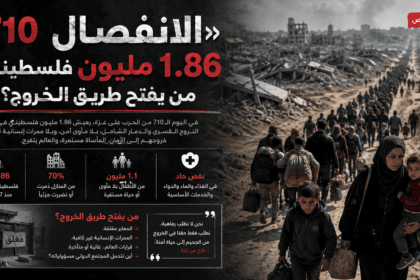

Abu Dhabi, UAE – Ben-Gvir proposes the expulsion of 1.86 million Palestinians within seven years, while Netanyahu insists on maintaining control over large parts of the Gaza Strip. Meanwhile, the Trump plan and the UN-Arab League peace plan stipulate that Gaza’s residents will not be forced to leave. So, who will shape Gaza after the war? The battle for Gaza is no longer just about a ceasefire and the disarmament of Hamas; it has entered a deeper phase: who decides who stays in the Strip and who leaves?
On September 3, 2026, Israeli National Security Minister Itamar Ben-Gvir unveiled the “Disengagement 710” plan, which he described as a project for the “voluntary emigration” of the majority of Gaza’s population. The plan aimed to have 250,000 Palestinians leave in the first year, 1.11 million within three years, and approximately 1.86 million within seven years.
It is noteworthy that the plan does not treat emigration as an individual choice, but rather as a government project. It proposes establishing a Ministry of Immigration, providing travel, housing, training, employment, and support for up to 24 months, in addition to paying funds to countries receiving emigrants. The plan estimates initial Israeli funding at approximately 10 billion shekels, with the potential to reach 50 billion with international participation. However, the larger figure, 1.86 million, reveals the true nature of the project. If implemented, we will not be talking about a limited emigration movement, but rather a reshaping of Gaza’s demographic map.
Ben Ghafir has the plan, but he doesn’t have the destination.
The plan proposes Turkey, Ethiopia, the Democratic Republic of Congo, and Arab states as potential destinations, but its implementation hinges on the agreement and willingness of other countries to receive large numbers of Palestinians. To date, no country has announced its acceptance of 1.86 million people under this scenario. This highlights the first gap between theory and reality: Israel can determine the target number of departures, but it cannot unilaterally decide which countries will receive them. Furthermore, any large-scale exodus requires border arrangements, transportation, funding, legal status, and safe passage. This makes the process contingent on the positions of the United States and regional states, particularly those bordering Gaza.
Trump draws a different map
Ironically, Ben-Gvir bases his argument on Trump’s earlier statements about the possibility of Gaza residents leaving, but the subsequent official American position has taken a more complex direction. The Trump plan and the Peace Council stipulate that no one will be forced to leave Gaza, and that those who choose to leave are free to do so and have the right to return, while encouraging residents to stay and participate in reconstruction. The plan also proposes a technocratic Palestinian administration, security arrangements, and a phased Israeli withdrawal linked to the security situation and disarmament. Herein lies the contradiction: Ben-Gvir transforms the evacuation into a measurable political project, while the Trump plan makes the residents’ continued presence part of the Gaza reconstruction project. But the disagreement doesn’t end with Ben-Gvir and Trump.
Netanyahu draws the third map
Prime Minister Benjamin Netanyahu adheres to a different approach; he links an Israeli withdrawal to the disarmament of Hamas and says that Israel will not withdraw from the territory it currently controls. He has indicated that its forces control approximately 60% of the Gaza Strip. Thus, three competing maps emerge for Gaza: Ben-Gvir: a large-scale demographic change through “voluntary emigration”; Netanyahu: continued Israeli military control until security conditions are met; Trump and the Peace Council: a political transition and reconstruction with the residents remaining and not being forced to leave. Therefore, the real battle is not just about who will govern Gaza, but about who has the right to determine its population and its future.
“Voluntary migration”… Where does coercion begin?
Ben-Gvir’s plan describes the departure as voluntary, but international law sets a broader standard than simply not forcing a person to board a vehicle. Article 49 of the Fourth Geneva Convention prohibits the forced transfer or deportation from occupied territory, with limited exceptions for temporary evacuation for specific security or military reasons. Furthermore, the legal assessment of “coercion” can include circumstances that make residents feel they have no real choice but to leave. This leads to the more difficult question: Is departure truly voluntary if the choice is between remaining in a devastated area and enduring harsh humanitarian conditions, or obtaining housing, financial support, and employment opportunities in another country? The answer is not determined simply by labeling it “voluntary.” It depends on the circumstances of implementation and the actual choices available to the residents.
Washington holds a key.
Israeli Defense Minister Yisrael Katz stated on September 2 that plans to facilitate the departure of Gaza residents were still under consideration but were “frozen” by a decision from Trump. He added that Israel was prepared to facilitate departures by sea, air, and other means if it received American approval. This indicates that “Disengagement 710” is not a fully-fledged Israeli decision. Even if a future Israeli government were to adopt it, several external factors would still be contingent upon its implementation: American approval, the countries receiving Gaza, border crossings, funding, and regional arrangements.
The elections make “710” more than just a plan
The timing of the announcement is also significant; the Israeli elections scheduled for October 27, 2026, make the plan part of the political battle within Israel. Ben-Gvir declared that establishing a Ministry of Immigration would be a key demand of his party for joining the next government. This means the project could transform from an election platform into a coalition demand if the election results favor the right wing. From this perspective, the importance of “Disengagement 710” may not lie in its immediate implementation, but rather in transforming the idea of population transfer into a policy that could be included in the program of the next Israeli government.
Gaza between 3 maps
When considering the data, three visions for Gaza’s future emerge. The first seeks a massive reduction in the Strip’s population. The second aims to maintain Israeli security and military control until disarmament conditions are met. The third envisions the reconstruction of the Strip and a transitional administration that allows residents to remain and prevents their displacement. Therefore, the most crucial question is no longer: How many Palestinians does Ben-Gvir want to expel? Rather, it is: Who holds the power to “exit”? If Ben-Gvir’s plan prevails, the exodus of residents will become part of the new Gaza architecture. If Netanyahu’s plan succeeds, military control will remain the cornerstone of the map. If Trump and the peace council manage to impose their vision, reconstruction, the continued presence of residents, and post-war administration will become the foundation of the next phase. Ultimately, the conflict may not only be about who governs Gaza, but also about who decides who remains there at all.