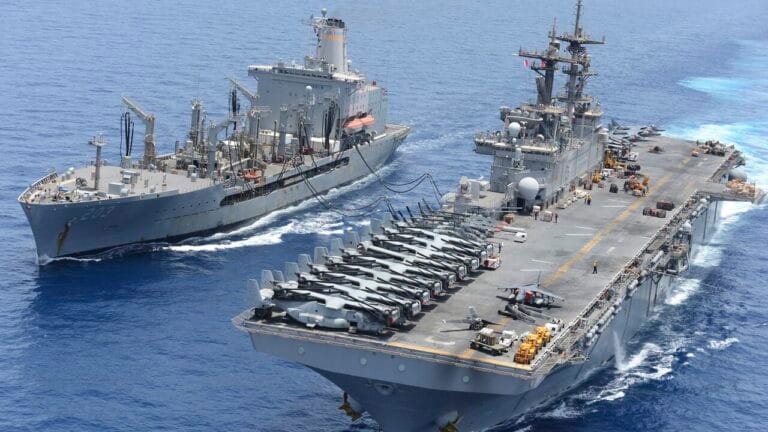
Washington, DC – The US Navy is facing increasing logistical pressures in the Middle East region due to the ongoing heavy military deployment and escalating security tensions. This situation presents new challenges to supply, maintain, and keep naval vessels operational. Warships deployed in the region require a continuous supply of fuel, food, spare parts, and equipment. They also need maintenance and technical support services. These needs become more complex the longer the deployment lasts and the greater the security risks surrounding shipping lanes.
The task is further complicated by tensions in some of the region’s vital waterways and ports. This may force supply vessels to alter their routes or travel longer distances to reach naval units deployed in operational areas. Supporting aircraft carriers and their accompanying vessels also presents a particular challenge. This is due to their massive operational needs and the necessity of a continuous supply flow to maintain their ability to operate for extended periods away from their home bases.
The pressures extend beyond fuel and basic supplies, encompassing maintenance, equipment and ammunition provision, and crew rotation. These are essential elements to ensure the continuity of naval operations without any decrease in readiness. These developments come at a time when the United States is striving to maintain a strong naval presence in the Middle East. This coincides with tensions related to maritime security in the Gulf and the Strait of Hormuz, which pose additional risks to shipping and supply lines.
Observers believe that a prolonged military deployment, coupled with disrupted shipping lanes and heightened security risks, could place a significant burden on the U.S. logistics system. This makes securing supplies as crucial as military force itself. As tensions in the region persist, maintaining stable and secure supply lines emerges as one of the most significant challenges facing the U.S. Navy. This becomes particularly apparent if operations expand or confrontations become protracted.