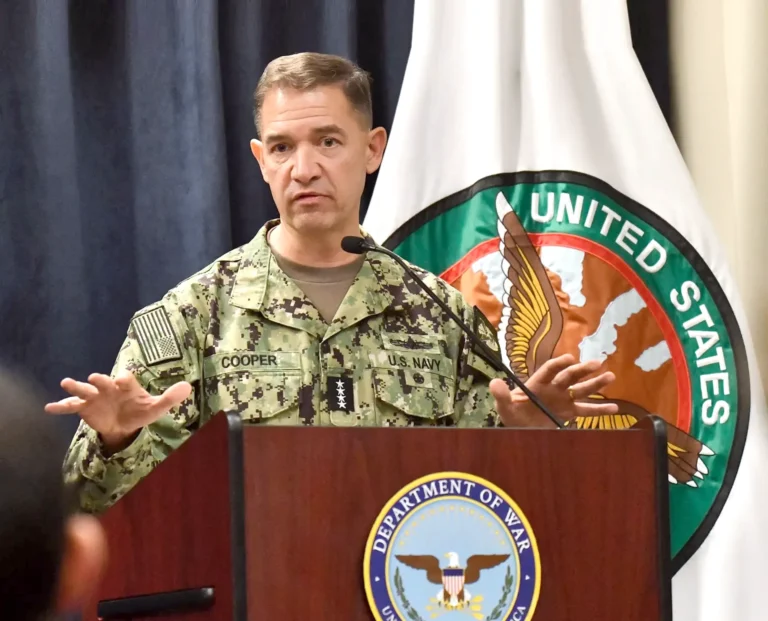
Washington, DC – US Central Command chief Brad Cooper confirmed that the Iranian navy suffered significant losses during the recent war. He stated that the Iranian navy “will not return to its pre-war state for a generation.” This comes amidst strikes targeting Tehran’s military capabilities and defense industrial infrastructure.
The US military official explained that Iran’s missile capabilities have declined by up to 90%. Furthermore, the Iranian naval fleet has been severely damaged, and its drone production infrastructure has been affected. He also confirmed that recent military operations have significantly impacted Iran’s combat capabilities.
He added that the United States has reinforced its military presence in the Central Command area of operations, deploying more than 50,000 US troops to the region. This deployment is part of preparations to address any potential security or military developments.
Military readiness and support for negotiations
The commander of U.S. Central Command indicated that Washington continues to support the diplomatic track while maintaining military readiness. He explained that the current mission of U.S. forces is to “be prepared to act” as negotiations with Iran continue.
He emphasized that U.S. forces maintain a military posture that provides the president and secretary of defense with multiple options. This ensures support for diplomatic efforts while simultaneously preparing for any escalation scenario that the region might witness.
He added that the United States seeks to maintain its military and strategic superiority in the Middle East. He noted that this requires full readiness to act should Tehran choose “retaliation instead of restraint.”
Tensions escalate in the region
The US statements come at a time of escalating tensions in the region stemming from the ongoing conflict between the United States and Israel on one side, and Iran on the other. This has been accompanied by reciprocal attacks and threats targeting US interests and military bases.
Observers believe that the Central Command’s remarks reflect continued US concern about the possibility of Iran restructuring its military capabilities or carrying out retaliatory operations through its regional proxies. This comes despite ongoing diplomatic efforts aimed at containing the crisis.
The United States continues to bolster its military presence in the region, particularly in the Arabian Gulf and around the Strait of Hormuz. This comes amid repeated warnings of threats to international navigation and global energy security.