- The test is not a war… it’s the first hour of the crisis.
- Gulf-specific system
- The new battle: “linking up weapons,” not buying weapons.
- Washington: The partner that is hard to ignore
- Why has air defense become central to the equation?
- UAE: Security through deterrence and diplomacy
- The biggest obstacle… is not the missile.
- Six layers could make the “Gulf Shield”
- Does the system need only one partner?
- Three scenarios for the future of Gulf security
- The real test… can the same decision be made?
Abu Dhabi, UAE – From early warning and information sharing to air defense, maritime security, and energy protection, the Gulf possesses most of the components of collective security. However, the real test lies in the ability to integrate these components under the pressure of crisis, without compromising the sovereignty of each individual state. In a region where trade, energy, and international security intersect, the most pressing question for the Gulf is no longer: Who possesses the strongest defense system? The more critical question has become: If one Gulf state faces a widespread threat, can all six countries perceive the same danger, share information simultaneously, and coordinate their response with equal speed?
This question presents the Gulf security system with a different kind of test; one that doesn’t measure the number of aircraft or missiles, but rather the degree of interdependence among national capabilities. This doesn’t mean the GCC states are starting from scratch. Since the Council’s founding in 1981, security and military cooperation structures have evolved, culminating in the Peninsula Shield Force, the Unified Military Command, and the Joint Defense Agreement. However, recent years have pushed this cooperation to a more urgent stage, with the growing threat of missiles and drones, maritime threats, and the vulnerability of energy facilities and critical infrastructure.
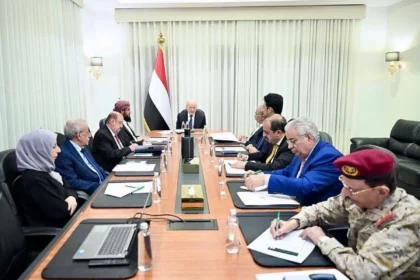
In September 2025, following the Israeli attack on Qatar, the Joint Defense Council of the Gulf Cooperation Council (GCC) held an extraordinary meeting and directed the unified military command to activate joint defense mechanisms and Gulf deterrence capabilities. The Council also announced steps including increased intelligence sharing, the exchange of aerial situational awareness between operations centers, accelerating work on a ballistic missile early warning system, and updating joint defense plans. This is where the real story begins.
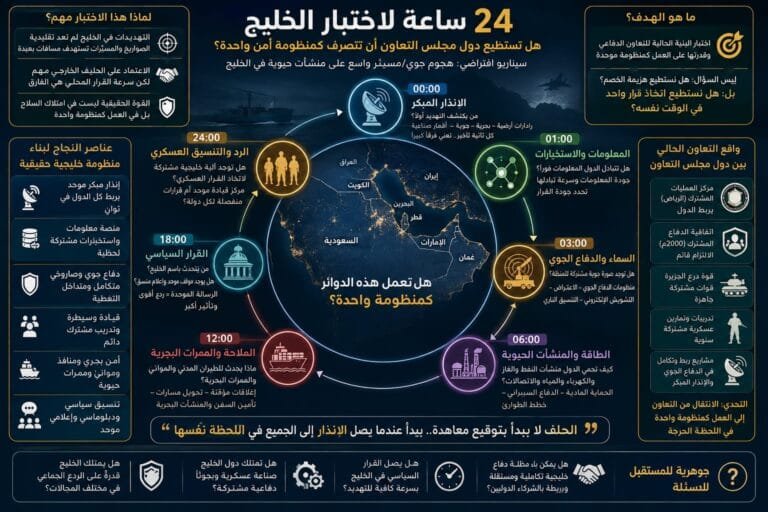
The test is not a war… it’s the first hour of the crisis.
To assess the readiness of Gulf collective security, a hypothetical scenario can be envisioned: the emergence of a widespread aerial threat targeting a vital area in the Gulf. The scenario is not concerned with identifying the source of the attack or how to counter it militarily, but rather with a single question: how would the cooperation system function during the first 24 hours?
00:00 — Warning
Can monitoring systems detect threats and send warnings to partners quickly?
01:00 — Information
Can national data be transformed into a shared picture that allows decision-makers to understand the regional situation?
03:00 — Airspace
Can different defense systems exchange information and coordinate effectively?
06:00 — Infrastructure
How can the protection of energy, water, electricity, airports, and ports be strengthened?
12:00 — Navigation
How will countries deal with any potential disruption to shipping, air traffic, and trade?
18:00 — Political Decision-Making
Can Gulf capitals maintain a rapid consultation channel and a consistent political message?
24:00 — Response
Will existing cooperation mechanisms evolve into a comprehensive collective response, or will key decisions remain within the national framework of each country?
Gulf-specific system
The term “Gulf NATO” has become common in political and media discourse, but it is not the official name of a new, existing alliance.
A more accurate professional view is that it expresses a potential path for developing an existing collective defense system. Recent analyses indicate that the Gulf states do not necessarily need to create a new alliance from scratch, but rather to develop existing structures, particularly in the areas of joint command, early warning, air and missile defense, and information sharing. The GCC states already possess a unified military command, which represents the most important institutional framework for Gulf military coordination. In September 2025, the decision to enhance information sharing, transmit air situational awareness, and accelerate the early warning system revealed that the Gulf trend is practically moving towards greater interdependence of national capabilities, not simply acquiring additional weapons.
The new battle: “linking up weapons,” not buying weapons.
The fact that each country possesses advanced defense systems does not automatically guarantee the existence of a fully integrated regional defense system.
The real test begins when these systems are capable of: monitoring, data exchange, threat analysis, creating a shared picture, and coordinating responses. This is precisely the challenge addressed by specialized studies on Gulf defense. The challenge lies not only in possessing advanced systems but also in their ability to interoperate and exchange information in a timely manner. Specialized analyses indicate that the differences in weapons systems, software, and procedures among the Gulf states represent one of the obstacles to complete integration. Here, the question shifts from: Who has the best defense system? to: Can the different systems communicate with each other?
Washington: The partner that is hard to ignore
Any professional discussion of Gulf security would be incomplete if it ignored the American role. But building greater Gulf capability does not necessarily mean replacing the American partnership. The United States remains a key partner for the Gulf Cooperation Council (GCC) states in the areas of defense, security, maritime navigation, training, and intelligence sharing. In January 2026, U.S. Central Command and regional partners announced the establishment of an air and missile defense coordination cell at Al Udeid Air Base in Qatar, with the aim of enhancing integration and information sharing between the United States and its regional partners. The Gulf-U.S. ministerial meeting in June 2026 also discussed enhancing regional security and stability, along with de-escalation and mediation efforts, while Washington reaffirmed its commitment to the security of the GCC states. This leads to a different paradigm than the “Gulf versus Washington” dichotomy: greater Gulf capabilities plus broader international partnerships. In other words, strengthening self-reliance can proceed in parallel with the American partnership, not necessarily at its expense.
Why has air defense become central to the equation?
Because the nature of threats has changed. Risks are no longer limited to traditional ballistic missiles; the landscape has become more complex with the proliferation of drones and cruise missiles, along with threats that can target critical infrastructure and maritime routes. In this environment, possessing a robust defense system within the borders of a single state is insufficient. Aerial threats do not recognize political boundaries as quickly as government institutions do. Therefore, early warning systems, shared aerial imagery, and information sharing have become among the most important elements of any modern collective defense system. This is precisely what the Gulf Cooperation Council (GCC) has prioritized for development following the September 2025 crisis.
UAE: Security through deterrence and diplomacy
For the UAE, developing Gulf defense cooperation should not be perceived as a project of escalation or an open arms race.
UAE policy combines protecting sovereignty and strengthening deterrence on the one hand, with diplomacy, de-escalation, and dialogue on the other.
At the Gulf-US Ministerial Meeting in June 2016, the UAE emphasized the importance of GCC unity, and the meeting reaffirmed the continued strategic partnership between the Gulf states and the United States. This approach aligns with a broader vision based on protecting regional stability, respecting state sovereignty, and maintaining the security of navigation and trade, while using diplomacy to prevent crises from escalating into wider conflicts. Therefore, building greater Gulf defense capabilities can be viewed as a tool for safeguarding stability, not a call to war.
The biggest obstacle… is not the missile.
Purchasing a new radar or defense system may be a technical and financial matter. But building a shared security network raises a more sensitive question: Who owns the information? When is it shared? What are the limits of data sharing? Who decides that a threat warrants a collective response? And how can operations be coordinated while preserving the sovereignty of each state? These questions make building an integrated Gulf defense system as much a political and institutional project as it is a military one. Therefore, the most realistic path may not be to establish a comprehensive military alliance all at once, but rather to develop integration in areas where the GCC states have greater common ground.
Six layers could make the “Gulf Shield”
The future of the Gulf security system can be envisioned through six layers:
1. Early Warning: A network capable of rapidly sharing warnings.
2. Information: Increased exchange of intelligence data and images related to shared threats.
3. Air and Missile Defense: Enhanced interoperability between different systems.
4. Energy and Infrastructure Security: Protection of vital facilities as an integral part of national and regional security.
5. Maritime Security: Protection of trade, ports, and sea lanes.
6. Political Decision-Making: Rapid consultation channels that ensure the political process remains aligned with security developments.
The result is not necessarily a single “Gulf army.” Rather, it is a Gulf network that can operate together when needed.
Why might a “network” be more important than a “shield”? A shield protects a region. A network allows each country to contribute its capabilities to a broader system. This model may be more suitable for the Gulf, as the GCC states maintain their own foreign policies and sovereign decisions, while simultaneously facing a range of transnational threats.
Therefore, the future could hold: strong national capabilities, a Gulf military command, joint early warning systems, information sharing, maritime cooperation, and international partnerships, instead of building a replica of military alliances outside the region.
Does the system need only one partner?
The regional landscape points to a trend toward diversifying partnerships, rather than relying on a single power. The United States remains a key security partner, while the Gulf states are simultaneously expanding their defense, political, and economic ties with other international and regional powers. However, diversification does not necessarily mean creating opposing alliances. Rather, it can mean having more options while maintaining the centrality of Gulf Cooperation. This gives the GCC states greater room for political and security maneuvering in a rapidly changing regional environment.
Three scenarios for the future of Gulf security
First: Gradual Integration
The GCC states continue to develop early warning systems, information sharing, joint exercises, and interoperability.
Result: A more efficient Gulf defense system without the creation of a new alliance.
Second: A Multi-Layered Gulf Shield
Integration expands to include air and missile defense, maritime and cyber security, and infrastructure protection.
Result: The GCC transitions from a mere coordination framework to a more integrated security system.
Third: A Multi-Partner Security Network
Each state continues to develop its external partnerships, in parallel with deepening Gulf coordination.
Result: A “Gulf NATO” does not emerge in the traditional sense, but rather a multi-party regional security network.
This scenario appears, in the foreseeable future, to be the most consistent with the nature of Gulf relations and existing international partnerships.
The real test… can the same decision be made?
Here we arrive at the heart of the matter.
The Gulf states possess advanced systems; this is a reality.
The existence of a unified military command is a reality.
The existence of joint defense cooperation is a reality.
The existence of a strategic partnership with the United States is a reality.
However, the question that remains unresolved is: to what extent can these components be integrated into a single system that operates swiftly and effectively during a crisis? This is the difference between security cooperation and collective security. The former means that states cooperate when needed. The latter means that the cooperation structure itself is ready to operate before a crisis occurs.
The Gulf states do not necessarily need a version of NATO as much as they need to develop their own model of collective security. The region already possesses most of the essential building blocks: the Gulf Cooperation Council, the unified military command, the Peninsula Shield Force, the Joint Defense Agreement, advanced national defense systems, and extensive international partnerships. The next challenge is to connect these building blocks.
If the Gulf states succeed in developing a more integrated early warning network, exchanging information more quickly, linking operations centers, improving interoperability of defense systems, and enhancing maritime and energy security, while preserving the sovereignty of each state, they will have taken a significant step toward a new model of regional security. This doesn’t necessarily have to be a “Gulf NATO,” but something more realistic: a Gulf that can protect its stability without closing the door to partnership or diplomacy.
Ultimately, the test returns to the question from which the file began: If the crisis starts at zero hour, can the Gulf transform within the first hour from six national systems into a single security network? The answer to this question will determine the shape of Gulf security in the coming years.