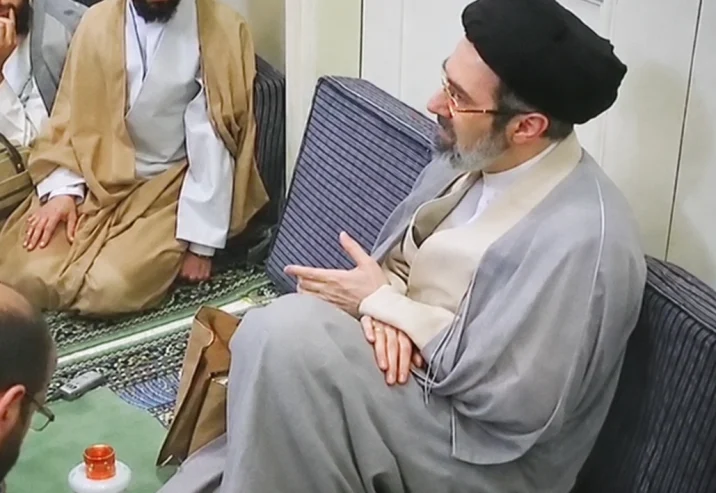
Tehran, Iran – Iran’s semi-official Mehr News Agency published a video on Saturday showing Supreme Leader Mojtaba Khamenei, the first video the agency has released of him since he assumed office. This comes amid continued uncertainty surrounding the timing of the video’s recording and his health. There has been months of absence from public view. In the approximately 13-second clip, Khamenei is seen sitting in a room surrounded by several people, seemingly during a religious gathering. Mehr presented the recording as a new video being published for the first time. However, it did not specify when or where it was filmed.
A media investigation raises questions about the history of the video.
In a significant development, Al-Ghad TV reported that visual analysis of the footage revealed it was not a new recording. The channel pointed to the similarity between the location, the arrangement of people, and the clothing of some attendees with a clip previously broadcast by Iranian television on March 20. Al-Ghad stated that the clip published by Mehr News Agency on August 8 was an excerpt from a longer recording released in March. It noted the identical appearance of two individuals in both recordings, one wearing a black jacket and the other a blue shirt. There were also similar backrests and seating arrangements. According to this analysis, the newly released video does not prove that Mojtaba Khamenei appeared on camera in recent days. Despite this, Mehr News Agency published the video under a headline suggesting it was the Supreme Leader’s first appearance.
Uncertainty persists regarding the health condition.
The video’s release comes amid widespread speculation about the health of Mojtaba Khamenei, who has been absent from public view since the outbreak of the US-Israeli war on Iran last February. Iranian reports had indicated that he sustained injuries to his leg and face during the war. Ahmad Khatami, a member of Iran’s Assembly of Experts, previously stated that the leg injury was so severe that amputation was considered before medical intervention could save it. Iranian President Masoud Pezeshkian, in an interview broadcast on Iranian television in recent days, said that communication with Mojtaba Khamenei is “extremely difficult” at present. However, he confirmed that meetings have been held with him.
Pezeshkian meets with Mojtaba Khamenei
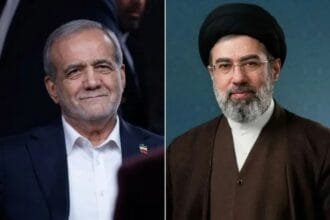
Concurrently with the circulation of the video, Iranian state media reported on Sunday that President Masoud Pezeshkian met with Supreme Leader Mojtaba Khamenei to discuss a range of economic and military issues. The reports stated that the meeting addressed the economic and living conditions, developments in the war, and military matters. It also covered resources and expenditures in rials and foreign currencies, energy, and economic relations with foreign partners. The announcement of the meeting comes days after Pezeshkian’s remarks regarding the difficulty of communicating with the Supreme Leader. This has brought renewed attention to the challenges facing the Iranian leadership in managing the country amidst ongoing military and security tensions.
An appearance that does not settle the debate
The published recording alone does not resolve the debate surrounding Mojtaba Khamenei’s health or current whereabouts, especially given the lack of a stated date of recording and the absence of any clear timeline within the clip. Furthermore, Al-Ghad’s investigation, which found similarities between the scenes and a March recording, casts doubt on the video’s authenticity. This necessitates distinguishing between the recording’s release in August and the actual date of the footage it contains.
The reported meeting between Pezeshkian and Mojtaba Khamenei, if it did indeed take place around the time the video was released, remains a separate development. It requires confirmation from official Iranian sources regarding its timing and location, without considering the video itself as proof. This development comes at a time when the Iranian leadership is managing the country amidst highly sensitive military, economic, and security circumstances. The Supreme Leader retains broad authority over foreign policy, security, and defense matters.