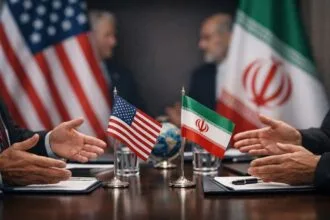
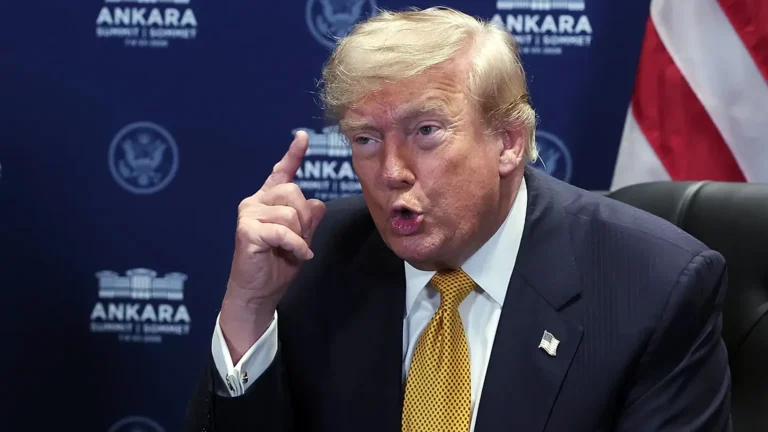
Washington, United States – US President Donald Trump expressed cautious optimism to reporters on Monday about the course of diplomatic efforts to contain the Iranian war, but warned that if the United States and Iran fail to reach a satisfactory agreement, Washington “will go back to doing what we were doing” when US forces were launching intensive strikes against Iranian targets.
The Iranian position and US military moves
Despite the Iranian regime’s official insistence on not participating in any direct talks with the United States, it acknowledged the existence of ongoing and intensive talks with the Sultanate of Oman, specifically aimed at establishing “mechanisms related to maritime navigation” in the strategic Strait of Hormuz, after three consecutive nights of relative calm in the pace of operations.
In the same context, the US Ambassador to the United Nations, Mike Waltz, confirmed during his appearance on the program “Face the Nation with Margaret Brennan” that the temporary cessation of hostilities mainly aims to “give diplomacy some space” to move, stressing at the same time that more US military reinforcements and assets are still “continuously moving to the region” in anticipation of all emergencies.
Details of Islamabad’s negotiations and rejection of US proposals
In a significant development in the negotiations, Kazem Gharibabadi, Iran’s Deputy Foreign Minister for Legal and International Affairs, revealed that Tehran had categorically rejected a US proposal presented during the recent talks in Islamabad, Pakistan, describing the American proposal as containing “extreme demands.” The Iranian official confirmed that his country had made no attempt to keep the talks going after the US threats to withdraw.
In a speech to a conference of legal professionals, Gharibabadi explained, “The American side presented a proposal reflecting extreme demands. The Iranian delegation explicitly rejected this proposal.” He added that the American side had previously declared that if the proposal was rejected, the negotiations would be considered a failure and the delegation would withdraw, noting that this is precisely what happened, as the American side ended the sessions. Gharibabadi emphasized that “there was no insistence or pleading on the part of the Iranian delegation to continue the negotiations, and this approach was an example of the ‘gracious diplomacy’ of the Islamic Republic of Iran.”
The Deputy Foreign Minister also addressed the issue of the Strait of Hormuz, explaining that after Iran “once again closed the Strait of Hormuz following the crimes committed by the United States more than two weeks ago,” subsequent talks were held with Omani mediation. He noted that the other side insisted on keeping the southern route open to shipping until the Iranian-Omani negotiations concluded, but the Iranian delegation rejected this proposal as well.