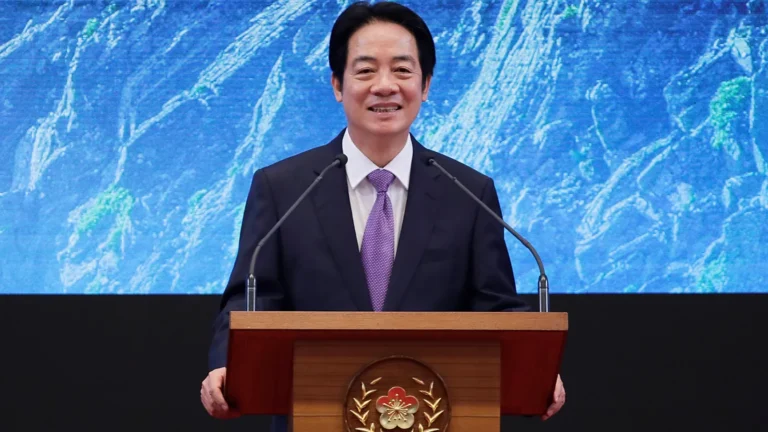
Taipei, Taiwan – In a resolute address to the annual congress of the ruling Democratic Progressive Party (DPP), Taiwanese President Lai Ching-te stressed the need for national unity to safeguard the island’s democratic model. He also warned against Beijing’s continued attempts to annex Taiwan. Lai, who advocates for Taiwan’s independent identity, called on his party members to remain vigilant. The aim was to counter what he termed the “red terror” perpetrated by the Chinese authorities.
China’s “legal war”
The Taiwanese president warned that Beijing’s threats are no longer limited to military maneuvers, but have expanded to include what he called “legal warfare.” He pointed to China’s new “racial unity law,” which theoretically gives it a basis for taking action against individuals outside its borders. This move is causing deep concern in Taiwan, as it is seen as a potential legal tool that would give Beijing a pretext to prosecute or arrest Taiwanese citizens whom China labels as “separatists,” even though the Chinese legal system has no jurisdiction or enforcement authority within Taiwanese territory.
Preserving democratic identity
In a direct message to the Taiwanese people, Lai Ching-te asserted, “We must work together to safeguard our free and democratic way of life, and never allow democratic Taiwan to regress into becoming ‘Taiwan of China.'” These remarks reflect the current Taiwanese administration’s determination to strengthen its political independence. This policy continues to provoke Beijing’s ire, as the latter rejects Lai’s repeated calls for talks and labels him a “separatist.”
These developments come amid escalating tensions in the Taiwan Strait, as Beijing seeks to increase economic and political pressure on the island. In response, the Democratic Progressive Party continues to bolster its political presence by emphasizing that protecting democracy is the first line of defense against Chinese expansionist ambitions. With no official response yet from China’s Taiwan Affairs Office, attention remains focused on how Beijing will react to this escalating rhetoric. Its impact on regional stability in light of current geopolitical challenges is also being closely monitored.