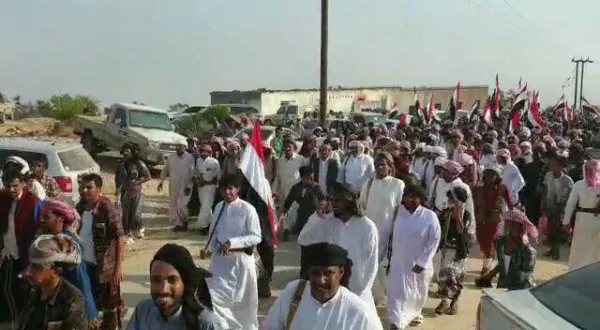
Aden, Yemen – Public anger and mass protests continue in Yemen’s Al-Mahra Governorate, rejecting efforts to release dozens of individuals convicted of terrorism and arms smuggling to the Houthi militias. This comes as part of what is known as a prisoner exchange deal between the Houthis on one side, and the Yemeni government and the Arab Coalition on the other.
Popular rejection in Al-Mahra
On Sunday morning, July 19, 2026, the city of Al-Ghaydah, the capital of Al-Mahra Governorate, witnessed a massive demonstration in which thousands of the governorate’s residents participated. They expressed their categorical rejection of the arms deal. In their statement, the participants affirmed that the deal represents a blatant violation of laws and justice, and constitutes a “free service” to the Houthi militias. They also pointed out that the deal includes arms dealers who have played a crucial role in bolstering the Houthis’ military arsenal throughout the years of war.
The case of arms dealer “Abu Bakr Ba’amalam”
Much of the public outcry has focused on the intention to release notorious arms dealer Abu Bakr Ba’amalam, who serves as a deputy minister in the unrecognized Houthi government. Ba’amalam is a key figure in Iranian arms smuggling networks supplying the militias. He was previously arrested by the US Navy in 2022 in the Arabian Sea while attempting to smuggle a shipment of weapons from Iran. He was later handed over to local authorities in Al-Mahra Governorate. Protesters believe his release would undermine efforts to combat arms smuggling.
Calls to end “guardianship”
The march participants described the prisoner exchange deal as “a new crime” added to the Houthis’ record of violations against victims of terrorism. The protesters also demanded a review of these deals, which include individuals involved in major security crimes. They expressed their rejection of what they called foreign interference in sovereign decisions related to the issue of prisoners and detainees.
These demonstrations in Al-Mahra reflect a significant gap between diplomatic efforts to negotiate prisoner exchange deals and the popular demands in Yemeni provinces that have long suffered from the consequences of arms smuggling and Houthi military operations. They emphasized that justice must take its course, independent of political compromises that could allow militias to reinstate their field commanders and grant impunity to members involved in illicit activities that threaten regional security and international navigation.