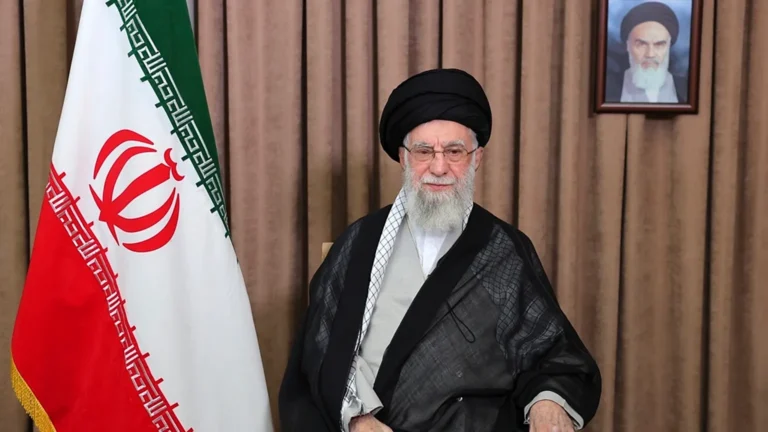
Tehran, Iran – In the weeks following the assassination of Iranian Supreme Leader Ali Khamenei, the power structure in Iran has undergone a profound reshaping. This shift transcends the traditional classifications observers have used to understand the Iranian political landscape, such as the “hardliners” versus “reformists” dichotomy that has dominated interpretations of the regime for decades. Two new power blocs have emerged, vying for the regime’s future: one advocating for openness to the world and an end to open confrontation with the West, and the other clinging to hardline revolutionary rhetoric and rejecting any flexibility in dealing with Washington or its allies.
Controversial speech revives the atmosphere of the revolution
The spark that revealed the extent of this division came from a speech delivered by Ali Khomeini, grandson of the regime’s founder, Ruhollah Khomeini, during a memorial service for Ali Khamenei. The speech adopted a harsh tone toward any potential rapprochement with Washington, describing negotiations with the United States as a form of treason. He also asserted that negotiating with Washington was no less dangerous than war itself, but rather a continuation of it by other means.
This hardline rhetoric has revived memories of the speeches of the early revolutionary era and raised serious questions about whether the country is moving toward greater rigidity in its foreign and domestic policies. This comes at a time of escalating regional and international pressure on Tehran following the recent war and the assassination of Mojtaba Khamenei. It also occurs amidst uncertainty about who actually holds the reins of power within the regime’s institutions.
Two rival blocs with no unified center of power
The old political classifications are no longer capable of explaining the current landscape. Following Khamenei’s death and the recent war, two new power blocs have emerged, sharing influence within the deep state institutions. The first bloc, the pragmatic current, seeks to move the country beyond the revolutionary model that prevailed under the two previous leaders. It also pushes for normalizing relations with the world, conditionally accepting the rules of the international order, opening the door to economic cooperation, and ending the constraints imposed on Iran by regional and Western issues. Among the most prominent figures associated with this current are diplomats Abbas Araqchi and Mohammad Bagher Ghalibaf. These two men wield considerable influence in decision-making circles related to the nuclear program and foreign relations.
In contrast, the second bloc, described as an extension of the so-called “Steadfastness Front,” continues to adhere to the revolutionary principles established by Khomeini and Khamenei. It rejects any pragmatism in dealing with foreign affairs, considering any concession the beginning of the complete collapse of the revolutionary project. Ali Khomeini’s speech in Qom can be interpreted specifically as an attempt by this second bloc to consolidate its presence amidst the absence of a strong, representative leader. This bloc possesses no other widely accepted figure besides Saeed Jalili, who is not particularly popular even within the regime’s inner circle. Therefore, these circumstances have led it to attempt to transform Ali Khomeini into an alternative political symbol to compensate for the lack of unified leadership. It is noteworthy that Ali Khomeini was not a prominent political figure before this speech. In fact, his most prominent attribute is his family name, which this bloc has attempted to employ as a symbolic weapon against the rival faction and as a means of invoking a historical legitimacy lacking in other figures in the second tier.
Negotiation as War: A Reading of the Political Content
Since both war and negotiation are tools of international politics used to reach a settlement or establish a new system of relations, Khomeini’s characterization of negotiations as an extension of war is not entirely without theoretical basis. However, this does not mean that Iran’s actual foreign policy follows this vision. Ali Khomeini does not yet wield real influence in the government’s decision-making process. Meanwhile, the team actually responsible for negotiations and foreign policy largely belongs to the pragmatic faction led by Araqchi and Qalibaf, which creates a relatively wide gap between symbolic rhetoric and actual decision-making.
Khomeini’s vision is described as an extension of a revolutionary perspective that considers the differences between the Democratic and Republican parties in the United States to be insignificant. It posits that there is only one absolute truth, beyond negotiation or compromise. This vision contrasts sharply with Khomeini’s own behavior during the American hostage crisis, when the crisis was exploited for tactical purposes within American politics itself. This reveals that pragmatism was not entirely absent, even during the most radical moments of the Islamic Revolution, and that ideological rhetoric often masks more pragmatic calculations than it appears. Furthermore, Khomeini’s speeches, from a political standpoint, lack depth and eloquence, relying primarily on slogans. This suggests that this vision will not, at least in the foreseeable future, constitute a major determinant of Iranian foreign policy, although it may be capable of influencing the internal mood of the hardline faction.
The role of family names in the rise of Mojtaba Khamenei and Ali Khomeini
Two concurrent phenomena can be linked: Mojtaba Khamenei’s ascension to the leadership and the emergence of Ali Khomeini as the voice of the Steadfastness Front. The absence of any serious opposition to Mojtaba Khamenei’s leadership stems primarily from his being the son of the late Supreme Leader. In the chaos that followed the assassination, no other figure was capable of uniting the various power centers within the regime behind him. Despite prior speculation of potential opposition from within the Assembly of Experts or the networks of influence, the exceptional circumstances and the symbolic weight of the “Khamenei” name ultimately decided in favor of Mojtaba’s leadership. This occurred at a moment when the country desperately needed a symbol to prevent a complete breakdown of the balance of power.
The same logic applies to the rise of Ali Khomeini as an unofficial spokesperson for the hardline faction. His family name evokes memories of the revolution’s formative era for the more revolutionary wing of the regime, a fact exploited by media outlets close to this faction to amplify his rhetoric and present it as a return to the spirit of Khomeini’s grandfather. However, its content offers little new intellectually or politically; it merely repackages old slogans in a new guise.
Division without a unified compass
It is impossible to speak of a single strategy currently governing decision-making in Tehran, given the competition between two relatively equal factions vying for control of the symbolic and media landscape, and for shaping a different future for the country. While the Steadfastness Front clings to a vision that ignores the realities of shifting global balances, the pragmatic current is pushing for engagement in international relations and gradual integration into the global economy.
This division is not confined to Iran; it has a parallel reflection within the United States. There, views diverge between those who see the possibility of reaching an understanding that partially infringes upon Iranian sovereignty, and those who consider the entire regime to be fundamentally unnegotiable.
It is likely that the results of the upcoming US elections in November, amidst the division of public opinion between those who support and oppose intervention, will play a role in determining which of the two Iranian factions will ultimately prevail.
The continuation of this open conflict between the two factions, in the absence of a unified power center resembling the role previously played by Ali Khamenei, remains a factor that could lead to a genuine upheaval in the power structure within the Iranian regime. Therefore, it could paint a political landscape radically different from what Iran has known for decades, at a time when the contours of the “day after Khamenei” are far from clear.