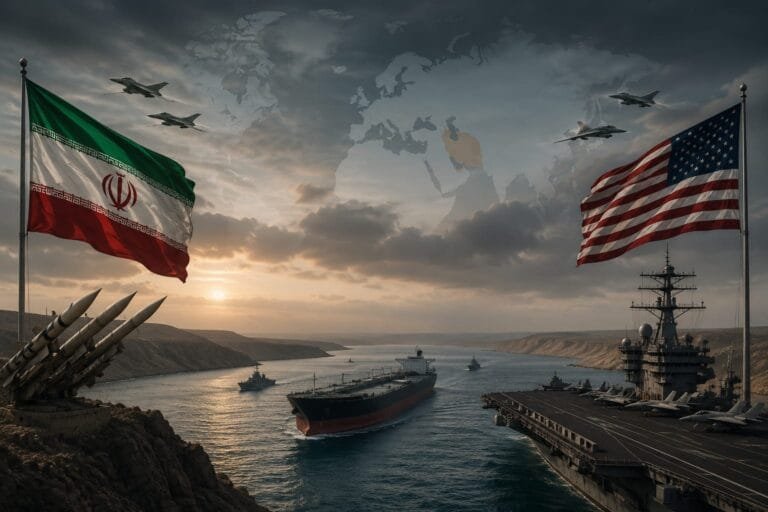
Washington, DC – Iran’s announcement of its intention to close the Strait of Hormuz, should it be officially and practically implemented, has raised widespread questions about the legal and military ramifications of such a move. This comes amid escalating tensions with the United States following a series of US strikes. Several observers believe that shifting the conflict from reciprocal military attacks to a threat against one of the world’s most vital maritime chokepoints could provide the United States and its allies with broader political and legal justifications, potentially leading to the formation of a unified international front.
The Strait of Hormuz… the world’s energy artery
Approximately one-fifth of the world’s seaborne oil trade passes through the Strait of Hormuz, along with vast quantities of liquefied natural gas. Any disruption to shipping would not only affect the United States and the Gulf states, but also Europe, Asia, and the entire global economy. For this reason, the strait is not viewed as a regional interest, but as an international waterway with ties to the interests of dozens of nations.
Legal dimension
From the perspective of international law, freedom of navigation in international straits is broadly protected under the rules of the United Nations Convention on the Law of the Sea. Any action that obstructs or impedes international passage may be considered by many states to be a violation of freedom of navigation. Western powers may use this to justify diplomatic, economic, or even military action, according to their legal and political interpretations. Iran, on the other hand, holds a different legal view regarding its territorial sovereignty and certain passage provisions, making the issue a matter of legal and political contention. Therefore, it is not entirely settled.
Why might that be a strategic mistake?
If the confrontation turns from a bilateral dispute between Washington and Tehran into a crisis that threatens global energy supplies, Iran may face an even greater challenge: expanding the circle of affected countries. European countries, which may disagree with the United States on some issues, depend to varying degrees on the stability of energy markets and freedom of maritime trade. If it sees that its economic interests are threatened, the possibilities of coordination with Washington on sanctions issues, protection of navigation, and perhaps participation in international naval operations to protect ships may increase. Likewise, Asian countries such as Japan, South Korea, India, and China also depend on the flow of oil through the strait. Therefore, the continuation of the closure makes it a global concern, although the positions of these countries may differ in how to deal with the crisis.
Will the dispute turn into a broader Western alliance?
Politically, the threat to international shipping could give the United States an opportunity to garner greater support from its allies, given that the issue is linked to global trade and not just the US-Iranian dispute. However, the extent of this support will depend on several factors, including the duration of the blockade, its actual impact on shipping, international reactions, and whether the crisis will be addressed through diplomatic efforts.
Possible scenarios
Scenario 1: International mediation succeeds in containing the crisis, with a gradual de-escalation and the reopening of maritime routes.
Scenario 2: Tensions persist, with a strengthened international naval presence to protect navigation, but without a significant expansion of military operations.
Scenario 3: The confrontation widens if commercial vessels are directly attacked or shipping is disrupted for an extended period, potentially prompting broader military responses from a US-led international coalition.
Scenario 4: Economic pressure and sanctions continue without escalating into a full-blown regional confrontation, with the crisis remaining within the framework of mutual deterrence.
If Iran’s goal in announcing the closure of the Strait of Hormuz is to increase pressure on the United States, this move also carries strategic risks. It could broaden the circle of countries that perceive their vital interests as threatened, potentially leading to a larger international alignment against Tehran. Ultimately, the course of events hinges on whether the announcement translates into an actual closure, and also on how international powers react to any developments on the ground.