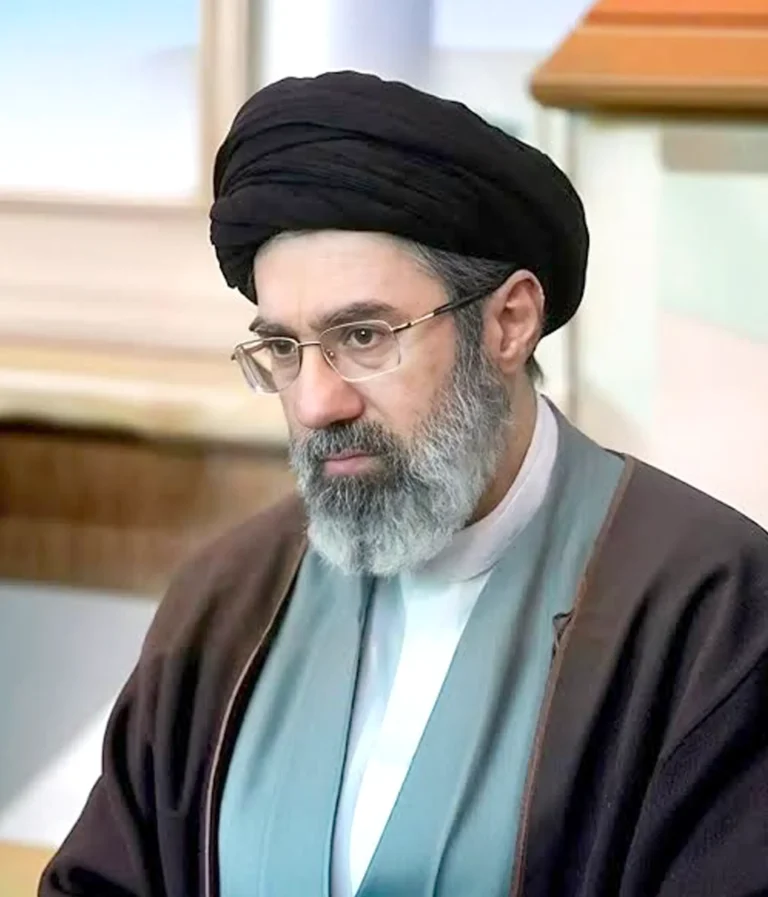
Tehran, Iran – In remarks carrying significant political and legal implications, Mojtaba Khamenei, in a message marking “Judiciary Week” and the anniversary of the assassination of Ayatollah Seyyed Mohammad Beheshti and his companions,
called for intensified efforts to pursue those he described as “criminals who committed crimes
against the Iranian people and their leaders.” He also stressed the necessity of their prosecution.
Public rights and the prosecution of “arrogant powers”
In his message, Khamenei emphasized that fulfilling the people’s rights should not be limited to individual or specific cases.
Rather, it must extend to all public and social rights that pertain to national sovereignty and the dignity of citizens.
In this context, he considered one of the “most prominent legal and judicial issues” of concern to the Iranian people
at present to be the pursuit of rights violated by “arrogant and aggressive powers” and international criminals.
He further stressed that the crimes committed against the Iranian people should not go unpunished.
He called for these violations to be treated as “independent legal cases,” indeed, for “hundreds and thousands of cases”
to be seriously presented before national and international courts to ensure that the perpetrators do not escape accountability.
Confessions of adversaries and expansion of the scope of prosecution
In his analysis of the legal process, Khamenei pointed to a crucial point: the statements of the leaders of
the United States and the Zionist entity—whom he described as brazen in their boasting
about their crimes—constitute, in essence, a legal admission of these actions.
He also asserted that this public boasting provides a strong and appropriate basis for demanding the plundered rights of the Iranian people.
This, he argued, is what the judiciary should utilize as irrefutable evidence of guilt in international forums.
Connecting the past and present, Khamenei called upon the judiciary to implement the directives of the martyred leader of the revolution,
which he had emphasized in a meeting last July, regarding the pursuit of the crimes of the “Second Imposed War.”
He added that it is essential to extend this process to include what he termed the “Third Imposed War.”
He further stressed the necessity of continuing the legal proceedings
until verdicts are issued and executed against those involved in these crimes.
Holding criminals accountable is a national and moral duty
Khamenei concluded his message by emphasizing that the ultimate goal of
these international and domestic legal proceedings is not merely to recover usurped rights,
but to create a strong “legal deterrent” that will prevent the recurrence of such crimes in the future.
He stressed that holding criminals accountable is a national and moral
duty undertaken by the judiciary at this sensitive juncture in the country’s history.
These calls come amidst ongoing regional and international tensions. Through these statements,
Tehran is attempting to assert the “legitimacy” of its legal struggle and to utilize all available tools,
including the judicial system, to pressure its international adversaries
and document the violations it claims to have suffered throughout years of conflict.