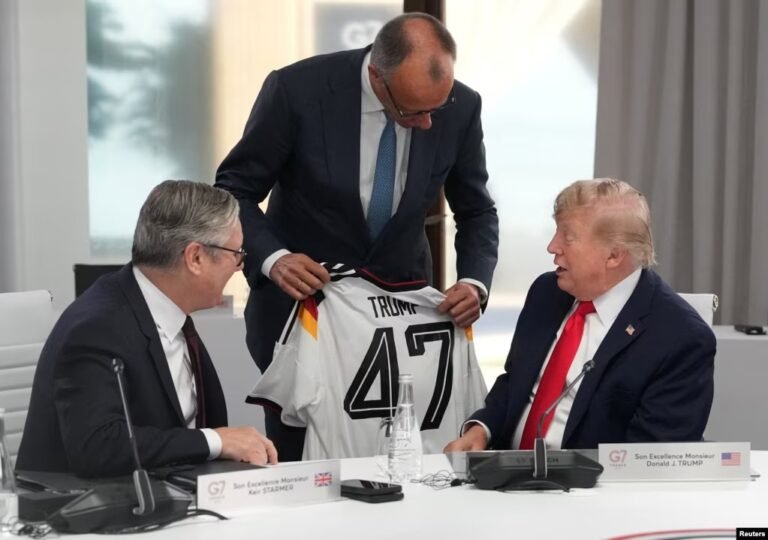
Evian, France – A notable diplomatic gesture unfolded behind the scenes at the G7 summit in the French resort of Evian. German Chancellor Friedrich Merz presented US President Donald Trump with a symbolic gift: a white official German national football jersey bearing the name “Trump” and the number “47” on the back, a reference to the current US president’s 47th term.
Mertz approached Trump holding the jersey, which was identical to the official design worn by the German national team in the current World Cup. This occurred while the US president was seated at the negotiating table for a closed-door working meeting. Trump accepted the gift with a smile and held up the jersey for photographers to pose for a commemorative photo.
Despite this cordial, protocol-driven atmosphere, behind the scenes, a deep divergence and clear rifts exist between the US administration and the German government. Indeed, recent months have witnessed a sharp divergence in views between Merz’s party (the Christian Democratic Union) and the US president regarding the mechanisms for managing the war against Iran and the strategy being pursued toward Tehran. This German position has been met with harsh criticism and repeated public attacks by Trump.
The US president did not hesitate to direct sharp and direct criticism at the policies of the German chancellor and his party. He stated that Merz’s party should “spend more time and effort on ending the Russian war in Ukraine” instead of interfering in Middle Eastern affairs. He added in his scathing attack that the top priority for the German leadership should be focused on “fixing their failing country, particularly with regard to the escalating migration crisis and the complex energy issues” plaguing the European continent.
This diplomatic spat reflects the extent of the pressure Washington is exerting on its European allies, particularly Berlin, to adopt its new vision for ending regional conflicts through direct deals. This comes at a time when European powers are expressing reservations about limiting their military and security options in the face of regional threats.